CertLeaf
Organ Donation Awareness Certificate Generator for Colleges, NGOs, and Hospitals
Use CertLeaf to issue certificates for organ donation awareness participants, volunteers, speakers, coordinators, and campaign partners in bulk.
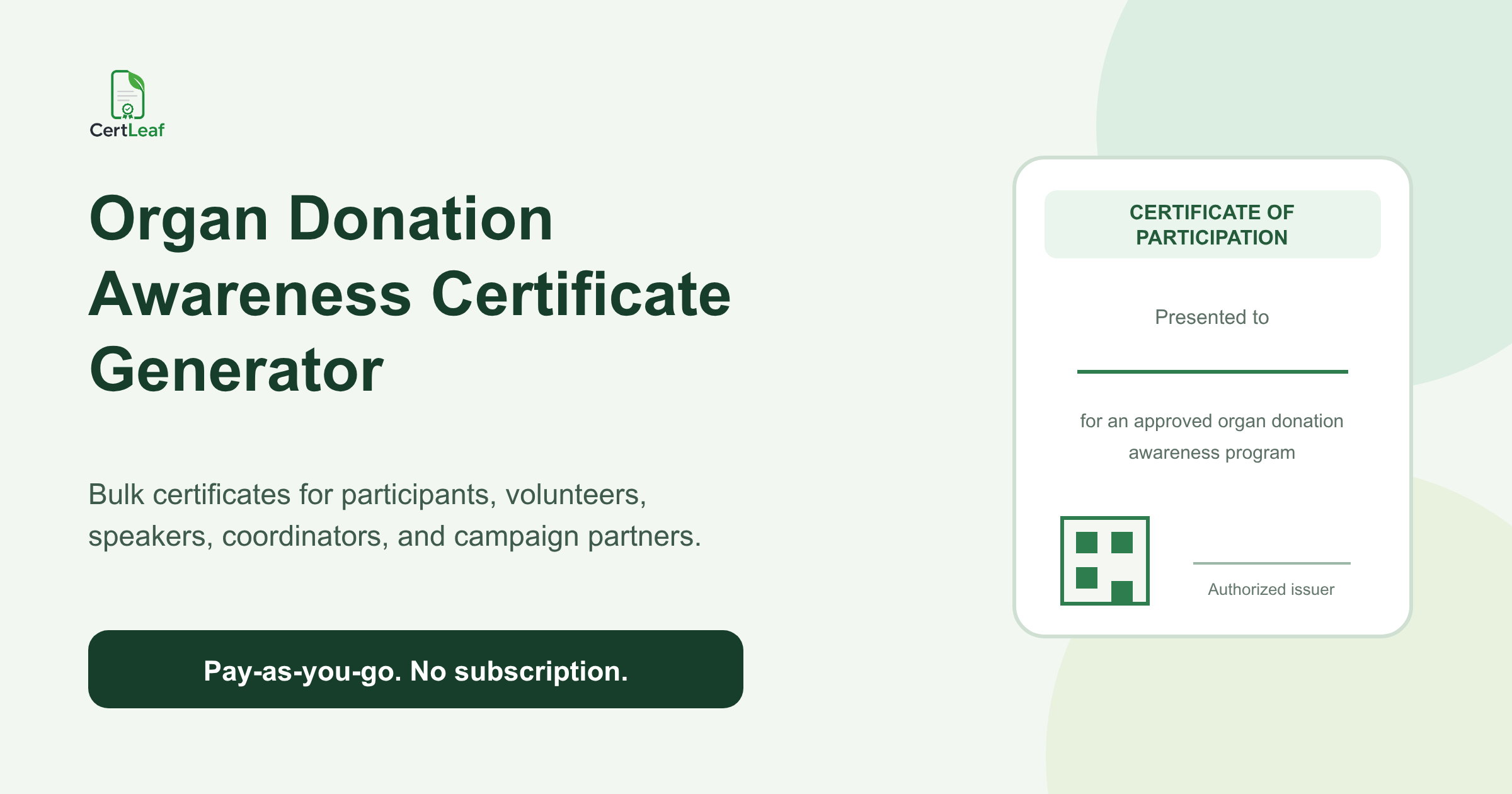
Organ donation awareness programs need a dedicated certificate issuing platform when the same campaign includes session participants, student volunteers, speakers, hospital coordinators, community partners, and organizing teams. They may share one campaign identity, but they did not make the same contribution and should not receive the same generic document.
CertLeaf helps colleges, hospitals, NGOs, transplant awareness groups, community organizations, and CSR teams issue accurate certificates at campaign scale. Create reusable templates for each role, import an approved recipient CSV, generate the batch, send certificates by email, and add QR verification when recipients may share the document later.
The platform is pay-as-you-go, with no subscription. India-first teams can purchase credits in INR through Razorpay, and a new account includes 20 free signup credits for testing a small sample.
CertLeaf handles certificate issuing. It does not register organ donors, collect pledges or consent, assess medical eligibility, confirm transplant status, or replace an authorized hospital, registry, or government process.
Why organ donation awareness campaigns need role-specific certificates
A college awareness session may have 200 attendees, 25 student volunteers, two guest speakers, a faculty coordinator, and a hospital or NGO partner. A city campaign may add ambassadors, help-desk teams, quiz participants, and community coordinators.
Using one certificate title for everyone creates vague records. A participant certificate should confirm approved participation in an awareness activity. A speaker appreciation certificate should recognize the talk or expert session. A volunteer certificate should describe outreach or event support without implying that the person pledged, donated, counselled a family, or held a medical role.
A practical certificate set can include:
Participation certificates for approved awareness sessions, quizzes, talks, exhibitions, or campus campaigns.
Volunteer contribution certificates for outreach, registration, communication, venue support, or logistics.
Speaker or resource-person appreciation certificates for approved talks and expert sessions.
Coordinator certificates for faculty leads, hospital coordinators, NGO teams, and organizing committees.
Partner appreciation certificates for hospitals, colleges, NGOs, associations, or community groups.
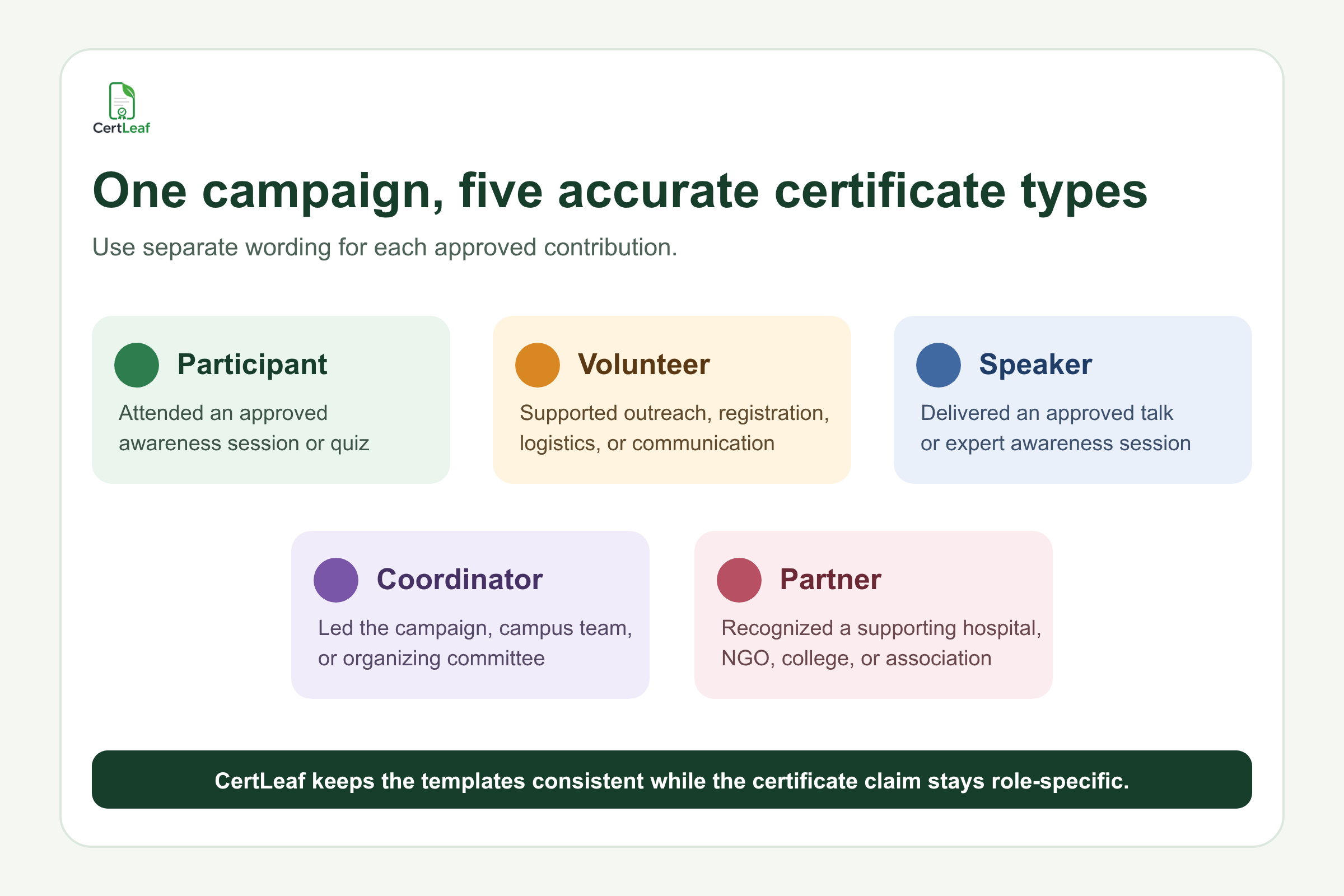
The visible wording should stay close to the organizer's approved record. Do not use titles such as "donor," "transplant coordinator," or "medical professional" unless the responsible organization has confirmed that wording for that recipient.
Sign up for CertLeaf and use the 20 free signup credits to test one participant, volunteer, speaker, coordinator, and partner certificate before preparing the full campaign batch.
Reusable templates give the whole campaign one identity
Organ donation awareness programs often repeat across campuses, workplaces, hospitals, and community venues. Rebuilding every certificate from a blank canvas wastes time and makes logos, signatories, colors, and fixed wording drift between events.
With CertLeaf, the issuing team can upload an approved base design, place the fields that change, and save the setup as a reusable template. Participant, volunteer, speaker, coordinator, and partner versions can use the same visual system while keeping their certificate titles and recognition statements distinct.
Useful dynamic fields may include:
recipient name
campaign or session name
recipient role
certificate type
organizing institution
event date
location or campus
certificate ID
Long names and campaign titles need an early preview. Test the longest recipient name, organization name, and session title before issuing the full batch. That is more useful than discovering after delivery that one college name covered a signature or a campaign title wrapped into the recipient line.
Teams running a broader community-health event should also review the guide to medical camp volunteer certificates for health drives. It explains how to separate awareness participants, volunteers, professional teams, organizers, and partners without turning certificate software into a medical-record system.
Build the issuing CSV from the approved certificate roster
The right file for CertLeaf is not the complete event registration export. It is a narrow, approved certificate roster with only the fields required to create and deliver each certificate.
A useful CSV may contain:
recipientName,email,campaignName,recipientRole,certificateType,eventDate,organizationName
One row should represent one approved certificate. If a guest speaker is also being recognized as a campaign coordinator, make that an intentional second record or a separate batch. Do not let a duplicate spreadsheet row decide which claims appear on a certificate.
The issuing file should not contain donor pledges, consent forms, medical eligibility, organ preferences, transplant details, health records, government identifiers, or private registration notes. None of that is required to place an approved name and role on an awareness certificate.
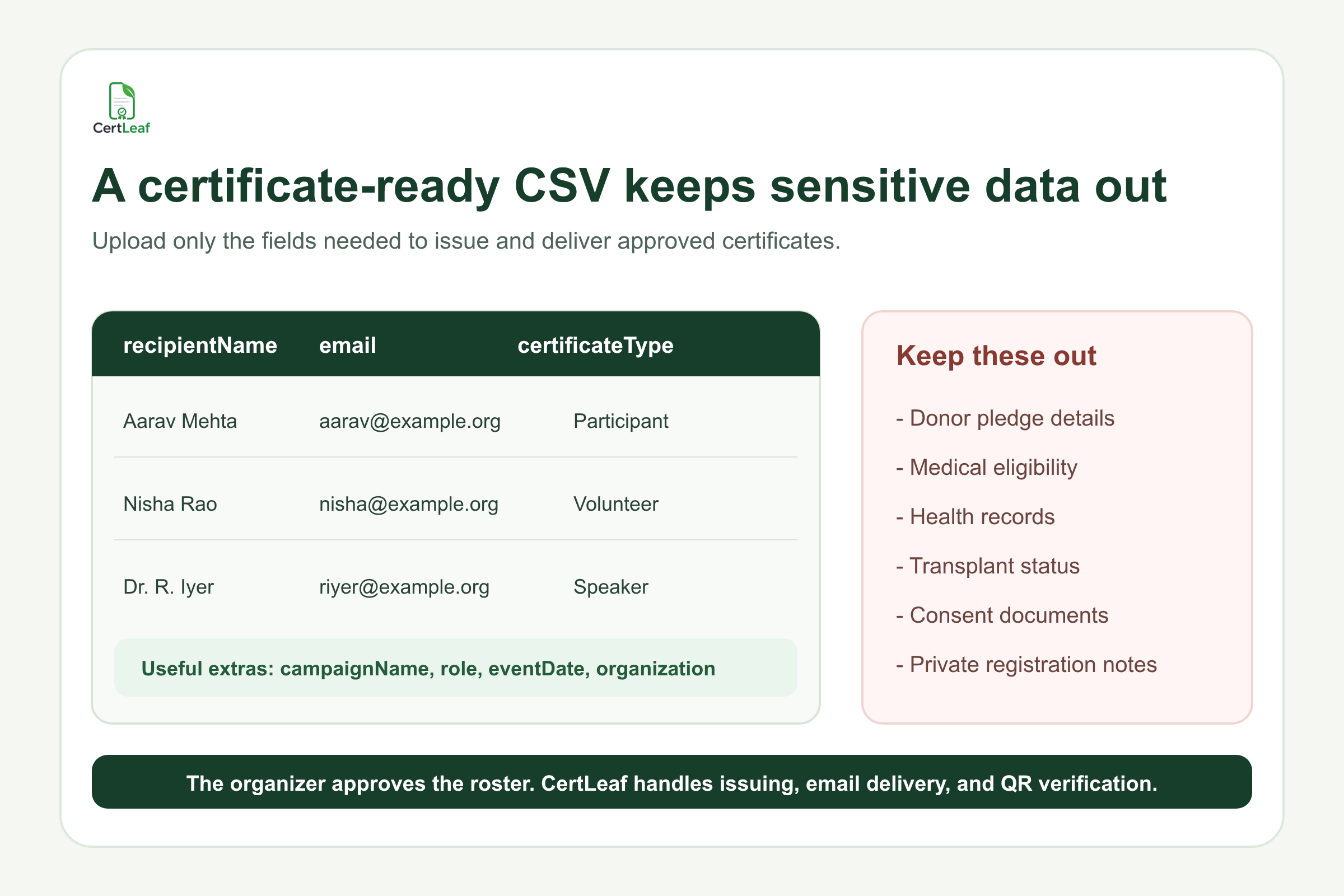
Keep the public verification record equally focused. A recipient name, campaign name, certificate type, issuer, date, and non-sensitive certificate ID may be useful. A QR-verifiable certificate should not expose health information or claim that an awareness participant is a registered donor.
For NGO and CSR organizers handling several contribution types, the guide to volunteer certificates for NGO events and social campaigns is a useful companion for role wording and partner recognition.
Have the approved roster ready? Try the organ donation awareness certificate use case in CertLeaf with 20 free signup credits. Use the sample batch to check CSV mapping, long names, email delivery, and every certificate type before buying credits for the complete issue.
Email delivery gives each recipient a direct record
Awareness campaigns often distribute materials through messaging groups, but a shared folder is a poor home for personalized certificates. Similar filenames are easy to mix up, and public links may expose documents to people who were not intended to receive them.
CertLeaf can send each certificate to the email address in its approved CSV row. The message can identify the campaign and certificate type, thank the recipient for the relevant participation or contribution, and provide one contact route for genuine corrections.
The delivery email should not mention private pledge choices, medical discussions, or registration details. It is a certificate message, not a donor or patient communication record.
Campus teams can also use the published guide to NSS camp certificates with QR verification when student service units are coordinating the campaign. That article is particularly useful for keeping one-day activity recognition separate from broader NSS records.
QR verification helps the certificate remain useful later
Students may add an awareness participation or volunteer certificate to an activity file, scholarship application, internship portfolio, or professional profile. Speakers, coordinators, and partner organizations may retain appreciation certificates with their program documentation.
A QR-verifiable certificate gives a reviewer a public route to check the certificate record issued through CertLeaf. The verification page should match the visible document. A volunteer record should not appear as participant completion. A speaker appreciation certificate should not imply a clinical qualification.
The boundary matters: QR verification confirms the certificate record created by the issuer. It does not confirm a donor pledge, legal consent, medical eligibility, donation status, transplant outcome, professional registration, or government recognition.
For another example of careful certificate wording around a sensitive awareness topic, see the guide to mental health awareness certificates for colleges and NGOs.
Pay-as-you-go credits suit campaign-based issuing
Organ donation awareness certificates are usually issued around a particular program, campaign week, campus event, quiz, exhibition, or community session. The issuing calendar can be busy for a few days and quiet for months.
CertLeaf uses pay-as-you-go credits instead of a subscription. That lets the organizer connect certificate cost to the actual campaign batch. India-first customers can pay in INR through Razorpay, and the 20 free signup credits make it possible to test the setup before committing to a larger issue.
Reusable templates also reduce repeat work. A hospital outreach team can retain its approved speaker and participant designs. A college can update the campaign name, date, and roster for the next session. An NGO can preserve its partner appreciation layout across several cities while changing the local organization and coordinator fields.
Check the current pricing and final recipient count before approving the issue. Use simple certificates where a private acknowledgement is enough and QR-verifiable certificates where the document is likely to be shared or checked later.
Where CertLeaf fits different awareness organizers
Colleges and universities
Create separate participant, student volunteer, speaker, faculty coordinator, quiz, and partner templates. Keep academic activity recognition distinct from any official donor-registration process.
Hospitals and outreach teams
Use approved institutional designs and role titles. The responsible hospital or program owner should approve recipients, signatories, wording, and logo use. Do not upload clinical, donor, patient, or transplant data into the certificate roster.
NGOs and awareness foundations
Reuse templates across community sessions, college visits, public talks, campaigns, and ambassador programs. Keep field volunteer, coordinator, participant, speaker, and partner records distinct.
CSR and workplace teams
Issue approved employee-participant, volunteer, speaker, organizing-team, and partner certificates without treating CertLeaf as an employee health, consent, or compliance system.
Event and communication partners
An agency can prepare the design and final CSV, but the responsible organizer should approve the recipient list, claims, signatories, and institutional marks before issuance.
Organ donation awareness certificate generator FAQ
What is an organ donation awareness certificate generator?
It is a certificate issuing tool for approved organ donation awareness programs, talks, quizzes, exhibitions, campus campaigns, and community events. CertLeaf supports reusable templates, bulk CSV issuing, email delivery, and optional QR verification.
Can CertLeaf issue certificates for participants and volunteers?
Yes. Organizers can use separate reusable templates for participants, volunteers, speakers, coordinators, campaign teams, and partner organizations. The organizer approves the recipient list and wording.
Does a CertLeaf certificate register someone as an organ donor?
No. CertLeaf does not record donor pledges, consent, medical eligibility, or official registration. It issues the awareness participation or contribution certificate approved by the responsible organizer.
Which CSV fields should an awareness campaign use?
Useful fields include recipientName, email, campaignName, recipientRole, certificateType, eventDate, and organizationName. Include only the data required for the certificate and its delivery.
Should pledge or medical information be uploaded?
No. Donor choices, consent records, medical eligibility, health information, transplant details, and private registration notes are not needed for certificate issuing and should remain in the authorized system used by the responsible organization.
Can an organ donation awareness certificate include QR verification?
Yes. CertLeaf can add a QR verification route to the issued certificate record. It confirms that record; it does not prove a pledge, clinical fact, transplant status, professional qualification, or official donor registration.
Is CertLeaf subscription-based?
No. CertLeaf uses pay-as-you-go credits. India-first customers can pay in INR through Razorpay, and new accounts receive 20 free signup credits for testing.
Give every campaign role the right certificate
An organ donation awareness program can bring together participants, student volunteers, speakers, coordinators, hospitals, NGOs, colleges, and community partners. Their certificates become more useful when each title and recognition statement describes the approved contribution accurately.
CertLeaf gives the issuing team one focused platform for reusable templates, bulk CSV issuing, email delivery, QR-verifiable certificates, and pay-as-you-go credits. Keep consent and medical records outside the certificate file, approve every claim, test the difficult rows, and issue the campaign batch without taking on a subscription.
Start with 20 free CertLeaf credits and test the program using a small, approved roster.