CertLeaf
Global Handwashing Day Certificate Generator for Schools and NGOs
Use CertLeaf to issue Global Handwashing Day certificates for students, volunteers, teachers, speakers, coordinators, and campaign partners in bulk.
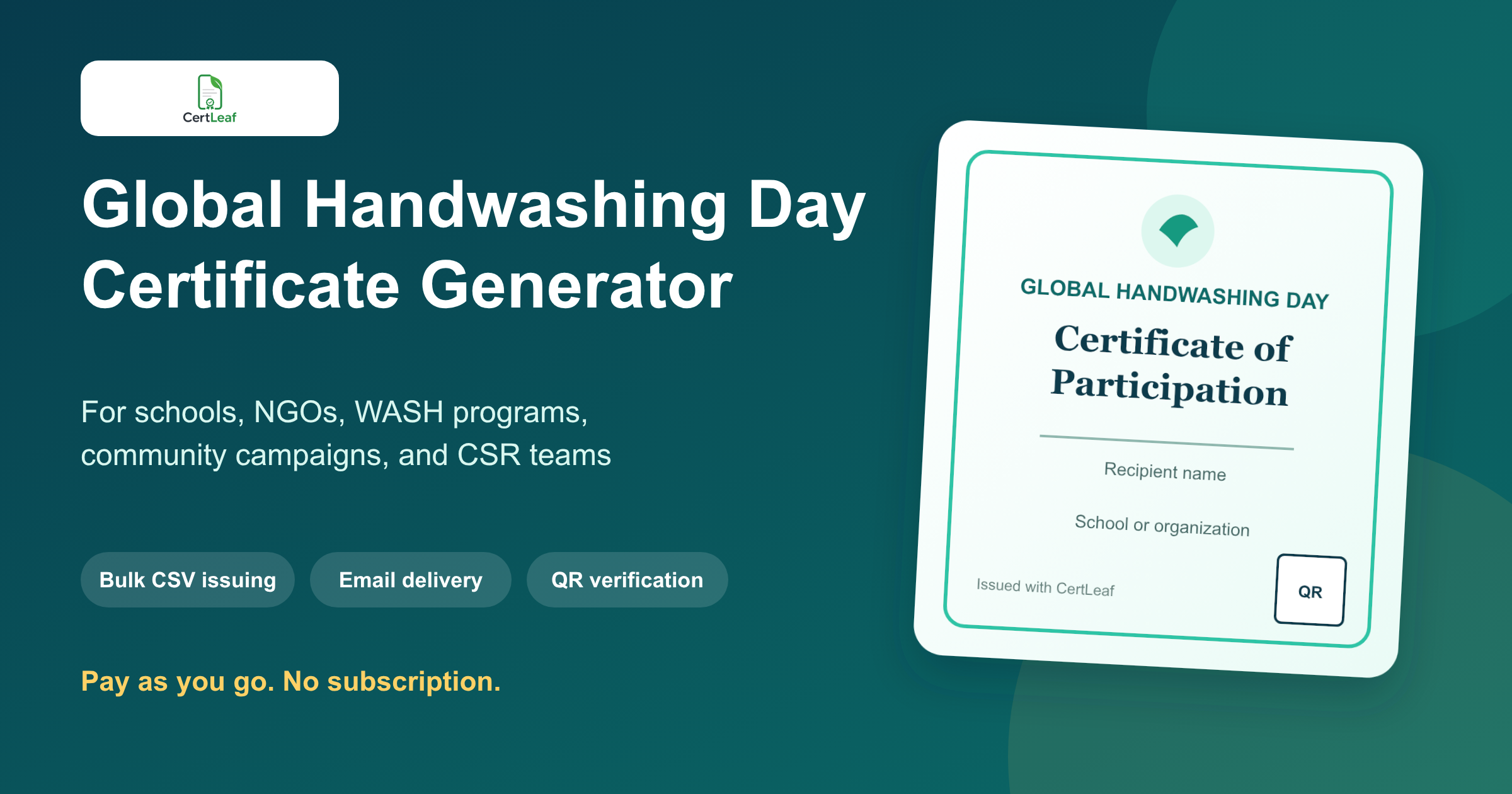
Global Handwashing Day programs need a dedicated certificate issuing platform when one campaign includes student participants, quiz winners, volunteers, teachers, health educators, coordinators, and partner organizations. These groups may share the same October 15 campaign identity, but they should not all receive the same generic certificate.
CertLeaf gives schools, NGOs, WASH programs, community organizations, and CSR teams one place to create reusable certificate templates, personalize them from an approved CSV, send certificates by email, and add QR verification where a certificate may be shared later.
The platform is pay-as-you-go, with no subscription. India-first organizers can buy credits in INR through Razorpay, and every new account includes 20 free signup credits for testing a small campaign sample.
CertLeaf handles certificate issuing. It does not measure handwashing behavior, assess hygiene standards, certify a school or facility, verify public-health outcomes, or replace the program records maintained by the responsible organizer.
Global Handwashing Day needs more than one certificate title
Global Handwashing Day is observed on October 15. A school may mark it with an assembly, a handwashing demonstration, a poster contest, a hygiene quiz, a classroom activity, or a student-led awareness drive. An NGO may coordinate school visits and community sessions. A CSR program may support activities across several locations with local teachers, field volunteers, and implementation partners.
The certificate set should reflect those differences. A student who joined a demonstration may receive a participation certificate. A quiz winner may receive an achievement certificate. A volunteer who supported outreach should receive appreciation for that contribution, while a resource person should be recognized for delivering a session or demonstration.
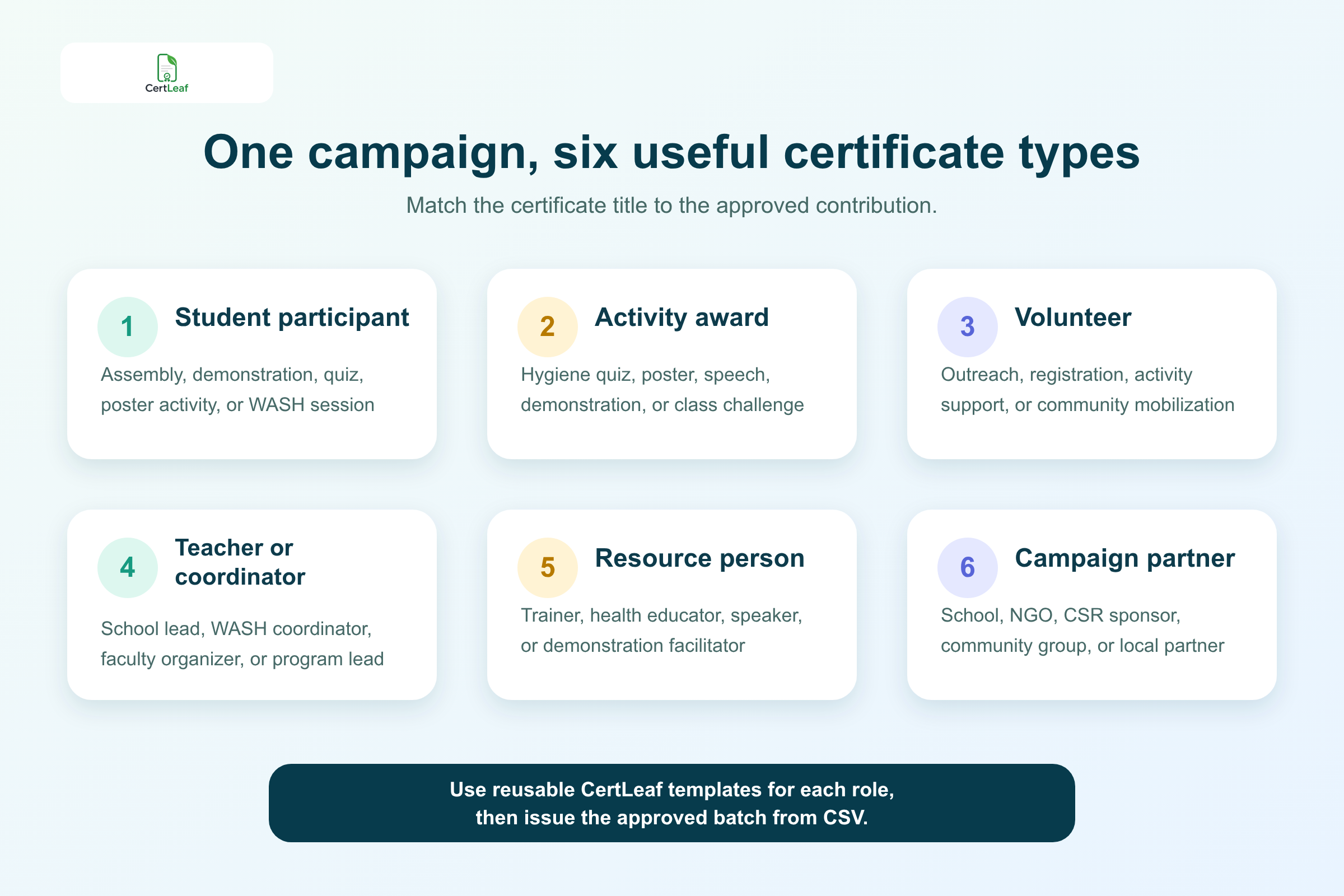
Useful Global Handwashing Day certificate types include:
Participation certificates for approved assemblies, demonstrations, quizzes, poster activities, WASH sessions, or community events.
Activity or achievement certificates for approved quiz, poster, speech, demonstration, or class challenge results.
Volunteer appreciation certificates for outreach, registration, activity support, or community mobilization.
Teacher and coordinator certificates for school leads, WASH coordinators, faculty organizers, and program teams.
Resource-person certificates for health educators, trainers, speakers, and demonstration facilitators.
Partner appreciation certificates for schools, NGOs, CSR sponsors, community groups, and local organizations.
The title and recognition statement should stay close to the organizer's approved record. Do not call a student a "hygiene champion" unless that is a real, approved campaign role or award. Do not describe participation as training completion when the activity was an assembly or awareness session.
Teams running wider social programs can use the guide to volunteer certificates for NGO and CSR campaigns for more detail on volunteer, coordinator, participant, and partner wording.
Sign up for CertLeaf and use the 20 free signup credits to test one student, volunteer, teacher, resource-person, and partner certificate before you prepare the full Global Handwashing Day batch.
Reusable templates keep a multi-school campaign consistent
A campaign spanning ten schools should look like one campaign without pretending every recipient had the same role. CertLeaf lets the issuing team upload an approved base design, place the fields that change, and save the setup as a reusable template.
The same visual system can support separate participation, activity-award, volunteer, teacher, speaker, and partner templates. Logos, colors, fixed campaign wording, signatories, and the October 15 date remain consistent. The certificate title and role statement change where they need to.
Useful dynamic fields may include:
recipient name
school or organization name
campaign or activity name
recipient role
certificate type
event date
location or district
certificate ID
Long school names, activity titles, and recipient names need an early preview. Test the longest values before issuing the full set. A certificate that looks balanced with "Aarav N." may become crowded when the recipient, school, and campaign names are all substantially longer.
Reusable templates also help with repeat programs. An NGO can retain its approved Global Handwashing Day design for the next district. A school group can keep separate student and teacher versions. A CSR team can preserve its partner-appreciation layout while changing the location and implementation partner.
A campaign CSV should contain certificate data, not health data
The final file sent to CertLeaf should be a narrow certificate roster, not a copy of every registration, survey, or program-monitoring field collected during the campaign.
A practical CSV can use columns such as:
recipientName,email,schoolOrOrganization,activityName,recipientRole,certificateType,eventDate,certificateId
One row should represent one approved certificate. If a teacher is intentionally receiving both a coordinator certificate and a resource-person certificate, record that as a deliberate second certificate. Do not allow an accidental duplicate row to make the decision.
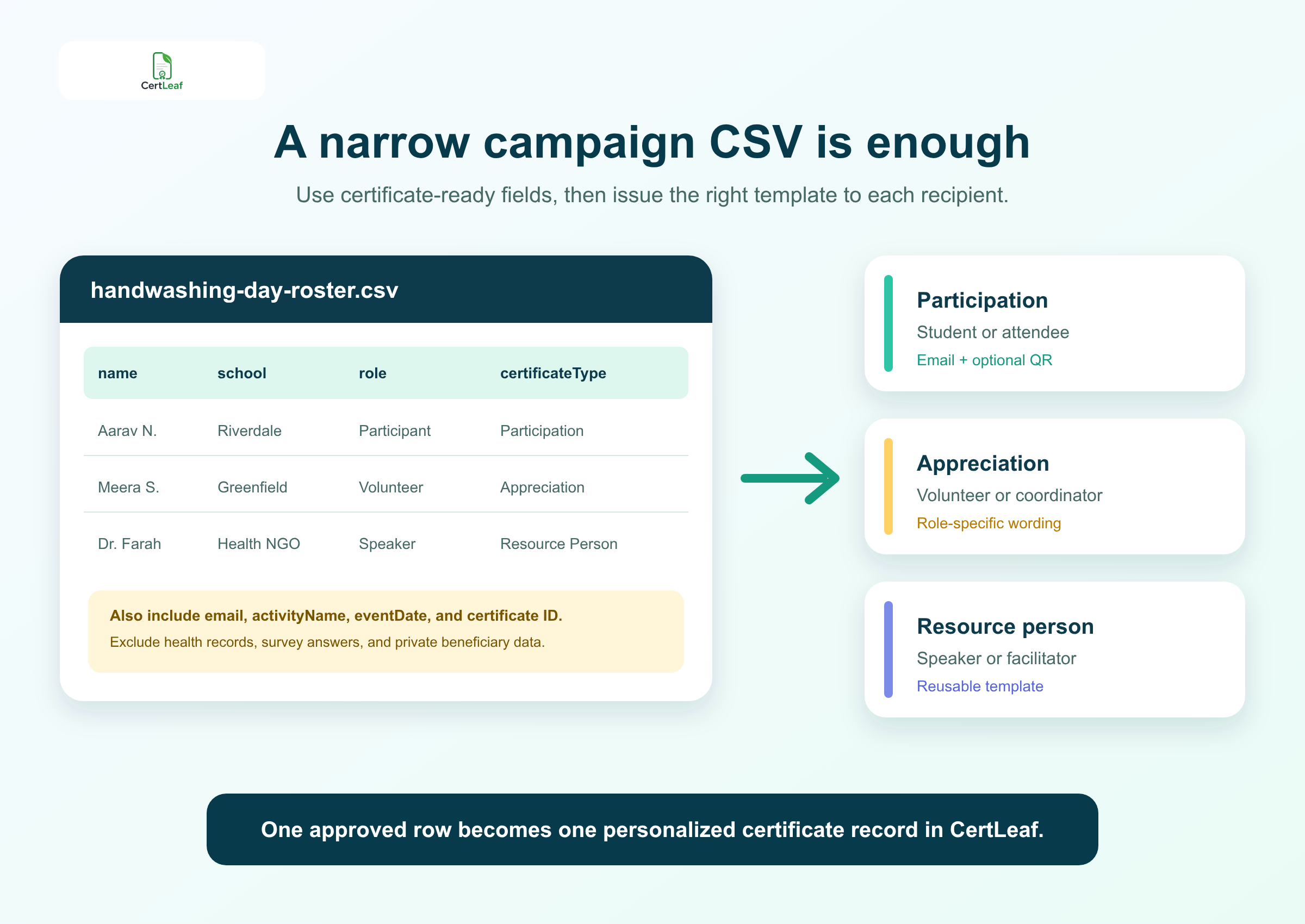
Keep health observations, survey answers, household information, beneficiary details, student notes, phone numbers, identity documents, and private monitoring data out of the issuing CSV. Those details are not required to place an approved name, organization, activity, role, and date on a certificate.
Before upload, prepare a clean certificate recipient CSV by reviewing duplicates, name spelling, email addresses, and the longest field values. This is especially useful when several schools or field teams submit rosters in different formats.
Have an approved campaign roster ready? Try the Global Handwashing Day use case in CertLeaf with 20 free signup credits. Use the sample issue to check field mapping, template selection, long names, email delivery, and QR placement before buying credits for the full batch.
Email delivery works across schools and community locations
A multi-location campaign can produce hundreds of files with similar names. Posting them in one shared folder makes it easy for recipients to open the wrong document, and manual attachment work becomes difficult when student, volunteer, teacher, and partner certificates use different templates.
CertLeaf can use the email address in each approved CSV row to send the corresponding certificate. The delivery message can name the Global Handwashing Day campaign, identify the certificate type, and provide one correction contact.
For younger students without individual email addresses, the organizer should decide whether delivery goes to a parent, teacher, school office, or another approved contact. That decision belongs with the school or program owner. CertLeaf should receive only the delivery address that the responsible team has approved.
Organizers who want a broader issuing reference can review the bulk event participant certificate process. It covers the general move from an approved list to personalized certificates and email distribution without changing the specific ownership of this handwashing campaign page.
QR verification supports later checking without making health claims
Students and volunteers may add campaign certificates to activity records, portfolios, internship applications, club files, or public profiles. Teachers, resource people, and partner organizations may retain appreciation certificates in program documentation.
A QR-verifiable certificate gives a reviewer a public route to check the certificate record created by the issuer. The verification details should match the visible certificate: recipient, campaign, certificate type, issuer, date, and an appropriate certificate ID.
That boundary matters. QR verification can confirm that the organizer issued the certificate record. It does not prove that a participant follows handwashing guidance, that a school meets a hygiene standard, that a facility passed an inspection, or that a campaign achieved a measured health outcome.
If the team is deciding which certificates need this feature, read when QR verification is useful for participation certificates. A simple internal appreciation certificate may not need it, while a student, volunteer, trainer, or partner certificate likely to be shared outside the campaign may benefit from an easy verification route.
Pay-as-you-go credits fit an annual campaign
Global Handwashing Day certificate demand is usually concentrated around October 15. A school may issue 80 certificates after one activity. An NGO may need 600 across several school visits. A CSR-supported program may have a larger batch for students, teachers, volunteers, and implementation partners, followed by months with no certificate issuing.
CertLeaf uses pay-as-you-go credits instead of a recurring subscription. Organizers purchase credits when a real campaign needs certificates. India-first teams can pay in INR through Razorpay, and the 20 free signup credits make it possible to test the setup before approving a larger issue.
Check the current pricing and final roster size before purchase. Use simple certificates where a private acknowledgement is enough and QR-verifiable certificates where recipients are likely to share the document or a third party may need to check it later.
Where CertLeaf fits different handwashing campaign organizers
Schools and school groups
Create separate templates for student participation, activity awards, teachers, student volunteers, coordinators, and invited resource people. Keep activity recognition separate from health, compliance, or inspection claims.
NGOs and WASH programs
Reuse approved campaign templates across schools, wards, districts, and community sessions. Keep certificate data separate from beneficiary records, monitoring surveys, household data, and program evaluation files.
CSR teams
Issue approved certificates for employee volunteers, school participants, coordinators, implementation partners, and speakers. The program owner should approve names, roles, logos, signatories, and wording before the batch is generated.
Community and local-government partners
Recognize approved facilitators, volunteers, schools, community groups, and partner organizations without presenting CertLeaf as a public-health reporting, inspection, accreditation, or impact-measurement platform.
Event and communication agencies
An agency can prepare the design and final CSV, but the responsible school, NGO, CSR team, or campaign owner should approve every recipient, claim, signatory, and institutional mark before issuance.
Global Handwashing Day certificate generator FAQ
What is a Global Handwashing Day certificate generator?
It is a tool for creating and issuing certificates for approved Global Handwashing Day activities such as school assemblies, handwashing demonstrations, quizzes, poster activities, WASH sessions, volunteer drives, and community campaigns. CertLeaf supports reusable templates, bulk CSV issuing, email delivery, and optional QR verification.
Can CertLeaf issue different certificates for students and volunteers?
Yes. Organizers can use separate reusable templates for student participants, activity winners, volunteers, teachers, coordinators, resource people, and campaign partners.
What fields should be in a handwashing campaign certificate CSV?
Useful fields include recipientName, email, schoolOrOrganization, activityName, recipientRole, certificateType, eventDate, and certificateId. Include only fields required for personalization, delivery, and the approved certificate record.
Should student health or survey data be uploaded?
No. Health observations, survey answers, household data, private student notes, beneficiary records, and identity documents are not needed for certificate issuing. Keep them in the authorized systems managed by the responsible organization.
Can a Global Handwashing Day certificate include QR verification?
Yes. CertLeaf can add a QR verification route to the certificate record. Verification confirms that issuer-created record; it does not certify hygiene behavior, facility standards, inspection results, or health impact.
Is CertLeaf subscription-based?
No. CertLeaf uses pay-as-you-go credits. India-first customers can pay in INR through Razorpay, and new accounts receive 20 free signup credits for testing.
Issue the campaign certificates from one focused platform
A Global Handwashing Day program can involve students, activity winners, volunteers, teachers, coordinators, health educators, NGOs, CSR teams, and community partners. Their certificates are more useful when each title describes the approved contribution accurately.
CertLeaf gives the issuing team a focused platform for reusable templates, bulk CSV personalization, email delivery, QR-verifiable certificates, and pay-as-you-go credits. Keep health and monitoring data outside the certificate file, approve every role and claim, test the difficult rows, and issue the campaign batch without taking on a subscription.
Start with 20 free CertLeaf credits and test the program using a small, approved roster.