CertLeaf
National Cancer Awareness Day Certificate Generator for Colleges, NGOs, and Hospitals
Use CertLeaf to issue cancer awareness participation, volunteer, speaker, coordinator, and partner certificates in bulk for November 7 programs.
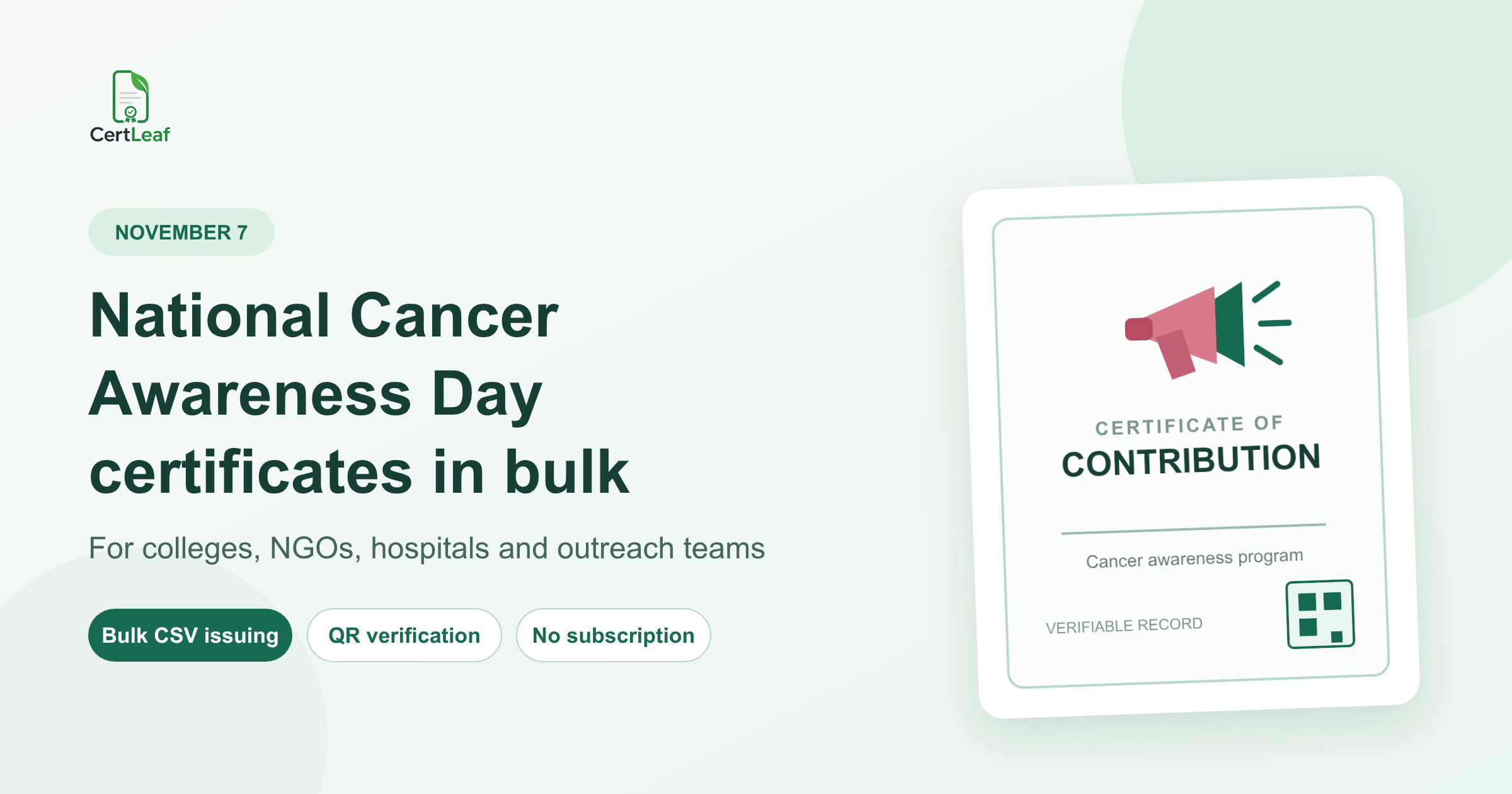
National Cancer Awareness Day programs need a dedicated certificate issuing platform when one campaign includes college participants, community volunteers, guest speakers, hospital outreach staff, coordinators, and partner organizations. They may share the November 7 campaign identity, but their certificates should describe different contributions.
CertLeaf helps colleges, NGOs, hospitals, awareness foundations, community groups, and CSR teams issue these certificates in bulk. Create reusable templates for each certificate type, upload an approved recipient CSV, generate the batch, send certificates by email, and add QR verification when the document may be shared later.
There is no subscription. CertLeaf uses pay-as-you-go credits, supports INR payments through Razorpay for India-first teams, and gives new accounts 20 free signup credits for testing.
CertLeaf handles certificate issuing. It does not run cancer screening, store patient records, verify medical services, assess professional qualifications, or decide who should receive recognition. The responsible organizer owns the program, roster, wording, approvals, and any sensitive health information.
A cancer awareness campaign needs more than one certificate title
A college may hold an expert talk, poster exhibition, quiz, volunteer-led outreach activity, and screening-awareness desk within the same program. An NGO may coordinate a public session with a hospital partner. A workplace CSR team may bring together employee volunteers, a speaker, an implementation partner, and approved participants.
One generic certificate cannot describe all of those roles accurately. A participant certificate can record attendance at an approved awareness activity. It should not imply that the recipient completed clinical training or underwent screening. A volunteer certificate can recognize outreach, registration, communication, or venue support without describing the person as a medical professional. A speaker certificate can thank an approved expert or resource person without adding a title the organizer has not confirmed.
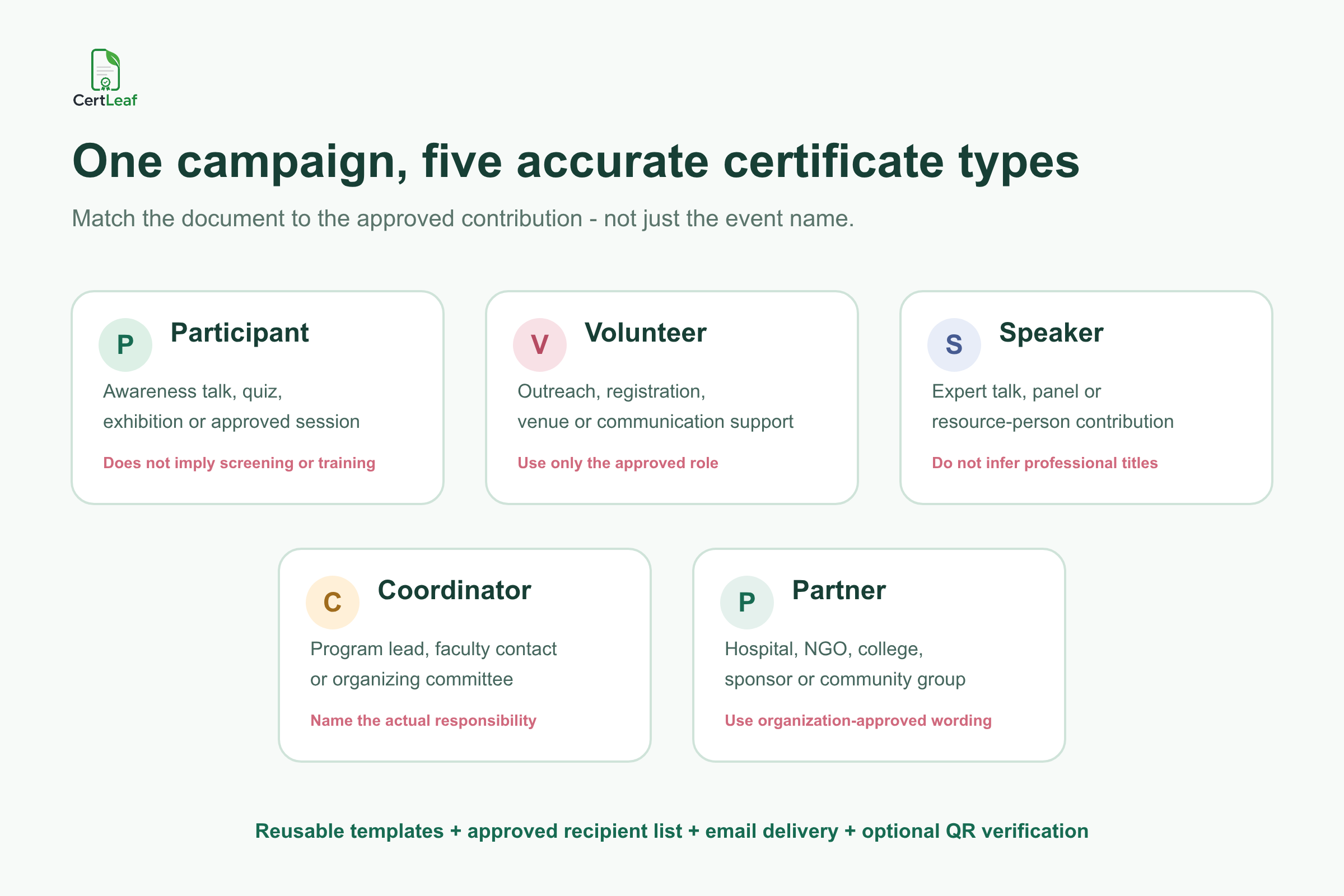
A practical certificate set may include:
Participation certificates for an approved talk, quiz, exhibition, webinar, or awareness session.
Volunteer contribution certificates for outreach, registration, communications, logistics, or venue support.
Speaker or resource-person appreciation certificates for an approved talk, panel, or expert session.
Coordinator certificates for program leads, faculty contacts, NGO teams, hospital outreach coordinators, or organizing committees.
Partner appreciation certificates for hospitals, colleges, NGOs, associations, sponsors, or community organizations.
The title and recognition statement should stay close to the organizer's approved record. Avoid wording that suggests diagnosis, treatment, screening results, medical training, professional registration, or patient care unless an authorized institution has explicitly approved the statement and it is genuinely the purpose of the document.
**Planning a November 7 program? Sign up for CertLeaf and use the 20 free signup credits to test one participant, volunteer, speaker, coordinator, and partner certificate before the full issue.**
Reusable templates keep the campaign recognizable
National Cancer Awareness Day is observed on November 7 in India, but awareness work is not limited to a single format. A campus can run a talk in the morning and a student exhibition in the afternoon. An NGO can repeat the same campaign across several colleges. A hospital outreach team can support community sessions in more than one location.
Rebuilding every certificate from scratch makes logos, fixed wording, signatories, and spacing drift between programs. With CertLeaf, the issuing team uploads an approved base design, places the fields that change, and saves the setup as a reusable template.
The participant, volunteer, speaker, coordinator, and partner versions can share the same visual identity while keeping the certificate claim specific. Common dynamic fields include recipient name, campaign name, certificate type, role, organization, event date, location, and certificate ID.
Test the awkward values early. A long hospital name, department name, campaign title, or recipient name can expose layout problems that a tidy first row will not. Generate a small sample before approving the complete batch.
Keep health information out of the certificate CSV
The final file sent to CertLeaf should be a narrow certificate roster, not the event's complete registration, screening, beneficiary, or patient record.
A useful issuing CSV may contain:
recipientName,email,campaignName,certificateType,role,eventDate,organizationName,certificateId
One row should represent one intended certificate. If a guest speaker is also receiving a separate coordinator certificate, make that a deliberate second record or issue it through a separate template batch. Do not let an accidental duplicate decide what the person receives.
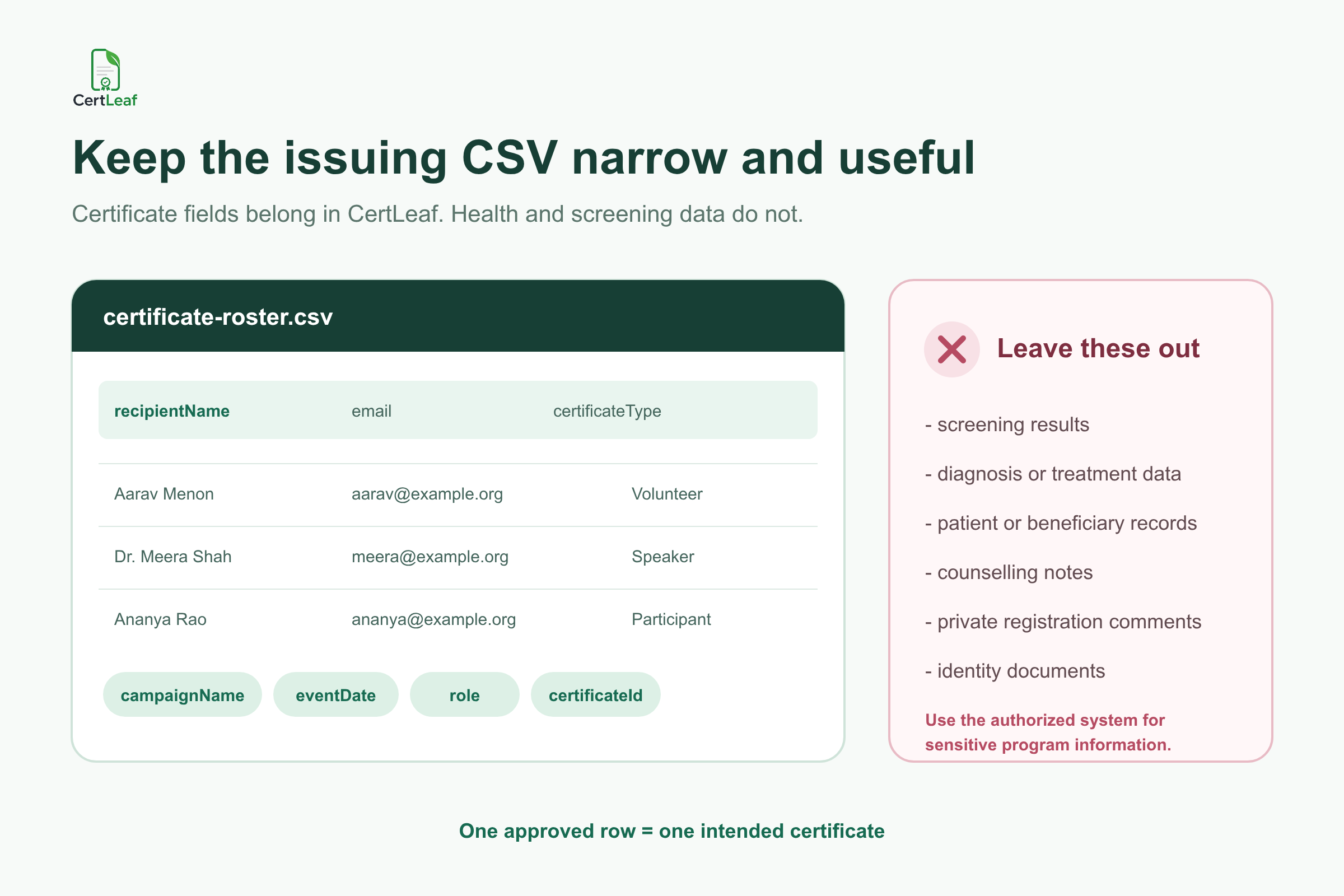
Screening results, diagnoses, treatment details, patient or beneficiary records, counselling notes, identity documents, and private registration comments are not needed for certificate generation. Keep them in the authorized system used by the responsible organization. The public verification record should also be limited to appropriate certificate details.
Before uploading the final file, review names, email addresses, duplicate rows, certificate types, and roles. CertLeaf's practical guide to preparing a certificate recipient CSV without name or email errors is the useful next step when several teams have contributed to the roster.
**Have an approved certificate list ready? Try the cancer awareness campaign use case in CertLeaf with 20 free signup credits. Check the difficult names, CSV mapping, email delivery, and each certificate type before purchasing credits for the full batch.**
Where CertLeaf fits the November 7 campaign
CertLeaf is software for issuing, distributing, verifying, and managing digital certificates. For a National Cancer Awareness Day program, the practical use is focused:
Upload the organizer's approved certificate design.
Create reusable templates for the certificate types the campaign needs.
Place fields for the recipient and approved program details.
Upload the final certificate roster as a CSV.
Review representative records, including long names and organization names.
Issue the approved batch and send certificates by email.
Use QR-verifiable certificates when recipients may share the document outside the program.
CertLeaf is not a campaign registration system, medical-record system, screening platform, learning management system, or professional credentialing authority. It starts after the organizer has approved the recipient list and certificate claims.
If a cancer awareness program includes a separate community screening camp or health drive, the guide to medical camp volunteer certificates for health outreach helps distinguish volunteer, staff, organizer, partner, and awareness-session records. The clinical or screening process should remain outside the certificate file.
Email delivery is better than a shared certificate folder
Awareness programs often rely on messaging groups for announcements, but a shared folder is a poor way to distribute personalized certificates. Similar filenames are easy to mix up. Partner certificates can sit beside participant files. Anyone with the link may be able to see more than intended.
CertLeaf can send each issued certificate to the email address in its approved CSV row. The message can identify the campaign and certificate type, thank the recipient for the relevant participation or contribution, and provide one route for genuine corrections.
Keep the email equally narrow. It should not mention screening results, health disclosures, counselling discussions, patient details, or private registration information. It is a certificate delivery message, not a medical or beneficiary communication.
NGOs and CSR teams running a larger volunteer program can use the guide to volunteer certificates for NGO events and social campaigns for more examples of contribution-specific wording and partner recognition.
QR verification gives recipients a checkable record
Students may add an awareness participation or volunteer certificate to a college activity file, internship application, scholarship record, or professional profile. Speakers, coordinators, and partner organizations may retain appreciation certificates with their program documentation.
A QR-verifiable CertLeaf certificate gives a reviewer a public route to check the certificate record created by the issuer. The verification details should match the visible document. A volunteer certificate should verify as a volunteer contribution, not as medical training. A participant record should not imply that the person was screened, treated, certified, or professionally qualified.
That boundary is important. QR verification confirms the certificate record. It does not prove a diagnosis, screening result, treatment outcome, medical qualification, regulatory status, or the effectiveness of an awareness program.
Pay-as-you-go credits fit campaign-based issuing
Cancer awareness certificates are usually issued around specific talks, college programs, public campaigns, volunteer activities, exhibitions, or community events. The organizer may need a meaningful batch in November and no certificate software for several quiet months.
CertLeaf uses pay-as-you-go credits instead of a subscription. India-first customers can purchase credits in INR through Razorpay. A new account includes 20 free signup credits, so the team can test templates and sample records before committing to the complete issue.
Reusable templates make the next campaign easier as well. The organizing team can retain approved participant, volunteer, speaker, coordinator, and partner layouts, then update the campaign name, date, location, and recipient roster. Check current pricing and the final batch size before approval, since plans and offers can change.
How different cancer awareness organizers can use CertLeaf
Colleges and student groups
Use separate templates for participants, student volunteers, quiz or exhibition contributors, speakers, faculty coordinators, and campaign partners. Keep student health information and any screening data outside the issuing roster.
NGOs and cancer awareness foundations
Reuse campaign-branded templates across college visits, public talks, volunteer orientations, community sessions, and outreach events. Use role and location fields only when the organization has approved them.
Hospitals and outreach teams
Use institution-approved branding, signatories, and professional titles. The responsible hospital should approve the wording and roster. Do not upload patient, screening, diagnosis, or treatment information for certificate issuing.
CSR and workplace teams
Separate employee participants, employee volunteers, speakers, organizing teams, implementation partners, and venue partners. CertLeaf issues the approved certificates; it does not hold employee health or screening records.
Event and communication partners
An agency can prepare the designs and final CSV, but the responsible college, NGO, hospital, foundation, or company should approve recipients, roles, signatories, logos, and certificate claims before issue.
Cancer awareness certificate generator FAQ
What is a cancer awareness certificate generator?
It is a tool for creating and issuing approved certificates for cancer awareness talks, quizzes, exhibitions, campaigns, volunteer activities, and community programs. CertLeaf supports reusable templates, bulk CSV issuing, email delivery, and QR-verifiable certificates.
Can CertLeaf issue National Cancer Awareness Day certificates?
Yes. Organizers can use CertLeaf to issue approved participant, volunteer, speaker, coordinator, and partner certificates for November 7 programs. The organizer remains responsible for the event, recipient approvals, and wording.
What types of cancer awareness certificates can be created?
Common types include participation, volunteer contribution, speaker or resource-person appreciation, coordinator, organizing-team, and partner appreciation certificates. Use separate templates when the title or recognition statement changes.
Which CSV fields are useful for the certificate batch?
Useful fields include recipientName, email, campaignName, certificateType, role, eventDate, organizationName, and certificateId. Include only information needed to create, deliver, or appropriately verify the certificate.
Should screening or patient data be included?
No. Screening results, diagnoses, treatment information, patient or beneficiary records, counselling notes, and identity documents are not needed for certificate issuing and should remain in the authorized system used by the responsible organization.
Can a cancer awareness certificate include QR verification?
Yes. CertLeaf can add a QR verification route to the issued certificate record. Verification confirms that record; it does not confirm health information, medical services, professional qualifications, or program outcomes.
Is CertLeaf subscription-based?
No. CertLeaf uses pay-as-you-go credits, supports INR payments through Razorpay for India-first customers, and gives new accounts 20 free signup credits for testing.
Give every campaign contribution the right record
A National Cancer Awareness Day program can bring together participants, volunteers, speakers, coordinators, hospitals, colleges, NGOs, and community partners. Their certificates are more useful when the title and wording describe the approved contribution without making medical claims.
CertLeaf gives the issuing team one focused platform for reusable templates, bulk CSV issuing, email delivery, QR-verifiable certificates, and pay-as-you-go credits without a subscription. Keep sensitive health information outside the certificate file, test every certificate type, and issue the approved campaign batch from one place.
Start with 20 free CertLeaf credits and test the program using a small, approved roster.