CertLeaf
World Science Day Certificate Generator for Schools, Colleges, and STEM Clubs
Issue World Science Day participation, achievement, speaker, volunteer, and partner certificates in bulk with reusable templates, email delivery, and QR verification.
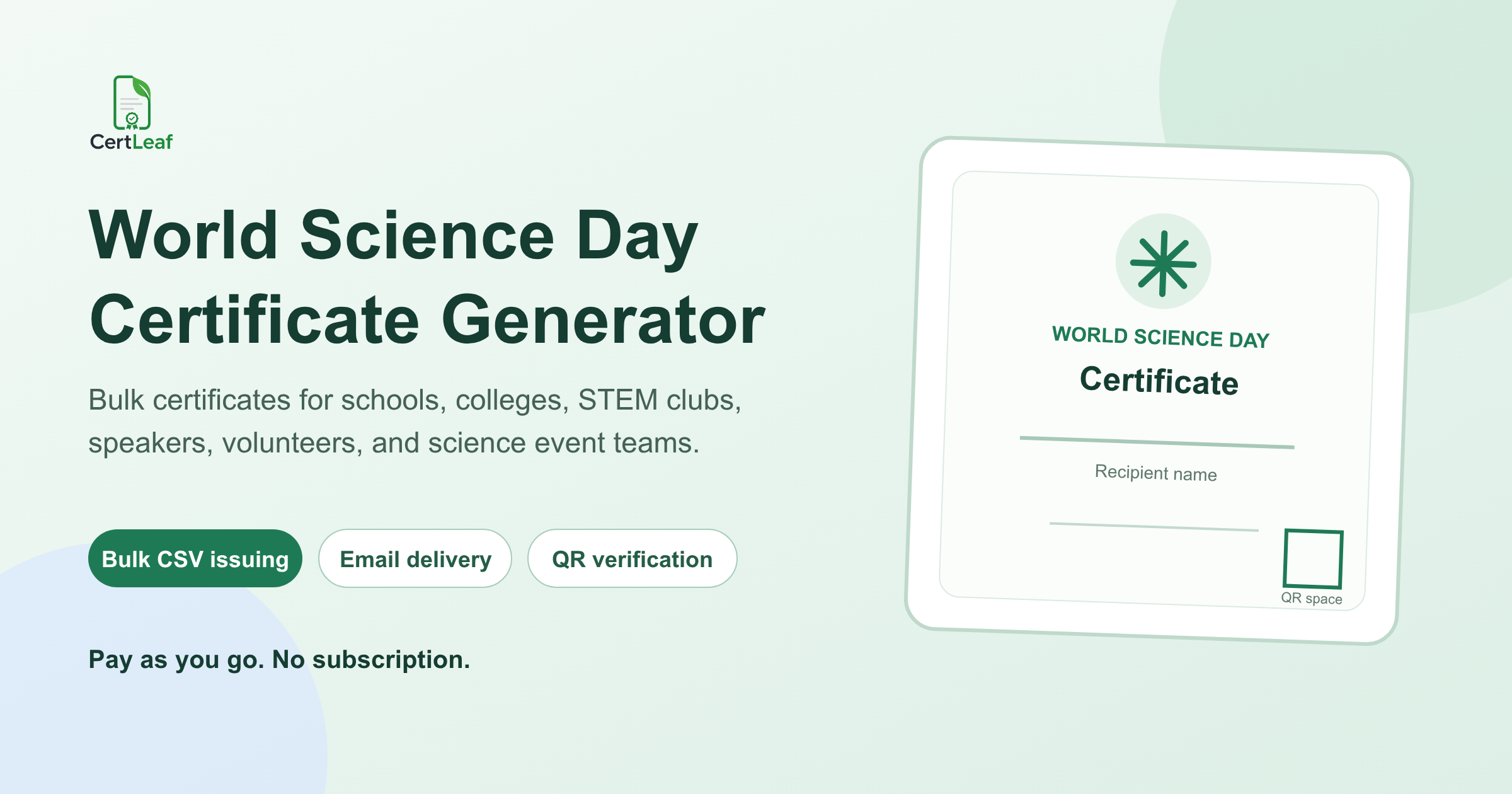
World Science Day programs need a dedicated certificate issuing platform because the event usually recognizes more than student attendance. A school may run a science talk, poster showcase, quiz, model display, or classroom challenge. A college STEM club may host researchers, judges, mentors, volunteers, and project teams. A community science group may work with several schools and partner organizations on the same program.
CertLeaf gives those teams one focused place to create reusable certificate templates, personalize certificates from an approved CSV, issue them in bulk, deliver them by email, and add QR verification when recipients may share the record later.
That makes CertLeaf a practical World Science Day certificate generator for schools, colleges, STEM clubs, science associations, museums, libraries, NGOs, and outreach teams. The organizer remains responsible for the event program, participation records, judging, awards, and approved wording. CertLeaf handles the certificate issuing layer after those facts are ready.
World Science Day for Peace and Development is observed on November 10. For teams planning talks, exhibitions, public engagement sessions, and student activities around that date, the certificate setup should be ready before the program begins, not assembled after every role has been mixed into one spreadsheet.
One science event can need several certificate types
A student participant, a project winner, a guest scientist, and a volunteer did not make the same contribution. Giving all four the same certificate title makes the batch easier to design but less useful to the recipient.
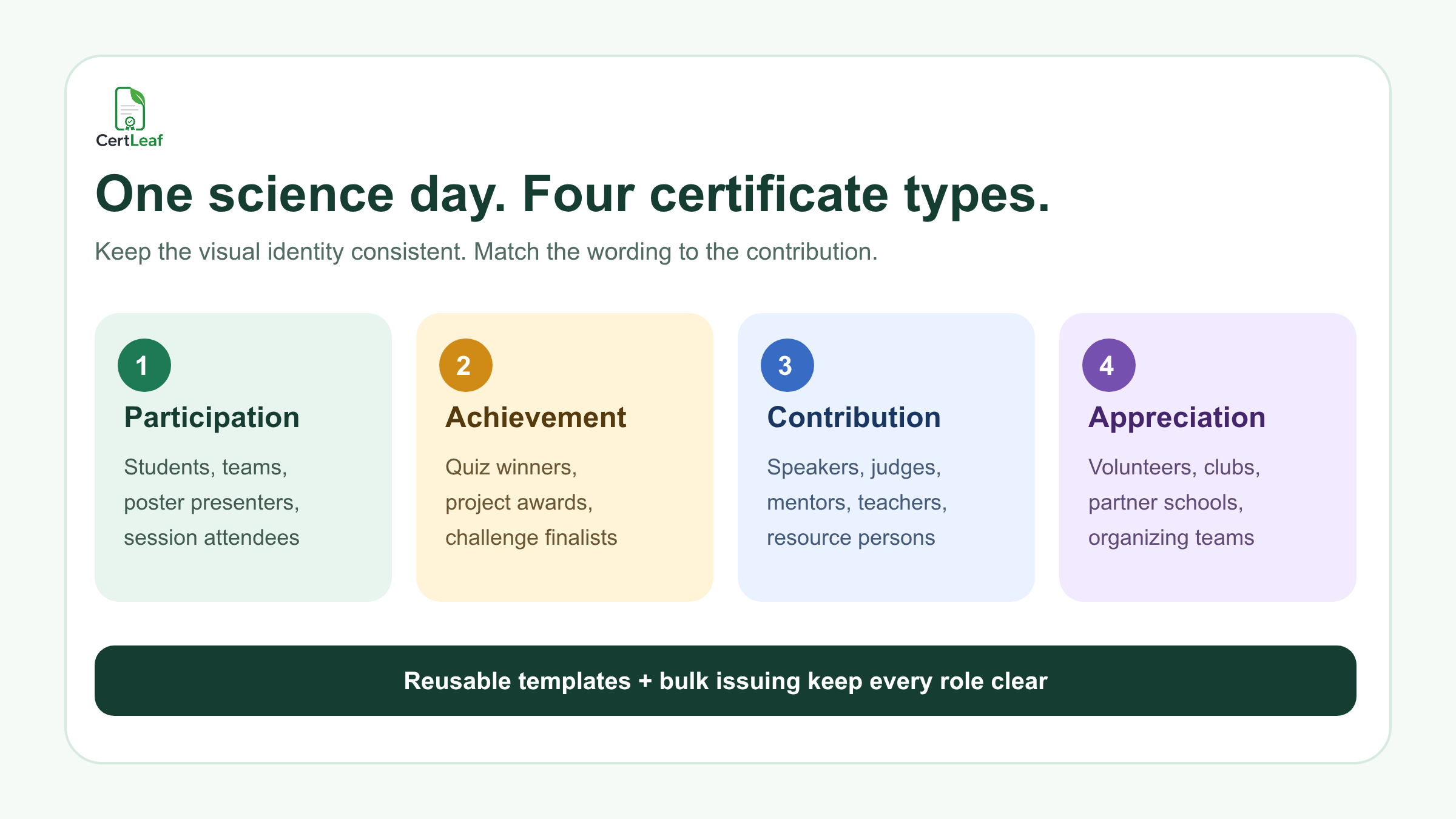
A useful World Science Day certificate set can include:
Participation certificates for students, project teams, poster presenters, quiz participants, or session attendees.
Achievement certificates for approved winners, finalists, project awards, or challenge categories.
Contribution certificates for speakers, judges, mentors, teachers, demonstrators, and resource persons.
Appreciation certificates for volunteers, organizing teams, clubs, partner schools, libraries, museums, NGOs, or supporting institutions.
The wording should describe the approved record. A student who attended a science talk should not receive a certificate that implies project completion. A volunteer certificate should not use winner language. A partner appreciation certificate should recognize support without claiming accreditation or endorsement.
CertLeaf lets the organizer keep one visual identity while saving separate reusable templates for the main certificate categories. Logos, colors, signatories, the November 10 date, and fixed event wording can remain consistent. The title and role-specific text can change where they need to.
Planning a World Science Day event? Sign up for CertLeaf and use the 20 free signup credits to test participant, speaker, volunteer, and award certificates before approving the full batch.
Built for talks, STEM activities, quizzes, and public science programs
The World Science Day certificate generator keyword covers a broad family of events, but the issuing need is specific: turn approved participation and contribution records into certificates people can actually receive and use.
Schools may run assemblies, science quizzes, poster activities, demonstrations, or student talks. Colleges may organize expert lectures, research showcases, innovation challenges, or STEM club events. Libraries, museums, science associations, NGOs, and outreach groups may hold public discussions, school visits, workshops, or community science sessions.
Some programs will need only one participation template. Others will need a small template family for students, speakers, volunteers, and partners. If the program includes models, posters, team projects, or formal awards, the guide to science exhibition certificates for schools, colleges, and STEM events is a useful adjacent resource for project, team, judge, mentor, and winner records.
CertLeaf does not replace an event registration platform, judging system, science assessment tool, project-submission portal, learning management system, or outreach reporting system. It is the issuing layer for the records the responsible organizer has already approved.
Reusable templates keep recurring science programs consistent
World Science Day returns every November 10, and many institutions also run science activities throughout the academic year. A good certificate setup should be reusable beyond one date.
In CertLeaf, the organizer can upload an approved base design, place the changing fields, and save the layout as a reusable template. A school can retain separate student and teacher versions. A college STEM club can keep participation, speaker, and volunteer templates. A science outreach organization can reuse the same partner-appreciation layout across several locations.
Useful dynamic fields may include:
recipientNameinstitutionNameactivityNamerecipientRolecertificateTypeawardOrCategoryeventDatecertificateId
Keep the template family small. Most events do not need ten designs. They need a few clear certificate meanings and layouts that have been tested with realistic data.
Test the longest recipient name, school name, activity title, and award category before the batch is issued. Check a certificate with every optional field present and another with only the required fields. Leave proper space for the CertLeaf QR code when verification is enabled rather than drawing a fake code into the background design.
Create a CertLeaf account and test the World Science Day template family with 20 free signup credits. Use the sample issue to check long names, role wording, email delivery, and QR placement before purchasing credits for the full event.
Use a focused certificate CSV, not the complete event database
A World Science Day program may collect registrations, student details, project abstracts, quiz scores, judge notes, consent information, feedback, and internal reporting data. Most of that does not belong in a certificate issuing file.
A practical World Science Day CSV can begin with:
recipientName,email,activityName,role,certificateType,eventDate
Add institutionName, theme, award, or certificateId only when the certificate or verification record needs those fields.
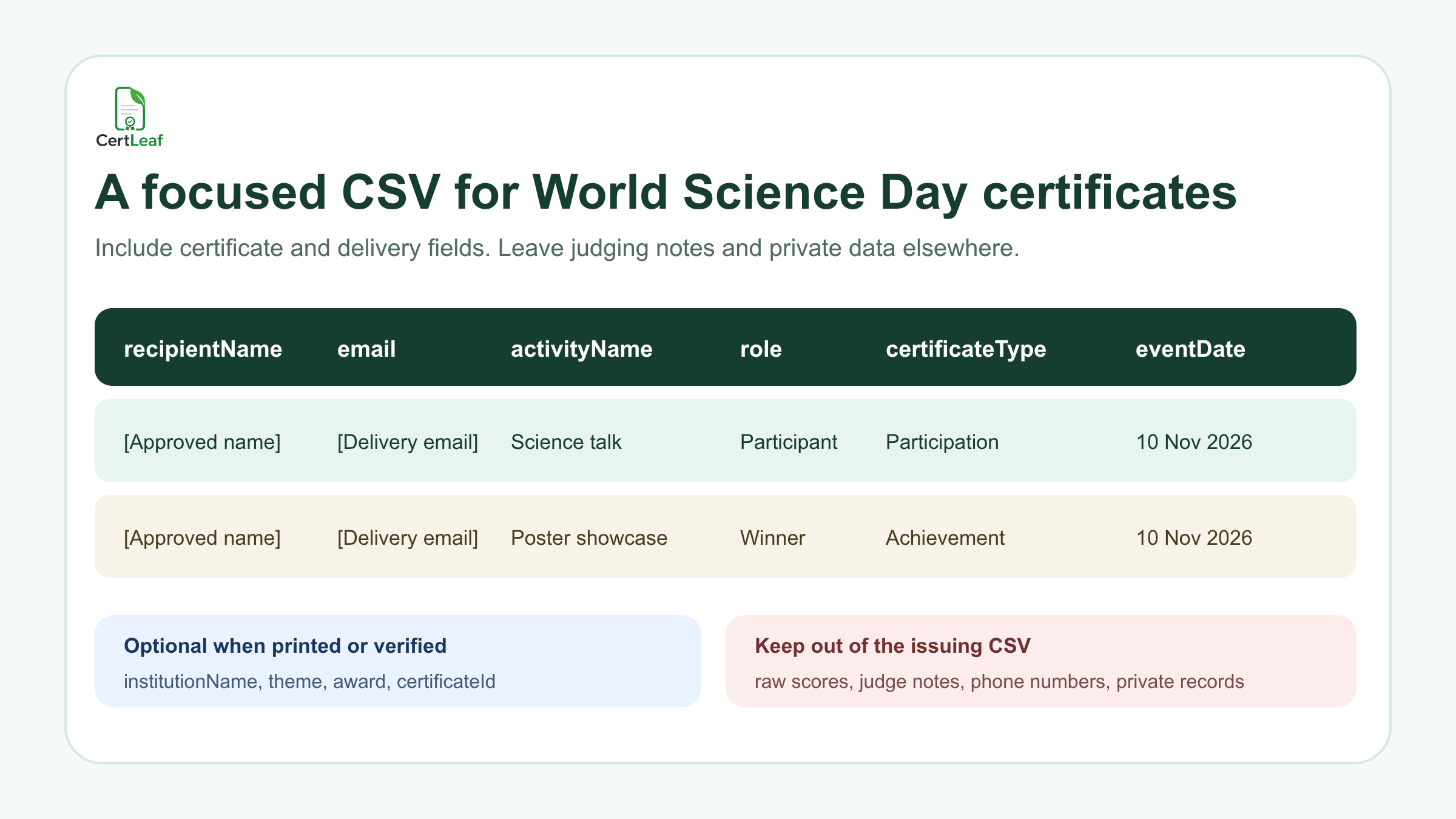
Use one approved row for one intended certificate. If a teacher is both the event coordinator and a speaker, decide whether that should produce one contribution certificate or two distinct records. Do not let a duplicate registration row make that decision.
Keep raw quiz scores, judge notes, phone numbers, identity documents, private student data, project evaluations, and internal comments in the systems owned by the organizer. The issuing CSV should contain only the fields required for personalization, delivery, and the approved public record.
When several departments or schools submit separate rosters, the guide to preparing a certificate recipient CSV without name or email errors is the useful next step. It covers duplicate rows, name formatting, email checks, and testing the field values most likely to stretch a certificate layout.
Email certificates without building a shared folder of mixed PDFs
World Science Day programs can involve several certificate categories that look deliberately similar. A shared folder containing student, speaker, winner, volunteer, and partner PDFs quickly becomes difficult to distribute safely. Manual attachment work adds another chance to match the wrong file to the wrong recipient.
CertLeaf ties the delivery email to the same approved row used to personalize the certificate. The organizer can issue the batch and send each certificate to its intended address without downloading and matching every PDF by hand.
For younger students, the school should decide whether delivery goes to a parent, teacher, school coordinator, or institution inbox. For project teams, decide whether each student receives an individual certificate or whether the approved contact receives a team record. Put that delivery decision in the CSV before issuing.
Send internal tests from each certificate category. Open the messages on a phone and laptop. Check the recipient name, activity, role, certificate title, date, and download experience. Give recipients one correction contact instead of asking them to message several club members.
Add QR verification when the certificate will travel
World Science Day certificates may appear in student portfolios, activity records, scholarship files, internship applications, club reports, speaker profiles, or volunteer records. A QR-verifiable certificate gives the next viewer a public route to check the issued CertLeaf record.
The certificate and verification page should agree on the recipient, issuer, event, certificate type, role or award, event date, and certificate ID where relevant. The useful part is the issued record behind the QR code, not a decorative square added to the design.
QR verification has a clear boundary. It can confirm that the issuer created a matching certificate record through CertLeaf. It does not verify a scientific claim, validate a project, confirm a quiz result independently, certify an institution, prove impact, or provide accreditation.
The guide to QR code certificates and public verification explains what the verification route should confirm and when a simple certificate may be enough.
Pay-as-you-go pricing fits an annual science event
World Science Day certificate demand is concentrated around an event. A school may issue 90 certificates after a November program. A college may issue 300 across talks, competitions, volunteers, and speakers. A science outreach group may issue several school batches during one campaign and then have no certificate work for months.
CertLeaf uses pay-as-you-go credits with no subscription. A simple certificate uses 1 credit. A QR-verifiable certificate uses 2 credits. New accounts receive 20 free signup credits, and India-first customers can purchase credits in INR through Razorpay.
Use the free credits to test the setup rather than assuming a full event will be free. Try one certificate from every template, the longest field values, an email delivery, and a QR-verifiable sample. Then calculate the full credit requirement from the approved row count and certificate type.
This keeps the certificate cost connected to the actual World Science Day program. The institution buys credits when certificates are ready to issue instead of paying a monthly fee during quiet periods.
Where CertLeaf fits each organizer
Schools and school groups
Issue approved certificates for student participants, quiz or project winners, teachers, coordinators, volunteers, and invited resource persons. Keep student and delivery data limited to what the certificate process needs.
Colleges and STEM clubs
Reuse participation, speaker, mentor, volunteer, and project-award templates across World Science Day, department talks, research events, and innovation programs. Use QR verification when recipients may share certificates beyond campus.
Science associations, museums, and libraries
Issue participation and contribution certificates for public talks, school outreach, demonstrations, panel discussions, and volunteer-supported programs without turning CertLeaf into an event registration or membership system.
NGOs and community science programs
Reuse approved templates across locations and partner schools. Keep beneficiary records, monitoring data, private student details, and impact reporting outside the certificate CSV.
Event and outreach agencies
An agency can prepare the design and issuing file, but the responsible institution should approve recipient names, roles, awards, logos, signatories, and certificate claims before the batch is generated.
World Science Day certificate generator FAQ
What is a World Science Day certificate generator?
It is a tool for creating and issuing personalized certificates for approved World Science Day activities such as science talks, quizzes, poster sessions, project showcases, demonstrations, public engagement programs, and volunteer-supported events. CertLeaf supports reusable templates, bulk CSV issuing, email delivery, and optional QR verification.
When is World Science Day for Peace and Development?
World Science Day for Peace and Development is observed annually on November 10. Schools, colleges, STEM clubs, science organizations, libraries, museums, NGOs, and outreach teams can use the date for science engagement programs suited to their own audience.
Can CertLeaf issue different certificates for students, speakers, and volunteers?
Yes. Organizers can save separate reusable templates or batches for participation, achievement, contribution, and appreciation records while keeping one consistent event identity.
What fields belong in a World Science Day certificate CSV?
Useful fields include recipientName, email, activityName, role, certificateType, and eventDate. Add institution, theme, award, or certificate ID only when the certificate or verification record needs them.
Can project winners and quiz winners receive achievement certificates?
Yes, after the responsible organizer approves the results and exact award wording. CertLeaf issues the approved record; it does not judge projects, calculate quiz scores, or decide winners.
Should World Science Day certificates include QR verification?
QR verification is useful when recipients may share the certificate in portfolios, applications, reports, or professional profiles. It confirms the issued CertLeaf record, not the scientific validity, judging decision, accreditation, or impact of the underlying activity.
Can CertLeaf email World Science Day certificates in bulk?
Yes. CertLeaf can use the approved email in each CSV row to issue and deliver certificates. Test each certificate category and delivery route before sending the full batch.
Is CertLeaf a subscription certificate platform?
No. CertLeaf uses pay-as-you-go credits with no subscription. New accounts receive 20 free signup credits, and India-first customers can purchase credits in INR through Razorpay.
Give the science program a proper certificate layer
World Science Day can bring together students, project teams, teachers, scientists, speakers, judges, volunteers, clubs, schools, colleges, and community partners. Their certificates should preserve those differences while still looking like one organized program.
CertLeaf provides reusable templates, bulk CSV issuing, email delivery, QR verification, pay-as-you-go credits, INR/Razorpay support, and 20 free signup credits. The organizer approves every participant, role, award, and claim. CertLeaf turns those approved records into consistent issued certificates without a monthly subscription.