CertLeaf
Workshop Certificate Generator: Create, Send, and Verify Certificates Without Manual Work
A practical guide for workshop organizers who need to generate participation certificates in bulk, send them by email, and make each certificate easy to verify with a QR code.
Most workshops end the same way.
The session is done. The feedback form is closed. Someone from the organizing team opens a spreadsheet, copies participant names into a certificate design, exports PDFs, checks spellings, attaches files, and sends emails one by one.
For 15 participants, this is annoying.
For 150 participants, it becomes a full evening of work.
That is the exact job a workshop certificate generator should handle: take your certificate design, take your participant list, generate certificates in bulk, send them to the right people, and make each certificate easy to verify later.
CertLeaf is built for this kind of workflow.
Not for designing fancy posters. Not for becoming a full learning management system. Just the boring but important part after a workshop: issuing clean, verifiable certificates without turning it into manual admin work.
Watch the CertLeaf workflow
If you want to see the platform before reading the full breakdown, these walkthroughs show the actual flow.
Create a template and issue a verifiable certificate
Bulk issue certificates from a CSV
Why workshop certificates are painful to issue manually
Workshop certificates look simple from the outside. Usually, they only need a few fields:
participant name
workshop title
date or date range
duration or number of hours, if that matters for the program
organizer or institution name
facilitator, trainer, or instructor name
signature
certificate ID
optional QR code or verification link
The problem is not one certificate. The problem is repetition.
If you are running a college workshop, a technical bootcamp, a training session, or a paid online workshop, you may have a spreadsheet with 80, 200, or 500 names. Manually editing each certificate means small mistakes start creeping in:
names copied with extra spaces
wrong email addresses
certificates exported with the wrong file name
participants asking for corrections days later
team members losing track of who received what
fake or edited PDFs being shared without any way to verify them
This is why a normal certificate maker is not enough. A design tool helps you make the certificate look good. It does not solve issuing, emailing, and verification.
For workshops, that difference matters.
What a good workshop certificate generator should do
A useful workshop participation certificate generator should do five things well.
Let you reuse the same certificate template.
Generate certificates in bulk from a spreadsheet or CSV.
Support custom fields like name, topic, date, duration, instructor, and certificate ID.
Send certificates by email, not just download a ZIP file.
Add QR verification so the certificate can be checked later.
A lot of pages in this search space focus on free templates or printable certificate designs. That is useful when design is the main job. But workshop organizers usually have a second job after design: issuing certificates to the right people without making mistakes.
CertLeaf focuses on that workflow.
You create the certificate layout once, upload participant data with CSV, generate the certificates, and send them out. If you want the certificate to be verifiable, CertLeaf can include a QR code that opens a public proof page for that certificate.
That is the part manual tools usually miss.
Design tool vs workshop certificate generator
This distinction is important.
A design tool helps you create a good-looking participation certificate. It is useful for layout, colors, typography, and printable designs. If you need one or two certificates, that may be enough.
A workshop certificate generator should handle the issuing process:
importing participant data from a CSV
mapping fields like name, email, workshop title, and date
generating many personalized certificates at once
sending certificates to participants
keeping verification possible through a certificate ID or QR code
For a real workshop, the certificate design is only the first step. The messy part is the participant list, delivery, corrections, and proof.
The CertLeaf workflow for workshop certificates
Here is the practical flow shown in the CertLeaf product walkthroughs.
1. Create your template from a base certificate design
Start at CertLeaf, sign up, and open the dashboard. From there, choose Create template.
Give the template a clear name, such as the workshop or event name, and upload your base certificate design. This is the certificate background you want to reuse for every participant.
Once the template editor opens, place dynamic fields on the certificate canvas. For a workshop, these may include:
{participant_name}{workshop_title}{completion_date}{organizer_name}{certificate_id}
The recipient name field can be dragged into the correct position and styled to match the certificate design. You can adjust the font, size, and placement so the generated certificates do not look like names were pasted in at the last minute.
You do this once. The point is to avoid opening the design again and again for every participant.
2. Add QR verification to the template
If the workshop certificate should be verifiable, add a QR code in the template editor and place it somewhere clean, usually a bottom corner.
That QR code is what turns the certificate from a static PDF into something people can check. If a recipient shares the certificate digitally or prints it, someone can scan the QR code with a phone and open the CertLeaf verification page.
Once the fields and QR code are in place, save the template.
3. Upload the participant list as a CSV
After the workshop, export your participant list as a CSV.
A simple CSV could look like this:
| participant_name | workshop_title | completion_date | |
|---|---|---|---|
| Anika Rao | anika@example.com | Advanced Product Strategy | 26 June 2026 |
| Rahul Mehta | rahul@example.com | Advanced Product Strategy | 26 June 2026 |
In spreadsheet form, each row becomes one certificate. The column names should match the fields you want to place on the certificate template.
CertLeaf uses this data to generate certificates in bulk. Each row becomes one certificate.
This is the main reason to use a bulk workshop certificate generator instead of manually editing PDFs. The spreadsheet is already where your participant data lives. The certificate tool should work with that instead of forcing you to copy and paste names by hand.
4. Generate certificates in bulk
For a single certificate, you can use the Issue flow: select the template, enter the recipient name and email, choose the issue type, select formats like PDF or PNG, and issue the certificate.
For a full workshop batch, use Bulk Issue.
Select the workshop template, choose the issue type, select the output formats, and upload the CSV containing recipient names and email addresses. Review the imported rows before submitting. This review step matters; it is where you catch spelling mistakes and wrong email addresses before certificates go out.
After submission, CertLeaf processes the bulk job in the background and shows progress until the certificates are generated.
Once the CSV is uploaded and mapped to the template fields, CertLeaf can generate the workshop certificates in one batch.
This helps when you are issuing certificates for:
hands-on technical workshops
college club events
faculty development programs
online or virtual training sessions
weekend bootcamps
paid skill-based workshops
academic or research methodology workshops
creative workshops
wellness workshops
competitions with participation certificates
The goal is not to make the process look complicated. The goal is the opposite: upload the list, review the fields, generate the certificates, and move on.
5. Add QR verification when credibility matters
A workshop certificate is often used later in a LinkedIn post, student portfolio, college submission, internship application, or internal training record.
That is where QR verification becomes useful.
With CertLeaf, a verifiable certificate can include a QR code. When someone scans it, they can open a public verification page and confirm that the certificate was issued by the organizer.
This is especially useful for colleges, training institutes, and paid workshops where participants may share certificates outside the original event group.
A plain PDF can be edited. A QR-verifiable certificate gives the organizer and recipient a cleaner way to prove it is real.
6. Send workshop certificates by email
Generating certificates is only half the work. Distribution is where many teams still waste time.
Downloading 200 PDFs and attaching them manually is not a serious workflow. It is just busywork.
CertLeaf is meant to help teams send workshop certificates by email after generation, so participants receive their ready-to-download certificate without the organizer handling every attachment manually.
This matters because certificate requests usually come after the event, when the team has already moved on to the next thing. A good certificate workflow should not need three follow-up calls and a shared drive folder full of renamed PDFs.
A practical rule: send certificates soon after the workshop, while the event is still fresh. For many teams, that means the same day or within the next couple of days. The longer it waits, the more likely participants are to chase the organizer, names get corrected in separate messages, and the certificate task becomes harder than it needed to be.
A quick checklist before generating workshop certificates
Before you generate the batch, clean the input once. It is much easier than fixing certificates one by one later.
Check these fields:
| Field | What to check before issuing |
|---|---|
| Participant name | Spellings, capitalization, and whether the name matches college/professional records |
| Email address | No typos, missing domains, or personal emails if institutional emails are required |
| Workshop title | Final title, not an internal working title |
| Date or date range | Correct workshop date, especially for multi-day sessions |
| Duration/hours | Include only if participants need it for records or credits |
| Instructor/facilitator | Correct name and designation |
| Organizer details | Correct department, club, institute, logo, and signature |
| Certificate ID | Generated or ready if you want unique tracking |
| Attendance criteria | Clear rule for who should receive a certificate |
For online workshops, also decide whether everyone who registered gets a certificate or only people who attended the required duration. That is a small policy decision, but it protects the value of the certificate.
Why CertLeaf is a good fit for workshop organizers
CertLeaf works well for workshops because the product is built around issuing, not just designing.
The strongest parts are simple:
Bulk CSV generation for participant lists
Reusable templates for repeated workshops and event formats
QR-verifiable certificates for public proof
Email distribution so certificates actually reach participants
Pay-as-you-go credits instead of a monthly subscription
INR pricing and Razorpay checkout for India-first teams
20 free signup credits to test the workflow before buying
That last point matters. Many workshop teams do not issue certificates every week. A college club may run three events in a semester. A trainer may run workshops in batches. A subscription is often overkill.
CertLeaf uses credits instead. Simple certificates use 1 credit. QR-verifiable certificates use 2 credits. You buy credits when you need them.
For workshop organizers, that is usually the more practical model.
When you should not use a workshop certificate generator
If you need one certificate, you probably do not need a dedicated tool.
Use Canva. Use a PDF editor. It is fine.
But if you need to generate workshop certificates online from a spreadsheet, send them by email, correct mistakes cleanly, and make them verifiable, then a manual design tool starts to break down.
The cutoff is usually not a fixed number. It is the moment you start thinking, “Someone has to sit and do all this.”
That is the moment to use a proper certificate issuing workflow.
A practical example
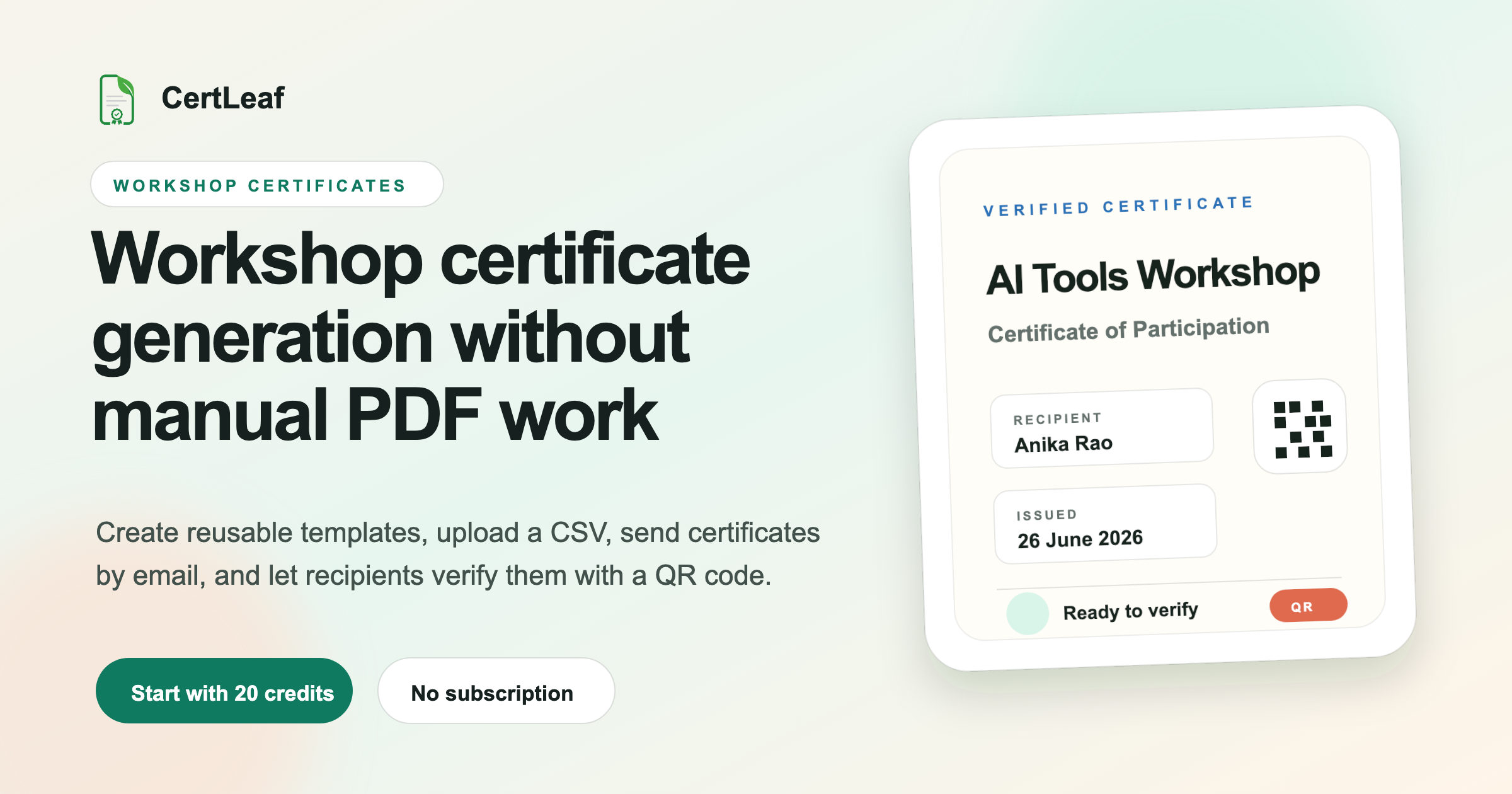
Say a college department runs a one-day AI tools workshop with 180 registered participants.
The old workflow might look like this:
Download form responses.
Clean participant names.
Open the certificate design.
Replace the name manually.
Export PDF.
Rename the file.
Repeat 180 times.
Attach certificates to emails.
Reply to correction requests.
The CertLeaf workflow is shorter:
Create the certificate template once.
Upload the base certificate design.
Place dynamic fields like recipient name on the canvas.
Add the QR code if the certificates should be verifiable.
Open Bulk Issue.
Upload the participant CSV.
Review imported rows.
Generate certificates in bulk.
Send them by email.
Let recipients verify them with a QR code if needed.
This is not a glamorous feature. It is just the part that saves the organizing team from repetitive work.
Related certificate workflows
Learn how to set workshop certificate eligibility from attendance and feedback before issuing the final batch.
See how to use QR verification for workshop certificates.
You can also check CertLeaf's pay-as-you-go certificate pricing.
FAQ: workshop certificate generation
What is a workshop certificate generator?
A workshop certificate generator is a tool that helps organizers create certificates for workshop participants. A good one should do more than design a certificate. It should help generate certificates in bulk, send them to participants, and keep a record that can be verified later.
Can I generate workshop certificates from a CSV file?
Yes. With CertLeaf, you can upload participant data using a CSV and generate certificates in bulk from a reusable template. This is useful when you have dozens or hundreds of workshop participants.
Can workshop certificates include QR verification?
Yes. CertLeaf supports QR-verifiable certificates. The QR code points to a public proof page where the certificate can be checked.
Can I send workshop certificates by email?
Yes. CertLeaf is built to support email distribution, so organizers do not have to download every certificate and attach files manually.
What details should a workshop certificate include?
A practical workshop certificate should include the participant name, workshop title, date or date range, organizer name, instructor or facilitator name, and signature. If the certificate may be used for college records, professional portfolios, or employer verification, also include duration/hours, a certificate ID, and a QR verification link.
Can I issue certificates for online workshops?
Yes. Online workshop certificates are common. Mention the workshop format if needed, and decide whether certificates go to all registrants or only participants who attended the required duration.
Is a workshop certificate generator different from Canva?
Yes. Canva is mainly useful for designing and editing certificates. A workshop certificate generator is useful when you need to issue certificates in bulk, use CSV data, email certificates, and add verification.
Is CertLeaf free for workshop certificates?
CertLeaf gives new issuers 20 free credits to test the workflow. After that, it uses pay-as-you-go credit packs. Simple certificates use 1 credit, and QR-verifiable certificates use 2 credits.
Try CertLeaf for your next workshop
If you are issuing certificates after a workshop, do not build a manual process around copy-paste, PDF exports, and individual emails.
Create the template once. Upload the participant list. Generate the certificates in bulk. Add QR verification when you need proof. Send the certificates out.
CertLeaf gives every new issuer 20 free credits, so you can test the workflow before buying a pack.