CertLeaf
How to Issue Workshop Certificates Based on Attendance and Feedback
A practical way to reconcile registration, attendance, and feedback records before issuing workshop certificates in bulk.

At 7:40 pm, the coordinator of a Saturday digital marketing workshop in Pune was looking at three numbers that refused to agree.
There were 186 registrations, 143 names in the attendance export, and 129 feedback responses. The workshop had ended an hour earlier. The speaker was on the way to the railway station, the classroom team was stacking chairs, and participants had already started asking for certificates in the WhatsApp group.
One attendee had registered with her college email, joined from a personal account, and submitted feedback with the college address again. Another appeared in the attendance file as Rohan - mobile. Three people completed the feedback form even though nobody could find them in the session record. A student who had stayed for the full workshop left before the feedback QR code appeared on screen.
This is where workshop certificates based on attendance and feedback become a judgment call, not a mail-merge task. The team needs a rule it can explain, a way to match imperfect records, and one approved list before any certificate batch is generated.
| Record | What it tells you | What it cannot prove alone |
|---|---|---|
| Registration form | Who intended to attend | That the person actually joined |
| Attendance export or sign-in | Who was present | The participant's preferred certificate name |
| Feedback form | Who submitted a response | Full attendance, especially if the link was shared |
| WhatsApp or email corrections | Alternate emails and name fixes | Eligibility without checking the main records |
For the Pune workshop, I would not issue from any one of these files. I would match them, review the uncertain rows, and export a separate certificate CSV containing only approved recipients.
Decide the workshop certificate eligibility rule first
The worst time to invent a certificate rule is after participants have completed the workshop.
If the event page promised a certificate to everyone who attended, feedback should not suddenly become a hidden requirement. If the registration page clearly said that participants must attend the session and submit the feedback form, then both conditions can be checked. The important part is that the rule was stated before people made decisions around it.
A usable rule might say:
> A participation certificate will be issued to registered participants who attend at least 75 percent of the workshop and submit the feedback form by 8 pm on 15 August 2026.
That sentence identifies the attendance threshold, feedback requirement, and deadline. It also leaves less room for the coordinator to make different decisions for similar cases.
I would keep the rule simpler for a two-hour college seminar. Registration plus confirmed attendance may be enough. For a practical workshop with limited seats, an institute may reasonably require attendance for the main exercise as well. The certificate wording should match the evidence: "participated in" is safer than "successfully completed" when there was no assessment.
Do not use feedback as a convenient substitute for attendance. A shared feedback link can reach people who left early or never joined. It is useful evidence, but it is not automatically a roll call.
Reconcile registration, attendance, and feedback
Start with the registration sheet because it usually has the cleanest name and email pair. Add attendance and feedback status to the same working row rather than keeping three tabs open and comparing them by eye.
Email is normally the best first match key. It still needs an exception pass. Participants switch between college and personal accounts. Video platforms capture display names such as Dr Mehta, iPhone, or a parent's name. In an offline workshop, a handwritten sign-in sheet may have no email at all.
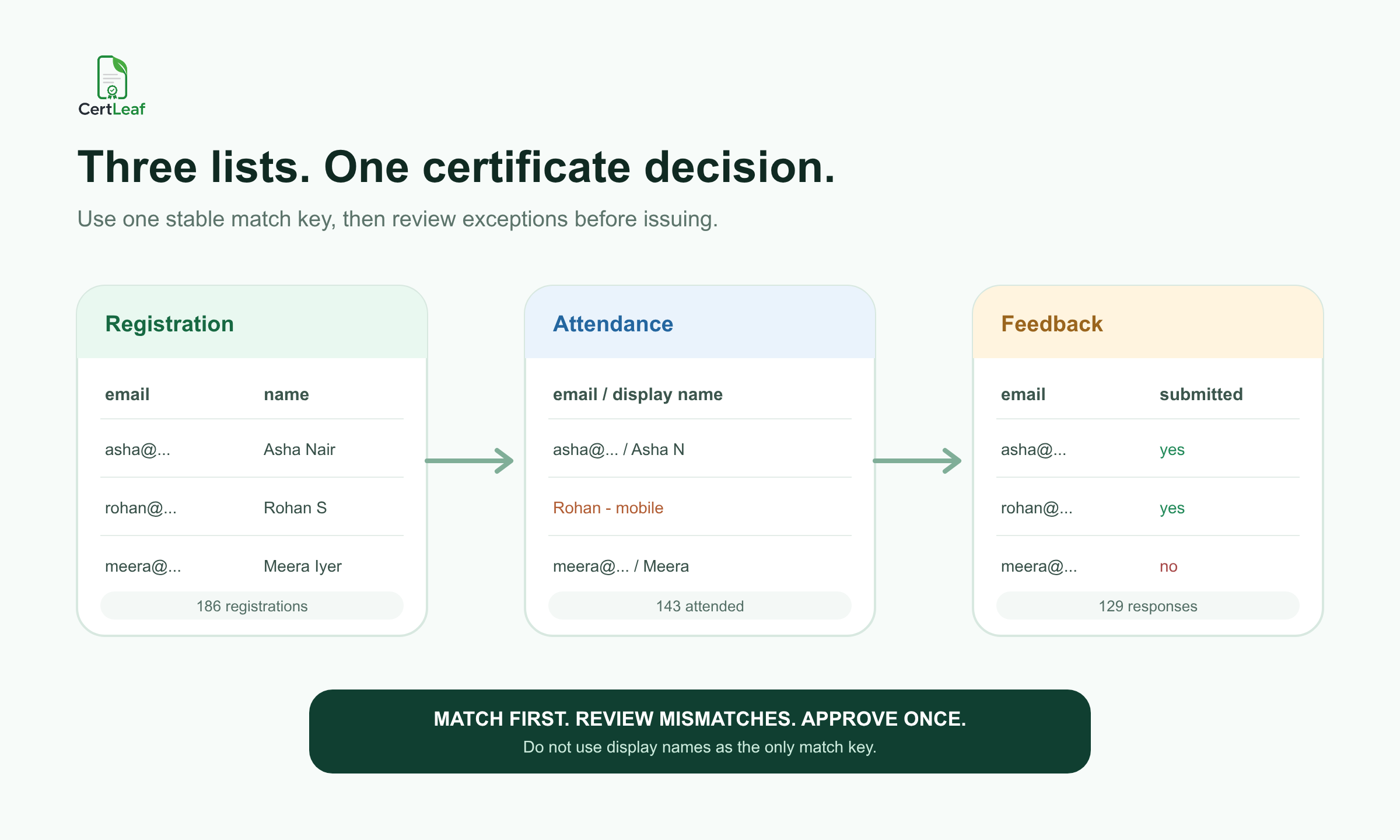
At the Pune event, Asha Nair matched cleanly by email across all three sources. Rohan's registration and feedback email matched, but the attendance record only said Rohan - mobile. The coordinator checked the join time and phone number before treating it as the same person. Meera appeared in registration and attendance but missed the feedback deadline.
Those rows should not be resolved through guesses or a complicated spreadsheet formula. Mark them for review. Keep the original values visible, add the confirmed match, and note who approved the decision.
The working sheet might include registered_email, attendance_identity, minutes_attended, feedback_email, name_for_certificate, eligibility, and review_note. Only the final name, delivery email, and certificate fields need to move into the issuing CSV.
Treat mismatches as a short exception queue
Most workshop rows will be obvious. The coordinator's time is better spent on the 10 or 15 exceptions than on manually rechecking every clean match.
The common exceptions are familiar: an alternate email, a shortened display name, one shared device, a duplicate feedback response, or a name correction sent after the form closed. Review those against another stable detail such as phone number, student ID, join time, or the organizer's sign-in record.
At a faculty tools session in Kochi, two lecturers joined from one laptop in a department room. The attendance export showed one display name, but the in-room coordinator confirmed both people on the signed sheet. That exception was reasonable because there was supporting evidence. It would have been harder to defend if the only proof was a message saying, "I was there."
Record the outcome in plain language: approved - college email matched registration and phone confirmed is more useful than a green fill color with no explanation.
Apply one explainable eligibility check
Once the records are matched, the actual decision should be boring. Each row follows the same rule.
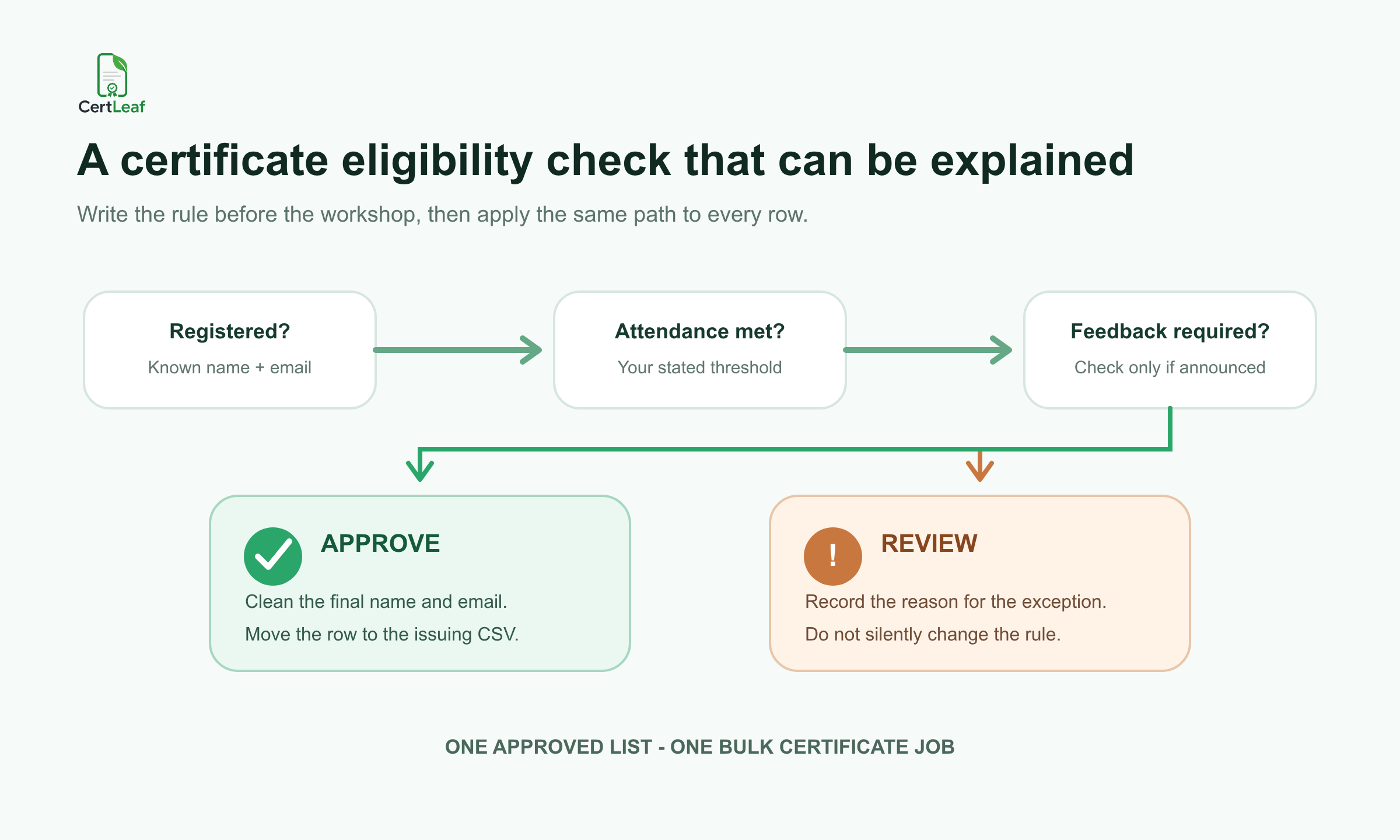
A participant who registered, met the attendance threshold, and completed an announced feedback requirement goes to the approved list. A row with an identity mismatch or missing evidence goes to review. A person who did not meet the published rule does not enter the first certificate batch.
There is one important exception: if feedback was never announced as a certificate condition, do not withhold a certificate only because the form is blank. Use the feedback data for event learning, not as a retroactive gate.
For borderline cases, ask the person who owns the workshop policy. The certificate operator should not quietly lower a 75 percent attendance rule because a senior participant complains, or reject a genuine attendee because the video platform recorded a strange display name. Approval and evidence belong together.
Create a clean certificate CSV after approval
The reconciliation sheet is an internal working file. It may contain attendance minutes, phone numbers, duplicate checks, notes, and reasons for rejection. Do not upload that entire sheet into a bulk certificate tool.
Export a smaller file containing only approved recipients and the fields needed on the certificate. For example:
full_name,email,workshop_title,workshop_date,certificate_type
Give the file a name that records what it is, such as pune-digital-marketing-workshop-approved-2026-08-15.csv. Keep the approved count in the handoff message. If the coordinator says 132 people were approved but the CSV contains 133 rows, stop and find the difference before issuing.
Check duplicates again after export. The same participant may have registered twice with two email addresses. Also scan the longest names and workshop titles because a clean CSV can still produce a bad certificate layout.
I test at least four rows: the longest name, a name with initials, the longest organization or college name, and one ordinary record. That small preview catches text touching signatures, awkward line breaks, and date formatting mistakes before they are repeated across the batch.
Where CertLeaf fits after the list is approved
CertLeaf handles the issuing work after the organizer has settled eligibility. Upload the approved recipient CSV, use a reusable certificate template, generate the certificates in bulk, and distribute them by email. A QR-verifiable certificate can also give colleges, employers, or event partners a public verification path when the recipient shares the PDF later.
That boundary is useful. CertLeaf should not decide whether Rohan attended enough of the Pune workshop or whether Meera's late feedback counts. The event team owns those decisions. The platform handles the repetitive part once the team provides an approved list.
For college departments and training institutes that run workshops in bursts, pay-as-you-go credits mean there is no subscription to maintain between events. New accounts receive 20 free credits, which is enough to test the workflow with a small batch before committing the full recipient list.
Send one test certificate to the organizing team. Open the email, download the PDF, scan the QR code if used, and confirm that the verification details match. Then issue the approved batch.
Keep late approvals out of the original batch
After the first send, somebody will usually produce a screenshot, an alternate email, or a feedback submission that needs review. Keep those requests in a small correction log rather than changing the original CSV and issuing the whole batch again.
Record the participant, missing condition, evidence received, decision, approver, and issue date. Approved late cases can go into a supplementary batch. This preserves the original issue record and avoids duplicate certificates for everyone else.
At the Pune workshop, four rows remained open on Saturday night. Two were approved on Monday after the attendance host confirmed alternate accounts. One participant had registered but joined for only 18 minutes. One had submitted feedback from a forwarded link without attending. The final numbers made sense because each exception had a reason attached to it.
Related certificate workflows
After confirming eligibility, generate and send the approved workshop certificate batch.
Before upload, prepare the final certificate recipient CSV.
FAQ about workshop certificates based on attendance and feedback
Can I issue workshop certificates after a feedback form is submitted?
Yes, if feedback submission was clearly stated as part of the certificate eligibility rule. Match the feedback response with registration and attendance records before approving the participant. A feedback response alone does not prove attendance.
How do I match workshop attendance with registration for certificates?
Use email as the first match key, then review alternate emails, shortened names, shared devices, and manual sign-in records. Keep uncertain rows in an exception queue and document the evidence used to approve them.
Should feedback be mandatory for a participation certificate?
It can be mandatory when organizers announce the condition before or during registration. It should not become a hidden requirement after the workshop. If it was not announced, attendance should generally be checked separately from feedback completion.
What columns should be in a workshop certificate CSV?
A practical issuing CSV can include the recipient's full name, email, workshop title, workshop date, and certificate type. Keep internal attendance calculations, phone numbers, and exception notes in the working sheet rather than the issuing file.
Can workshop certificates be generated and emailed in bulk?
Yes. Once the eligible participant list is approved, a bulk certificate platform can map CSV fields into a reusable template and email the generated certificates. CertLeaf supports bulk CSV issuing, email distribution, and optional QR verification.
Are QR-verifiable workshop certificates useful?
They are useful when recipients may share certificates with colleges, employers, clients, or professional bodies. The QR code provides a direct verification route instead of asking the workshop organizer to confirm each PDF by email.
What should I do when a participant used different email addresses?
Compare another stable detail such as phone number, student ID, join time, or organizer records. If the identity is confirmed, note the alternate address in the reconciliation sheet and use the recipient's preferred delivery email in the approved CSV.
Approve the list before you touch the template
The Pune coordinator finished with 132 approved recipients, seven reviewed exceptions, and four unresolved rows. The first certificate batch went out from one clean CSV. The two later approvals were issued separately on Monday.
The useful habit was not a clever formula. It was the order of work: state the rule, reconcile the records, explain the exceptions, approve the list, and then issue.
That order keeps a workshop certificate batch from carrying unresolved attendance questions into hundreds of PDFs and emails. Once the approved list is real, bulk issuing can be exactly what it should be: routine.