CertLeaf
Accredible Alternative for Course Certificates: When a Simple Bulk Issuing Tool Is Enough
A fair guide for small course and training teams deciding whether they need a full digital credential platform or a focused tool for bulk certificates, email delivery, and QR verification.
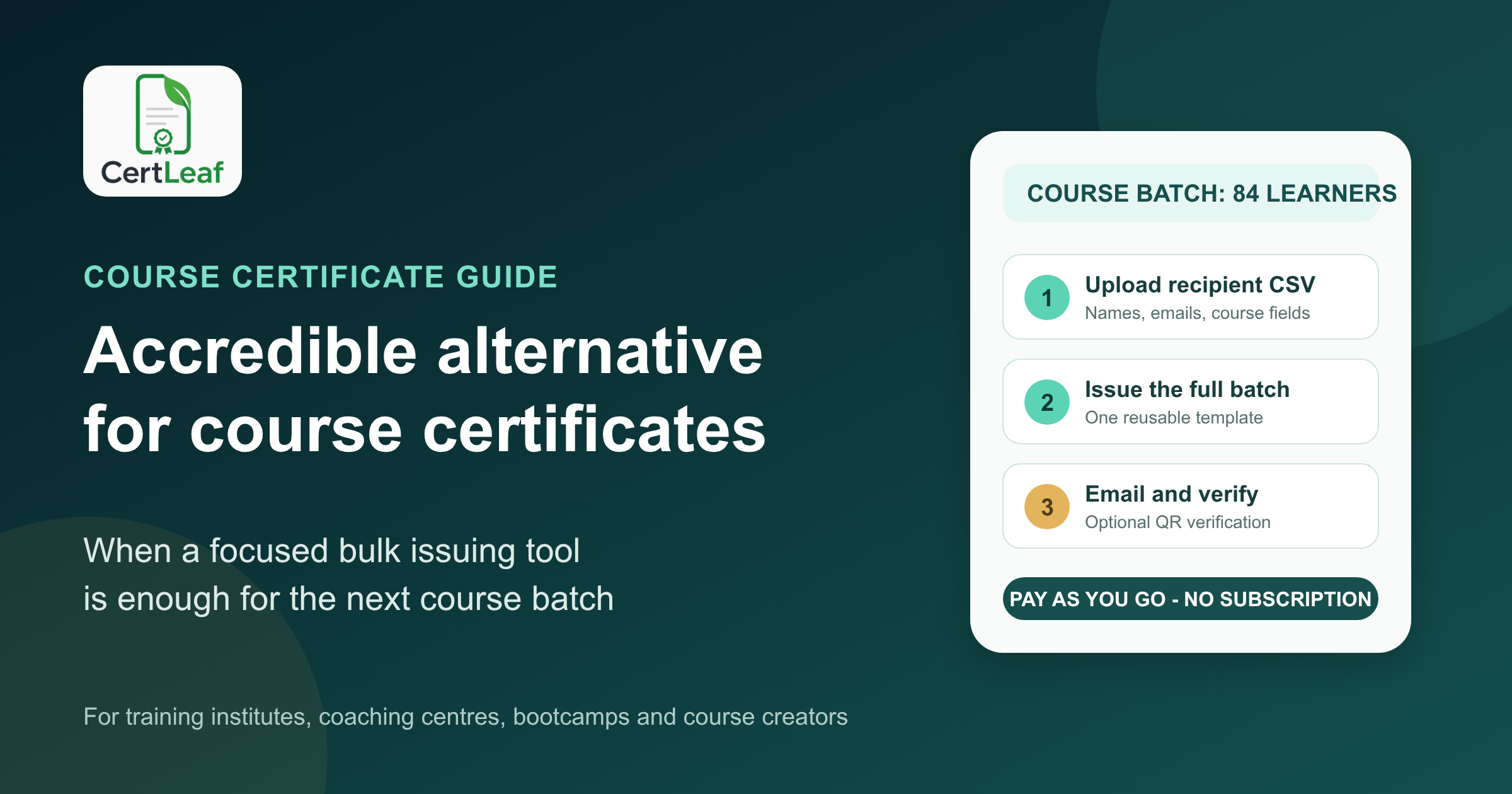
At 7:15 pm, the coordinator of a six-week data analytics course in Indore had 84 approved learners and three tabs open.
One tab showed the final attendance sheet. Another showed a digital credential platform with badges, learning pathways, wallet cards, skills data, analytics, and integrations. The third was the institute's actual certificate checklist: use the approved design, import 84 names and emails, generate the PDFs, send them, and make each certificate easy to verify.
The credential platform was capable. The checklist was much smaller.
That gap is what matters when searching for an Accredible alternative for course certificates. Accredible is built as a broad digital credential platform. Some course businesses need that breadth. A small training institute, coaching centre, bootcamp, course creator, or college program may mainly need to close the next batch cleanly.
This article compares those two buying situations. It does not claim that a focused certificate tool replaces credential pathways, badge ecosystems, compliance programs, deep integrations, or enterprise controls.
| Decision point | Consider a large credential platform | Consider a focused batch tool |
|---|---|---|
| Main outcome | A continuing digital credential program | Correct course certificates sent after each batch |
| Recipient experience | Badges, pathways, wallets, sharing and wider engagement | PDF delivery and optional QR verification |
| Operations | Integrations, analytics and program management | Reusable template, CSV upload and email delivery |
| Budget pattern | Ongoing recipient plan or contract | Pay for certificate credits when a batch is ready |
| Best question | How will credentials support the program? | How do we finish these 84 certificates properly? |
Pricing and product details change. The Accredible references in this comparison come from its official platform, features, and pricing pages reviewed on September 3, 2026. Confirm the current plan and every required feature before buying.
Start with the certificate's job
The Indore course did not award a professional certification with renewals, stackable milestones, or a public skills framework. Learners completed a defined short course. They needed a completion certificate carrying the learner name, course title, batch period, issuer, and completion date.
A few learners would add the PDF to a job application. That made verification useful. It did not automatically make a full credential program necessary.
I would write the required outcome in one sentence before comparing products:
> Issue the approved course completion certificate to every eligible learner, deliver it to the right email address, and let an outside reviewer verify it later.
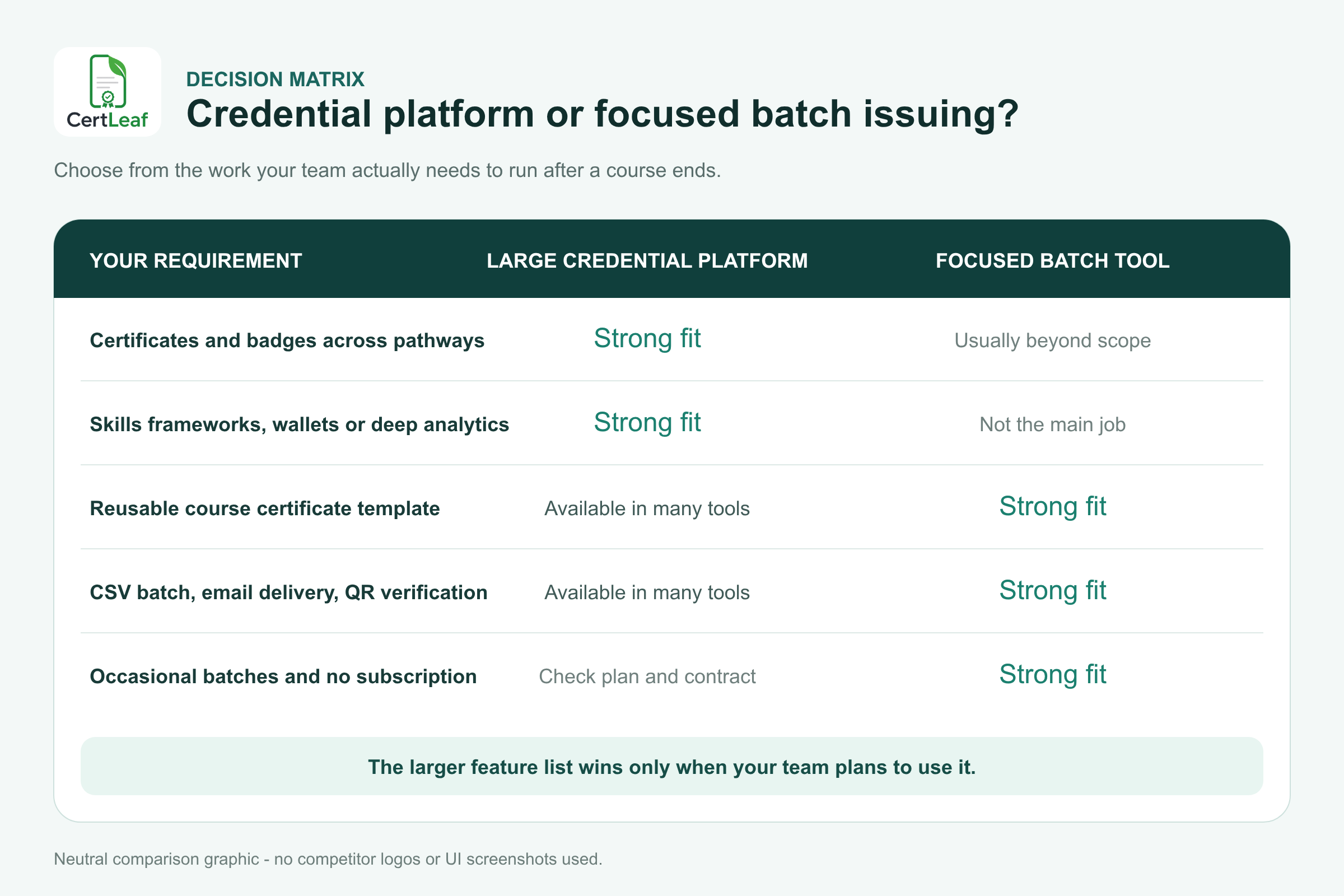
If the sentence expands to include digital badges, skills metadata, learning pathways, renewals, wallet cards, campaign analytics, SSO, multiple departments, or LMS-triggered issuing, evaluate a wider credential platform. Those are real requirements, not clutter, when the program depends on them.
What Accredible is built to do
Accredible's official pages position it as a digital credential platform, not merely a PDF certificate generator. Its published feature set includes digital certificates and badges, verification, skills frameworks, pathways, digital wallets, sharing, integrations and API options, credential and email analytics, expiration, dynamic updates, and broader program-growth tools. Availability can depend on the plan.
Its pricing page currently says plans are based on unique recipients rather than the number of credentials. The Launch offer shown during this review started at USD 45 per month on a 12-month term billed monthly and included 50 recipients, with unlimited credentials for each recipient. Custom plans add broader branding, reporting, support, pathways, wallet cards, and other options.
That model can be sensible for a course provider that wants each learner to collect several credentials over a year. If one person completes a foundation course, an advanced course, and a specialization, recipient-based pricing and pathways may line up with the program.
It is also a different commitment from buying only what is needed for an occasional certificate batch.
The fair conclusion is not that Accredible has "too many features." The conclusion is that those features should solve work your team genuinely owns. If nobody is responsible for credential pathways, campaign analytics, skills frameworks, or integrations, paying for a credential strategy will not create one.
What a small course team often needs instead
The certificate checklist at a small institute is usually operational.
First, approve the learner list. Then reuse the certificate design, map the changing fields, preview the awkward names, issue the full batch, and send the correct certificate to each learner. Add QR verification when a recruiter, college, partner, or employer may need to check the record.
CertLeaf is built around that narrower flow. It supports reusable templates, bulk CSV issuing, certificate email delivery, and QR-verifiable certificates. It does not position itself as a replacement for advanced credential networks, badge pathways, enterprise compliance programs, or a full LMS.
For teams already working from spreadsheets, the course completion certificate workflow for training institutes shows the operating detail from approved list to delivery. The software handles repetition. The institute still decides who completed the course and what the certificate should say.
The CSV is where the batch becomes real
At the Indore institute, the first export contained 87 rows. Two learners had registered with both personal and college email addresses. One learner had left the course after week two. The final eligible count was 84.
No certificate platform should guess which three rows to remove.
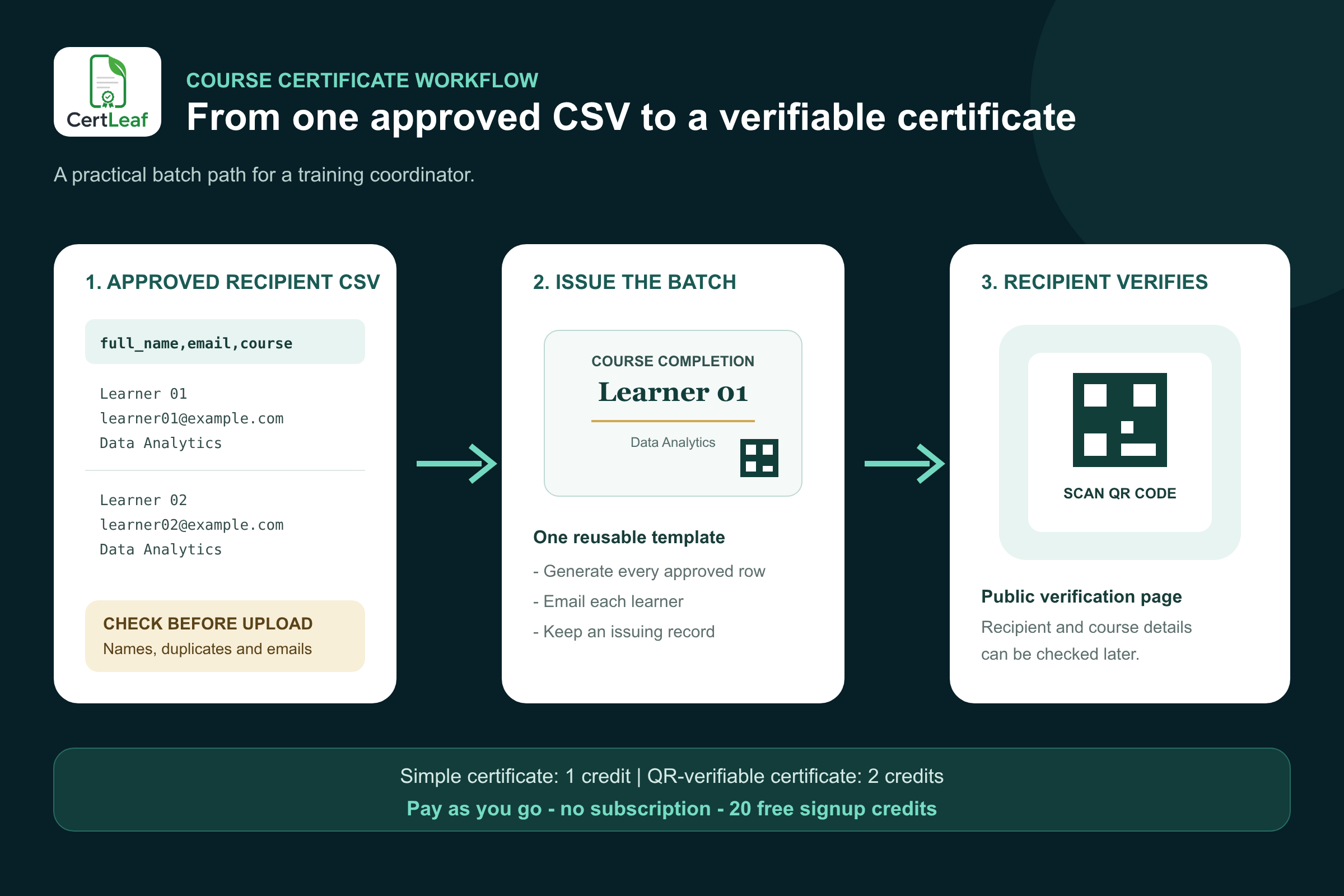
The issuing file only needed fields that affected the certificate or delivery:
full_name,email,course_name,batch_period,completion_date
A coordinator checked duplicates, confirmed the preferred certificate names, and tested the longest name against the template. That ten-minute review mattered more than comparing twenty feature boxes.
If your source file is still called final_batch_v4_revised.xlsx, use the certificate recipient CSV preparation guide before uploading it anywhere. A faster issuing tool will apply clean data consistently, but it will also apply a wrong email consistently.
QR verification without turning the course into a credential ecosystem
A course completion PDF may travel far beyond the institute's inbox. Learners send it to recruiters, upload it to application portals, and share it with colleges or clients.
A QR-verifiable certificate gives the reviewer a direct route to a public verification page. The useful part is the matching record behind the QR code. A square graphic that only opens the institute homepage does not answer whether this learner received this certificate.
That focused verification path can be enough for many short courses. Teams that need skills evidence, endorsements, credential wallets, stackable badges, or portable career records should evaluate a broader digital credential platform. Teams that need a certificate-specific public check can keep the workflow smaller.
Before sending a full batch, I would scan certificates from the exported PDFs, not just the template preview. Check that different learners open different matching records. The guide to QR-verifiable training certificates with unique certificate IDs covers that test in more detail.
Compare the budget model, not one headline price
Accredible's published pricing uses unique recipients and term-based plans. CertLeaf uses pay-as-you-go credits with no subscription. These models answer different issuing calendars.
A provider running continuous programs may prefer a standing credential platform. A coaching centre with four admission cycles, or a college department with two certificate batches each semester, may prefer buying credits only when a batch is approved.
In CertLeaf, a simple certificate uses 1 credit and a QR-verifiable certificate uses 2 credits. New accounts receive 20 free signup credits. India-first customers can buy credits in INR through Razorpay.
For the 84-learner Indore batch, the coordinator could test several rows with the free credits, then choose simple or QR-verifiable certificates based on how the learners would use them. There is no need to keep a subscription active between cohorts.
Do not compare price in isolation. Write down the annual learner count, number of credentials per learner, quiet months, verification needs, currency, taxes, procurement process, and the wider features the team will actually use. Then compare current quotes or checkout totals.
When to consider a large credential platform
Consider Accredible or another broad credential platform when credentials are part of the course product, not only the completion paperwork.
That may be the case when learners earn several badges across a pathway, credentials carry structured skills and evidence, expiry and renewals matter, recipients need wallet or transcript experiences, issuing must connect deeply with an LMS, or program teams need engagement and pathway analytics. Larger organizations may also require formal security reviews, SSO, custom agreements, white-labeling, dedicated support, and multi-team controls.
CertLeaf does not claim to replace those capabilities. If they are central to the program, include them in the evaluation and test the exact plan that provides them.
When CertLeaf is enough
CertLeaf may be enough when the practical requirement is shorter:
Use an approved certificate design again for the next cohort.
Upload a clean learner CSV instead of typing names one by one.
Generate a course batch and email each certificate.
Add a public QR verification route when the certificate will be checked outside the course.
Pay for the batch without taking on a subscription.
Buy in INR through Razorpay when that fits the institute's approval process.
This is the likely fit for a small training institute, coaching centre, bootcamp team, independent course creator, or college program issuing completion certificates at batch scale.
I would still run a five-recipient test. Use the longest learner name, a name with initials, the longest course title, one corrected email, and one ordinary row. Open every email. Read every PDF. Scan every QR code. The right product is the one your actual coordinator can operate without inventing a second process around it.
FAQ about choosing an Accredible alternative for course certificates
Is CertLeaf an Accredible alternative?
CertLeaf is a practical Accredible alternative for teams that mainly need reusable course certificate templates, bulk CSV issuing, email delivery, QR verification, and pay-as-you-go pricing. It is not a replacement for every advanced credential, badge, pathway, compliance, integration, analytics, or enterprise feature available in broader platforms.
Which tool is better for a small training institute?
Choose from the institute's real workflow. If the team issues completion certificates in occasional batches and does not want a subscription, CertLeaf may be the simpler fit. If the institute is building an ongoing digital credential program with badges, pathways, skills frameworks, deeper analytics, integrations, or learner wallets, evaluate Accredible and similar platforms.
Can CertLeaf issue course certificates from a CSV?
Yes. CertLeaf supports bulk CSV certificate issuing. The CSV can carry learner names, email addresses, course details, dates, and other fields used by the template. Review duplicate rows and test long names before processing the full batch.
Can course certificates be emailed to learners?
Yes. Email delivery is part of the CertLeaf issuing workflow, so the team does not need to attach each PDF manually. Test one internal delivery before emailing the full learner list.
Do all course completion certificates need QR verification?
No. A simple certificate may be enough for an internal or low-stakes course. QR verification is more useful when learners will show the certificate to employers, clients, colleges, or partners who need a direct way to check it.
Does CertLeaf require a subscription?
No. CertLeaf uses pay-as-you-go credits. Simple certificates use 1 credit, QR-verifiable certificates use 2 credits, and new accounts receive 20 free signup credits.
What should I test before choosing certificate software?
Use one real course template and five difficult learner rows. Test CSV mapping, long names, email delivery, PDF quality, QR verification, correction handling, and the steps required from the person who will run the next batch.
Choose the operating model you can explain later
The Indore coordinator did not need the tool with the shortest feature list or the longest one. She needed the tool that matched the institute's next twelve months.
If credentials are meant to become a learner network, a marketing channel, a skills record, or a structured journey across several programs, consider the larger platform seriously.
If the job is to issue 84 accurate course certificates, send them, and let someone verify them later, keep the system focused. A reusable template, one approved CSV, email delivery, QR verification, and pay-as-you-go credits may be enough.
Start a small CertLeaf test with 20 free credits
Sources checked for this comparison
Accredible pricing, reviewed September 3, 2026.
Accredible platform overview, reviewed September 3, 2026.
Accredible feature overview, reviewed September 3, 2026.