CertLeaf
Beauty Training Certificate Generator for Academies and Salon Trainers
Issue beauty course, salon training, and makeup workshop certificates in bulk with reusable templates, email delivery, QR verification, and no subscription.
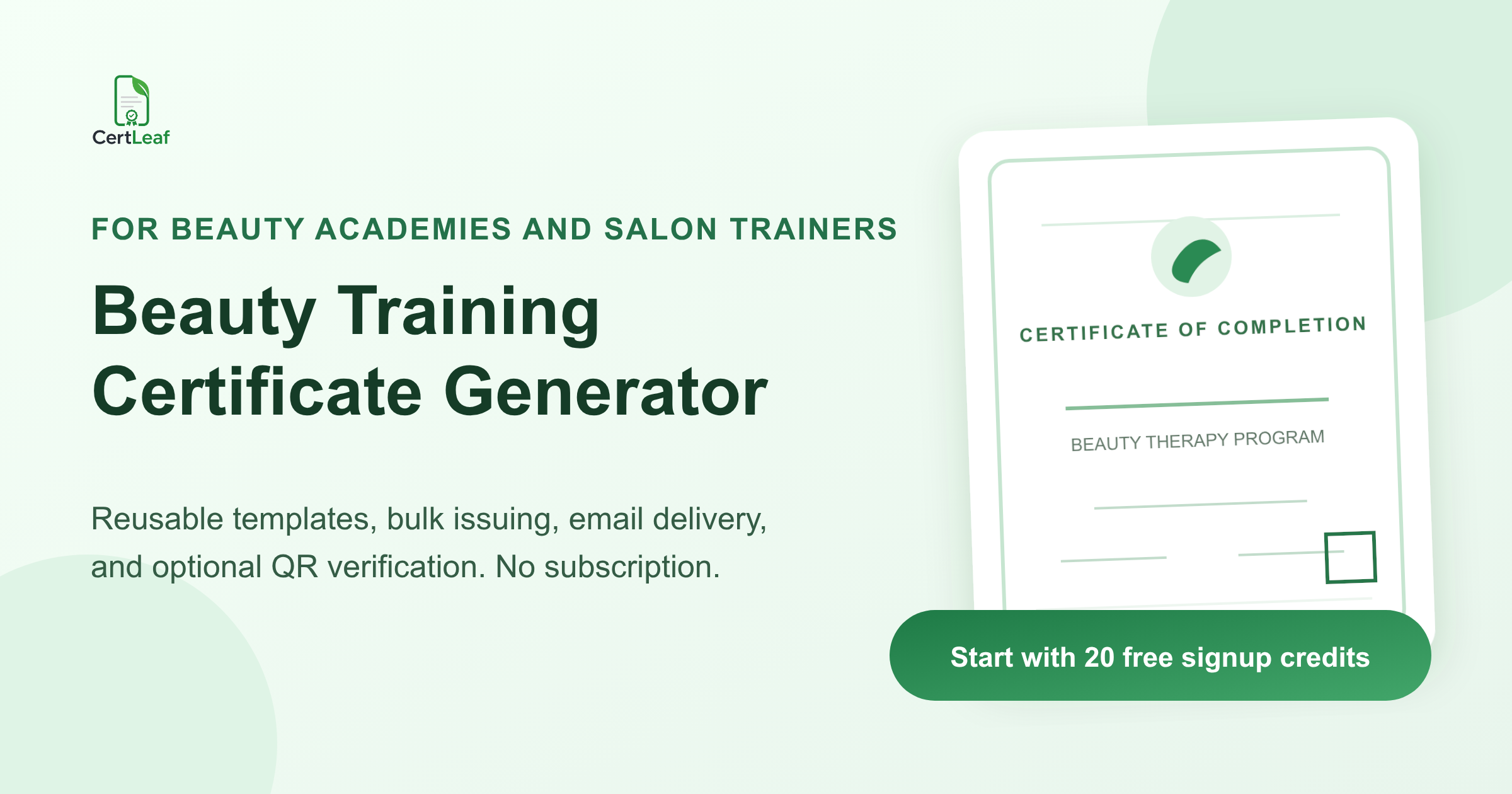
Beauty academies need a certificate platform that can keep pace with the range of programs they teach. A 120-hour beauty therapy course, a two-day professional makeup masterclass, a nail art module, and a guest trainer session should not all produce the same vague certificate.
CertLeaf gives beauty academies, salon educators, independent trainers, and vocational institutes a focused way to issue the right certificate for each program. Create reusable templates, personalize a complete batch from an approved CSV, email each certificate to the correct learner, and add QR verification when the record may be shown to a salon, employer, client, or another training provider.
The model is pay-as-you-go, with no subscription to keep active between cohorts. New accounts receive 20 free signup credits, so an academy can test the layout and delivery process before issuing a full group.
CertLeaf handles certificate issuing and verification. The academy still owns the course, practical assessment, completion decision, and any claim about accreditation or professional status.
Why beauty academies need more than a certificate design tool
Beauty and wellness training covers a wide set of job roles and course formats. Current Indian sector material includes beauty therapist, makeup artist, hair stylist, nail technician, spa therapist, cosmetologist, and salon management pathways. Short workshops and independent academy programs add even more variation.
That variety creates a practical issuing problem. The academy may need:
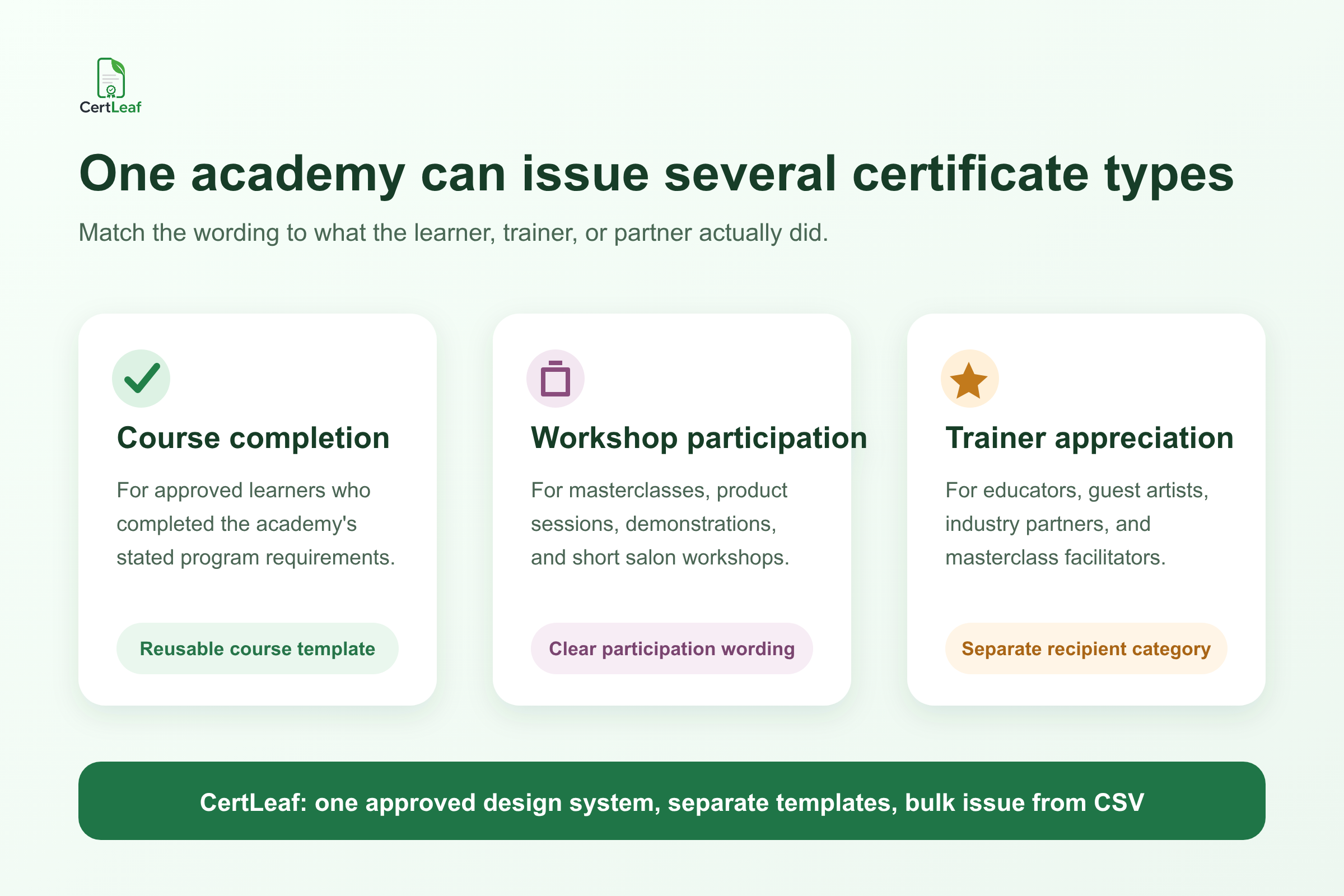
Course completion certificates for learners who met the stated program requirements.
Module certificates for nail care, hair styling, makeup, skin services, or salon hygiene.
Participation certificates for demonstrations, product sessions, and masterclasses.
Appreciation certificates for guest artists, educators, assessors, and industry partners.
Separate certificate wording for trainers or facilitators.
A design tool can make one attractive PDF. A beauty training certificate generator also needs to connect learner data, certificate type, batch issuing, email delivery, and verification. That is the part CertLeaf is built to handle.
Match the certificate to the program that was delivered
The certificate title should say exactly what the recipient completed or contributed to. "Certificate of Completion in Beauty Therapy Foundation" is clearer than "Professional Beauty Certificate." "Certificate of Participation in Bridal Makeup Masterclass" is honest for a short session that did not assess a complete occupational program.
Useful certificate titles may include:
Beauty Therapy Course Completion Certificate
Professional Makeup Workshop Participation Certificate
Nail Art and Salon Hygiene Module Certificate
Hair Styling Practical Training Certificate
Certificate of Appreciation for Guest Makeup Educator
Salon Skills Trainer Certificate of Appreciation
Avoid language such as "licensed beautician," "government certified," "accredited professional," or "job guaranteed" unless the issuing organization is authorized to make that exact claim. A polished certificate and a QR code do not create accreditation. CertLeaf records and verifies what the academy chose to issue; it does not approve the training program or license the learner.
This is also why one generic template rarely works well. The visual identity can stay consistent, but completion, participation, and appreciation certificates should have separate fixed wording. The guide to building a reusable training certificate template is a useful next step when the academy wants one design system across several course types.
Running a beauty course or salon workshop? Sign up for CertLeaf and use the 20 free signup credits to test the certificate wording, longest learner name, and email delivery before issuing the complete batch.
Build templates that survive real beauty course names
A template approved with a short sample may break when the actual data arrives. "Makeup Basics" fits almost anywhere. "Professional Bridal, Fashion and Portfolio Makeup Program" needs more room. The same is true for learner names, academy branches, trainer designations, and course dates.
In CertLeaf, the academy uploads its approved base design and places dynamic fields where learner and course information should appear. The template can then be reused for later cohorts while the CSV supplies the changing values.
A practical beauty academy certificate may include:
learner or recipient name
course, module, or workshop title
completion or participation date
training hours, when the academy records and approves them
academy, salon, or training provider name
trainer or authorized signatory
batch code or certificate ID
QR code for verification, when selected
Keep the design selective. A working learner record may contain attendance, practical scores, model-work notes, product lists, phone numbers, and trainer comments. Those details do not all belong on the certificate. Use only the fields that help explain or verify the issued record.
Test the longest values before saving the template. One long learner name, one long course title, one branch name, and one date range usually reveal the layout problems that ordinary sample rows hide.
Use a certificate-ready CSV instead of the full learner workbook
The learner workbook may be useful to trainers and administrators, but it is usually too broad for certificate issuing. Create a smaller export containing only approved recipients and the fields required for personalization and delivery.
A useful header can look like this:
learner_name,email,course_name,training_hours,completion_date,certificate_type
Use one row per certificate. If the same person receives a course completion certificate and a separate appreciation certificate, treat them as two deliberate records with the correct template and wording.
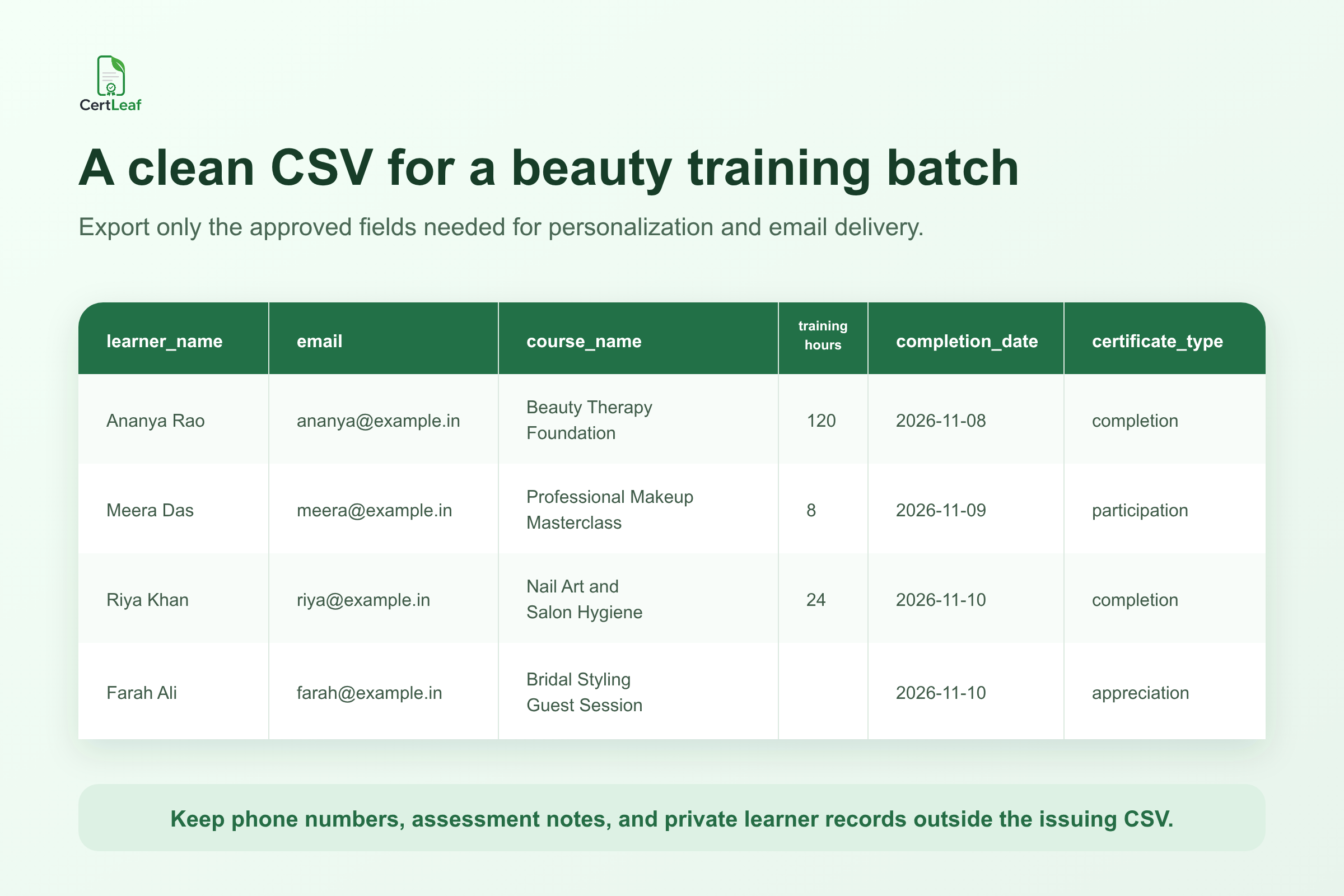
Before uploading the file, confirm:
The learner name is in the form the recipient expects on the certificate.
The email belongs to the right learner.
The course title matches the approved program name.
Training hours are supported by the academy's records.
Completion and participation rows are not mixed under one template.
Duplicate rows and blank email addresses have been resolved.
CertLeaf uses the approved CSV as the issuing source. It does not calculate attendance, practical scores, or course completion. Those decisions should already be settled by the academy before the export is created.
Email each certificate without opening every PDF
A batch is not finished when the PDFs exist. Learners still need to receive the correct files.
Manual delivery is manageable for six people. For a cohort of 80, it creates repeated work and avoidable mistakes: the wrong attachment, a skipped learner, an old email address, or no record of what was sent. CertLeaf can use the email field in the approved CSV to deliver each generated certificate to the matching recipient.
Send a small internal test first. Include the longest name, the longest course title, a blank optional field, and one ordinary learner. Check the PDF, recipient email, spelling, and certificate type. If the academy is issuing QR-verifiable certificates, scan the code from the exported PDF as part of the same test.
For teams planning the delivery message and follow-up process, the guide to sending certificates by email automatically covers the broader bulk email task.
Want to test a real salon training batch? Try CertLeaf with 20 free signup credits, send a few certificates to internal addresses, and review the complete learner experience before using paid credits for the cohort.
Add QR verification when the certificate will be checked later
Beauty course certificates can travel beyond the academy. Learners may show them to salons, employers, clients, partner institutes, or future educators. A QR-verifiable certificate gives the reviewer a public route to the issued record instead of asking them to judge a PDF by appearance alone.
The verification record should match the certificate: recipient name, program, issuer, date, and certificate ID or batch detail where used. It should not expose the learner's phone number, private assessment notes, practical evidence, or attendance workbook.
QR verification confirms that the issuer created the certificate record. It does not prove that the course is government-recognized, guarantee the learner's competence, or replace an employer's own skills assessment.
Academies that want a stable reference for corrections and later checks can follow the guide to QR-verifiable training certificates with unique certificate IDs. A readable ID also helps when a learner requests a name correction months after the original batch.
Why pay-as-you-go fits beauty training calendars
Many beauty educators issue in batches rather than every week. An academy may finish a foundation cohort this month, run two short masterclasses next month, and pause during the next intake period. An independent trainer may issue certificates after selected salon workshops rather than maintain a continuous credential operation.
CertLeaf uses credits instead of a monthly subscription. A simple certificate uses 1 credit, while a QR-verifiable certificate uses 2 credits. New users receive 20 free signup credits. India-first customers can purchase credits in INR through Razorpay when the next approved batch is ready.
This keeps the certificate cost connected to real courses and workshops. The academy can save its templates, return with a new approved CSV, and issue the next cohort without paying for idle months.
Beauty training certificate generator FAQ
Can CertLeaf issue beauty course certificates in bulk?
Yes. A beauty academy can upload an approved certificate design, create a reusable template, prepare a certificate-ready learner CSV, and issue the batch with CertLeaf. Certificates can also be emailed to recipients.
Can I create certificates for makeup and nail art workshops?
Yes. Use certificate wording that matches the program. A short makeup masterclass may need a participation certificate, while a structured nail technician course may use completion wording after the academy approves the learner's result.
Can beauty training certificates include course hours?
Yes, when the training hours are defined by the course and supported by the academy's records. Do not add hours only because they make the certificate look more substantial.
Does CertLeaf accredit beauty courses or license beauticians?
No. CertLeaf is software for issuing, emailing, verifying, and managing digital certificates. The academy or training provider owns the course, assessment, completion criteria, and any accreditation claim.
What should be in the beauty academy certificate CSV?
Typical fields include learner name, email, course name, training hours, completion date, certificate type, and batch code. Export only the approved fields needed for certificate personalization and delivery.
Should every beauty course certificate have a QR code?
No. Use QR-verifiable certificates when learners or third parties are likely to need a public verification route. CertLeaf also supports simple certificates for lower-stakes or internal use cases.
Is there a monthly subscription?
No. CertLeaf uses pay-as-you-go credits. New accounts receive 20 free signup credits, and Indian customers can purchase credits in INR through Razorpay.
Start with one beauty training batch
Choose one course or workshop. Approve the certificate wording, create the template, export only the required learner fields, and test the awkward rows. Then use CertLeaf to issue, email, and optionally verify the certificates without turning each cohort into a manual PDF project.
The first batch should prove the process. The next one should reuse it.