CertLeaf
EV Training Certificate Generator for Skill Centres and Academies
Issue provider-approved EV course, module, and workshop certificates in bulk with reusable templates, CSV upload, email delivery, optional QR verification, and no subscription.
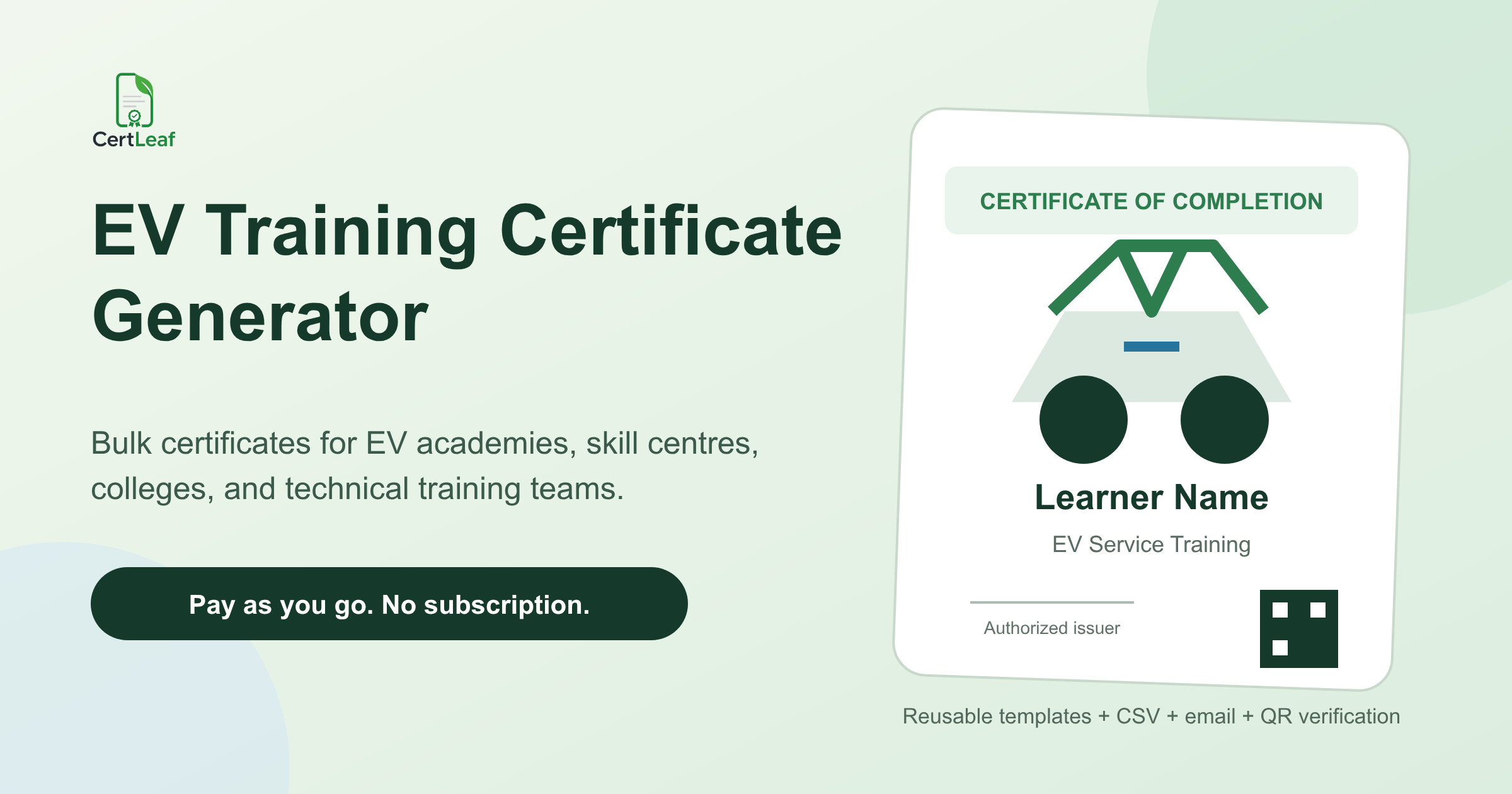
EV academies and skill centres need a certificate platform that can keep pace with technical training. One provider may run a 450-hour service technician course. Another may offer a five-day battery diagnostics program. A college might conduct an introductory electric mobility workshop for 120 students. Those programs need different certificate wording, but they can use the same reliable issuing system.
CertLeaf is an EV training certificate generator for providers that already know what they are authorized to issue. Build reusable templates, personalize certificates from an approved learner CSV, send each recipient the matching PDF by email, and add QR verification when the record may be checked later. Credits are pay-as-you-go, so there is no subscription to maintain between cohorts.
The training provider remains responsible for instruction, assessment, completion decisions, and credential wording. CertLeaf does not teach EV servicing, test technical competence, accredit a course, grant NSQF status, or replace an awarding body. It handles the issuing, delivery, verification, and record layer around the provider's approved certificate.
Who needs an EV training certificate generator?
The segment is wider than a dedicated automotive academy. Useful buyers include:
skill centres running electric vehicle service technician programs
private EV academies teaching batteries, charging, diagnostics, or maintenance
ITIs, polytechnics, and engineering colleges offering EV modules
automotive service groups training workshop or dealership teams
equipment and charging companies conducting operator training
college clubs and departments running electric mobility bootcamps
industry partners supporting short technical upskilling programs
What these teams share is repeat issuing. They may have 18 learners in an advanced lab cohort, 60 technicians across branches, or 200 students in a campus program. Editing and emailing every certificate separately gives the administration team unnecessary work and makes corrections harder to track.
Match the certificate to the EV program
An EV certificate should say what the provider can honestly confirm. Participation in a two-hour awareness session is not the same as completing an assessed service technician course. Finishing a battery safety module is not automatically a professional qualification.
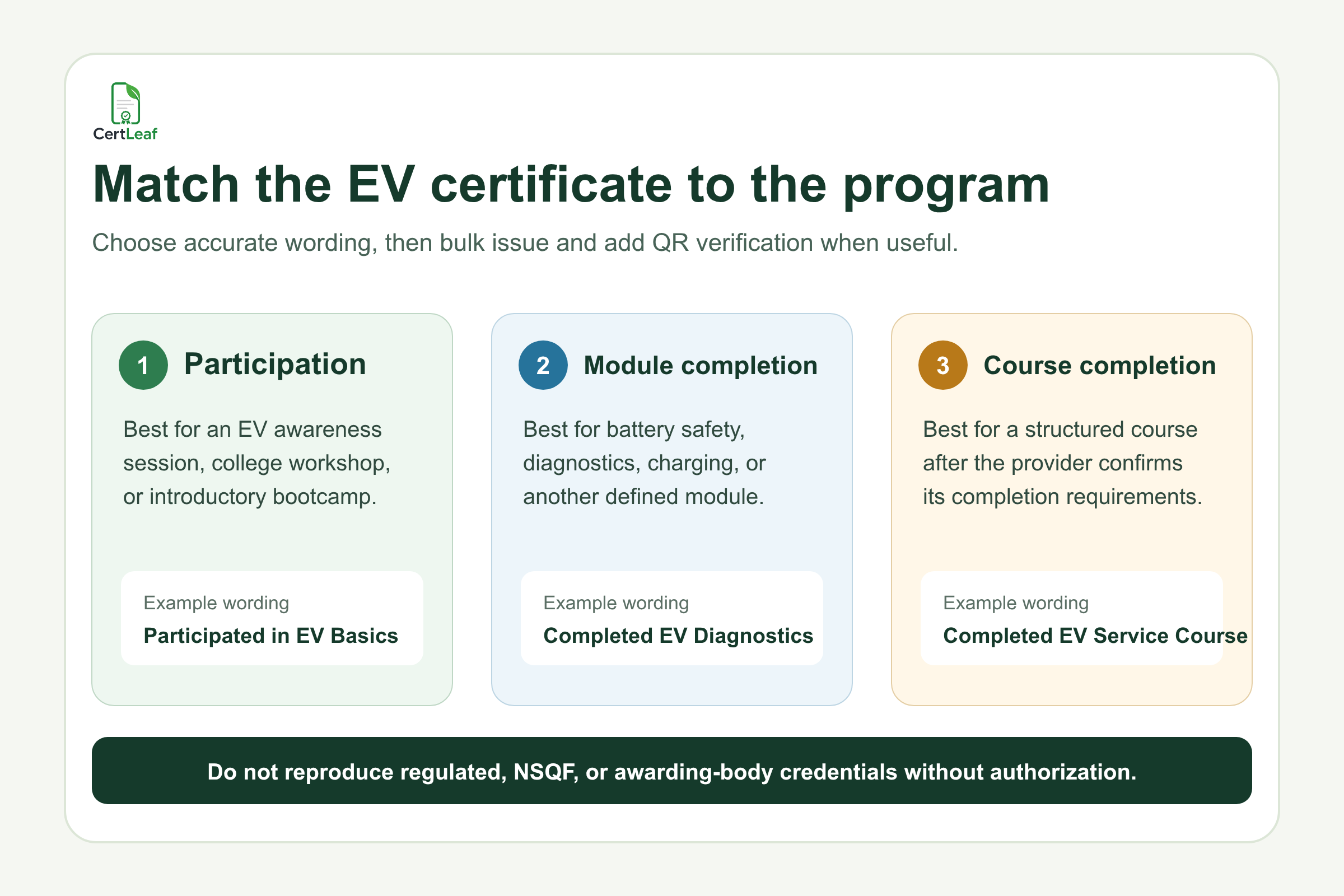
Three practical certificate types cover many EV training programs:
Participation certificate: for an awareness session, college workshop, demonstration, or introductory bootcamp.
Module completion certificate: for a defined subject such as high-voltage safety, charging systems, battery management, diagnostics, or preventive maintenance.
Course completion certificate: for a structured program after the provider has confirmed its own approved completion requirements.
Keep regulated and provider-issued records separate. If an authorized organization awards an NSQF, Skill India, ASDC, university, or other controlled credential, follow that organization's rules. Do not recreate its certificate in an independent template or imply that QR verification adds accreditation.
Running an EV workshop or technical cohort? Sign up for CertLeaf and use the 20 free signup credits to test separate participation, module, and completion templates before issuing the full batch.
Reuse an approved design across EV courses
EV training calendars change faster than the academy's visual identity. The logo, border, issuer details, and signatory area may stay fixed while the course title, module, dates, centre, trainer, and learner change.
CertLeaf lets the provider upload an approved base design and place dynamic fields over it. A practical EV training certificate template may include:
learner name
course or module title
certificate type
training period or completion date
centre, campus, or branch name
approved training hours, when recorded
certificate ID
QR code for a verifiable certificate
Test the design with difficult values. "Electric Vehicle Battery Diagnostics and High-Voltage Safety" needs more room than "EV Basics." Long learner names, multi-line institute names, and date ranges can expose layout problems before the real batch is generated.
Training teams that need a broader operating model can use the guide to bulk course completion certificates for training institutes for template testing, cohort delivery, and reusable batch planning.
Build a narrow EV learner CSV
The working learner file may include phone numbers, identity documents, assessment scores, practical observations, payment status, attendance records, placement notes, and safety documentation. Most of that does not belong in a certificate platform.
Export a smaller issuing CSV with only the fields needed for the certificate, delivery, and approved verification record. For example:
learnerName,email,courseTitle,moduleTitle,batchName,completionDate,trainingHours,certificateType,certificateId
One row should represent one approved certificate. If the same person receives a course completion certificate and a separate technical module record, treat them as two deliberate records rather than an accidental duplicate.
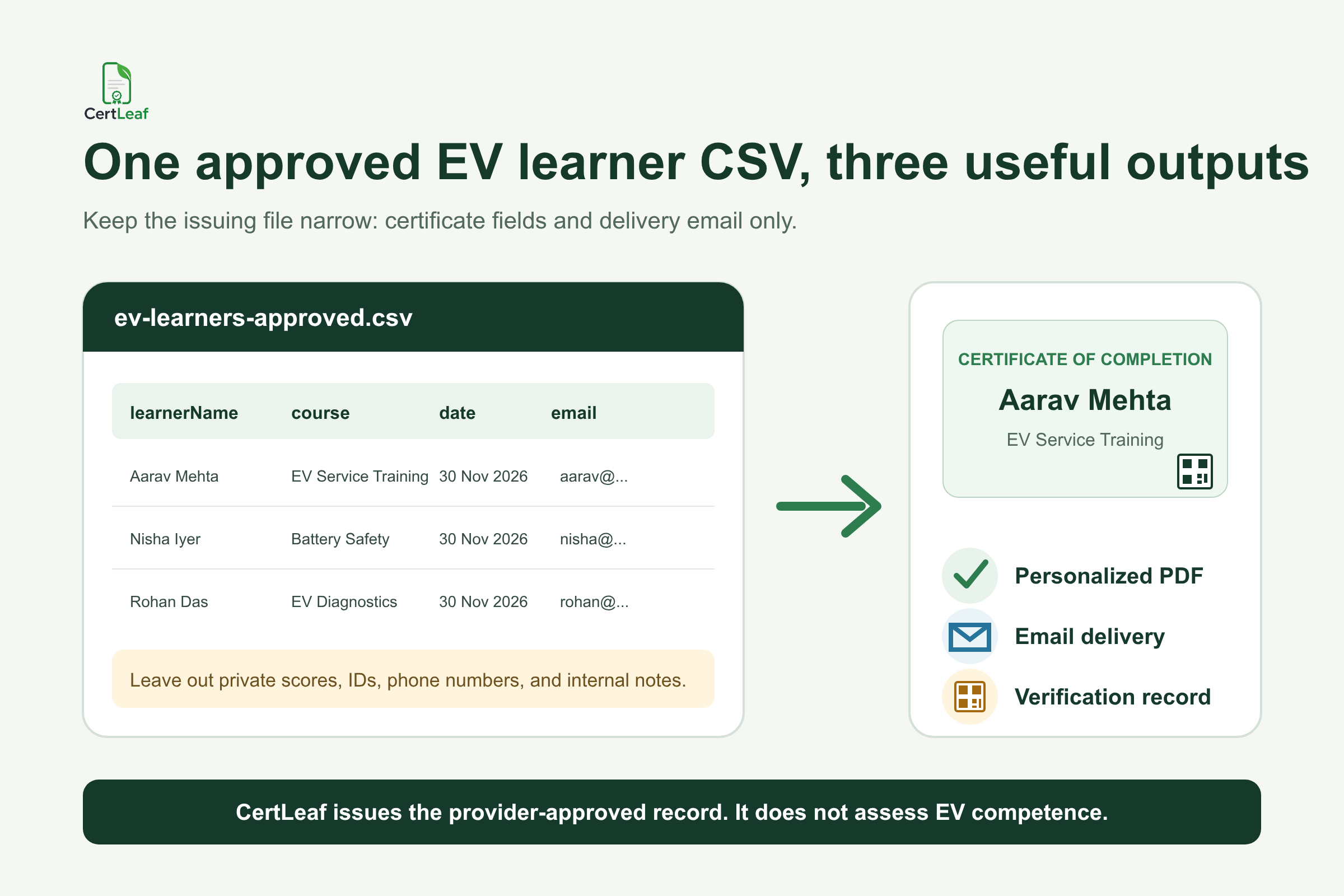
Check the learner name, email, program title, date, hours, certificate type, and ID before upload. Keep private scores, identity numbers, phone numbers, internal comments, and assessment evidence in the provider's own system.
CertLeaf uses the reviewed rows to populate the template. It does not decide whether a learner passed a technical assessment or completed enough practical hours. That decision stays with the responsible training provider.
Email each learner the matching certificate
A folder of PDFs is not a completed issuing process. Someone still has to match each file to the right learner and send it.
Manual delivery can be manageable for a small lab group. It becomes a poor system for 80 learners across service, battery, and charging batches. A file gets attached to the wrong message, one evening cohort is missed, or a corrected certificate is sent from another inbox with no clear record of the latest version.
CertLeaf uses the email field in the approved CSV to send each learner the matching certificate. The provider can keep the email clear: identify the course or module, explain what the certificate records, and give learners one route for genuine name or delivery corrections.
Want to test the recipient experience before the full send? Try CertLeaf with 20 free signup credits, issue a small internal batch, open the emails on a phone, and inspect every exported certificate.
Add QR verification when the certificate will travel
EV training certificates may be shown to employers, service centres, project partners, colleges, or another training provider. Once the PDF leaves the original email, the recipient may not have an easy way to show where it came from.
A QR-verifiable certificate gives a reviewer a public route to the issuer-created record. The certificate and verification page should agree on the learner name, program or module, provider, date, and certificate ID. Teams planning portable technical records can use the detailed guide to QR-verifiable training certificates with unique certificate IDs.
Keep the verification page narrow. It does not need private assessment marks, identity documents, phone numbers, attendance evidence, or trainer comments. It needs enough public information to compare the PDF with the issued record.
QR verification confirms that the provider issued the corresponding record through CertLeaf. It does not prove hands-on competence, workshop safety, licensing, accreditation, or eligibility for a regulated role.
Pay-as-you-go credits fit technical training calendars
EV training volume can be uneven. A skill centre may run a large technician cohort, pause while the next intake fills, then conduct several short employer programs. A college may need certificates for one bootcamp this term and none the next.
CertLeaf uses pay-as-you-go credits instead of a monthly subscription. New accounts receive 20 free signup credits. Simple certificates use 1 credit, while QR-verifiable certificates use 2 credits. India-first customers can purchase credits in INR through Razorpay when a real batch is ready.
This keeps certificate software separate from course fees, assessments, workshop equipment, and accreditation responsibilities. Providers comparing occasional credit purchases with recurring software plans can review the certificate generator without a subscription.
Check the live pricing page before setting a program budget because credit packs and offers can change.
Practical setups for different EV training providers
Skill centres and private academies
Maintain separate templates for full-course completion, technical modules, short workshops, and trainer recognition. Keep the academy identity consistent while changing the approved course and learner fields.
ITIs, polytechnics, and engineering colleges
Use wording that matches the actual activity. A guest lecture, lab workshop, departmental bootcamp, elective module, and full institutional course are different records.
Automotive employers and service networks
Use branch, team, or job-role fields only when they help explain the certificate. Keep employee performance notes and internal safety records outside the certificate CSV and public verification page.
Charging and equipment companies
An equipment demonstration may suit participation wording. A structured operator program may justify completion wording when the provider has approved its requirements. Do not imply a licence or external authorization that the program does not grant.
Industry-academia programs
Agree on the issuer, partner names, signatories, certificate type, and branding before building the template. If a university, council, or awarding body controls the certificate, follow its authorization process.
FAQ about EV training certificate generators
What is an EV training certificate generator?
It is software for creating and issuing personalized certificates for electric vehicle courses, technical modules, workshops, and bootcamps. CertLeaf supports reusable templates, bulk CSV issuing, email delivery, and optional QR-verifiable records.
Can an EV academy issue course certificates in bulk?
Yes. The academy can prepare an approved learner CSV, map its fields to a reusable template, generate the batch, and send each matching certificate by email. The academy remains responsible for training, assessment, learner approval, and certificate wording.
What fields belong in an EV training certificate CSV?
Common fields include learner name, email, course or module title, batch, completion date, training hours when approved, certificate type, centre name, and certificate ID. Include only what is needed for the certificate, delivery, or public verification record.
Can an EV course certificate include a QR code?
Yes. CertLeaf can issue QR-verifiable certificates linked to public verification pages. The page confirms the issuer-created record; it does not independently prove technical skill, accreditation, licensing, or employment readiness.
Does CertLeaf issue NSQF or ASDC certificates?
No. CertLeaf is certificate issuing software. It does not award NSQF status, represent ASDC or another awarding body, accredit EV courses, assess learners, or grant regulated qualifications. An authorized provider must follow the relevant awarding body's rules.
Is CertLeaf useful for short EV workshops?
Yes, when the organizer needs to issue participation or module certificates to an approved group. The wording should reflect the short workshop rather than present it as a full technician qualification.
Can Indian skill centres use CertLeaf without a subscription?
Yes. CertLeaf uses pay-as-you-go credits, supports INR payments through Razorpay, and provides 20 free signup credits for testing.
Give the next EV cohort a certificate process the team can repeat
EV training providers should spend their attention on instruction, labs, safety, assessment, and accurate learner decisions. Rebuilding PDFs and matching attachments should not demand the same effort.
Start with the provider's authority and approved certificate wording. Create reusable templates for the records the program actually issues, prepare a narrow learner CSV, test the awkward rows, and choose whether the certificates need QR verification. CertLeaf handles the repeated issuing and delivery work around those decisions.