CertLeaf
Internship Completion Certificate Generator: Bulk Certificates for Students
A practical workflow for colleges and training providers that need to approve internship records, generate completion certificates in bulk, email students, and add QR verification.
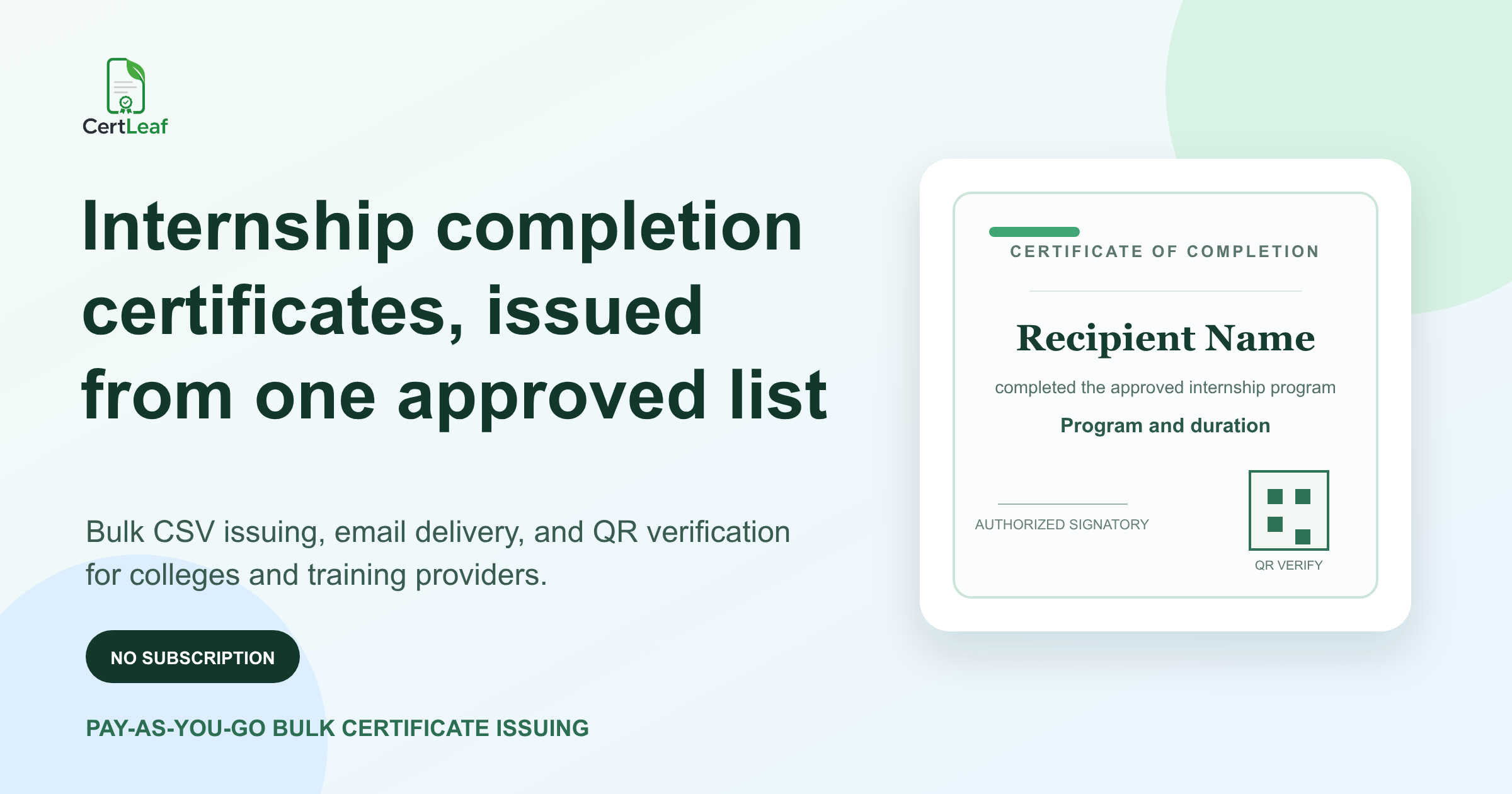
At 7:10 pm, the placement coordinator still had three internship trackers open. The first came from the student registration form. The second was maintained by faculty mentors. The third had arrived from partner organizations as a collection of completion notes, project evaluations, and signed PDFs.
The Bengaluru college had 92 students in its summer internship cycle. Eighty-four had clear completion records. Four were waiting for supervisor confirmation. Two had changed projects halfway through. One student had submitted everything under a personal email that did not match the college record. Another had completed six weeks, but the tracker still showed the original eight-week plan.
The request from the department office was short: send the certificates before the placement orientation on Monday.
An internship completion certificate generator can remove the repetitive PDF and email work. It cannot decide whether an internship was completed. That line matters. The college, training provider, or authorized internship host must approve the evidence first. The certificate batch should begin only after that decision has produced one clean list.
| Record | What it can prove | What to check before issuing |
|---|---|---|
| Student registration | Who entered the program | Identity, email, planned role |
| Mentor tracker | Internal progress | Dates, project, exceptions |
| Host confirmation | Work accepted by the supervisor | Issuer authority and final duration |
| Final project record | Required output was submitted | Completion rule was actually met |
| Approved issuing CSV | What belongs on the certificate | One final row per certificate |
For the Bengaluru batch, I would issue the 84 approved records first and keep the remaining eight out of the CSV. A late certificate is easier to explain than a completion claim the department cannot support.
Decide who is authorized to issue the internship certificate
Internships can involve several organizations at once. A college may coordinate the students. A company may supervise the work. A training provider may run the internship program and review projects. Sometimes the final certificate carries more than one name.
Before opening a template, answer one plain question: who is making the completion claim?
If the host company is the issuer, the certificate should follow its approved wording and signatory process. If the college ran a structured internal internship, the department may be the appropriate issuer. If a training provider delivered the internship program, it should confirm the completion criteria it applied. Do not add a company logo, signatory, or endorsement merely because students worked on a related project.
I would write the rule in one sentence and keep it with the batch record:
> Students will receive an internship completion certificate after the authorized supervisor confirms the final duration and accepts the required project submission.
This avoids a common argument later. Attendance at an orientation, registration for an internship, and completion of the work are different events. The certificate wording should match the evidence.
Keep completion, participation, and appreciation separate
One certificate title rarely fits everyone around an internship program.
A completion certificate belongs to a student who met the documented completion rule. A participation certificate may fit a short internship exposure program where the organizer is confirming involvement rather than completion of assessed work. An appreciation certificate can recognize a mentor, reviewer, or coordinator without describing them as an intern.
At a six-week data analytics internship in Kochi, two student coordinators also handled daily check-ins. The team first planned to add "Student Coordinator" as a note on their completion certificates. They later issued separate appreciation certificates instead. That kept the internship record about the students' own work and the appreciation record about their extra contribution.
This separation helps when the certificate is read months later by someone who was not part of the program.
Turn the approved records into one issuing CSV
The working internship tracker may contain supervisor comments, phone numbers, attendance details, assessment notes, project links, and placement preferences. Most of that does not belong in a certificate platform.
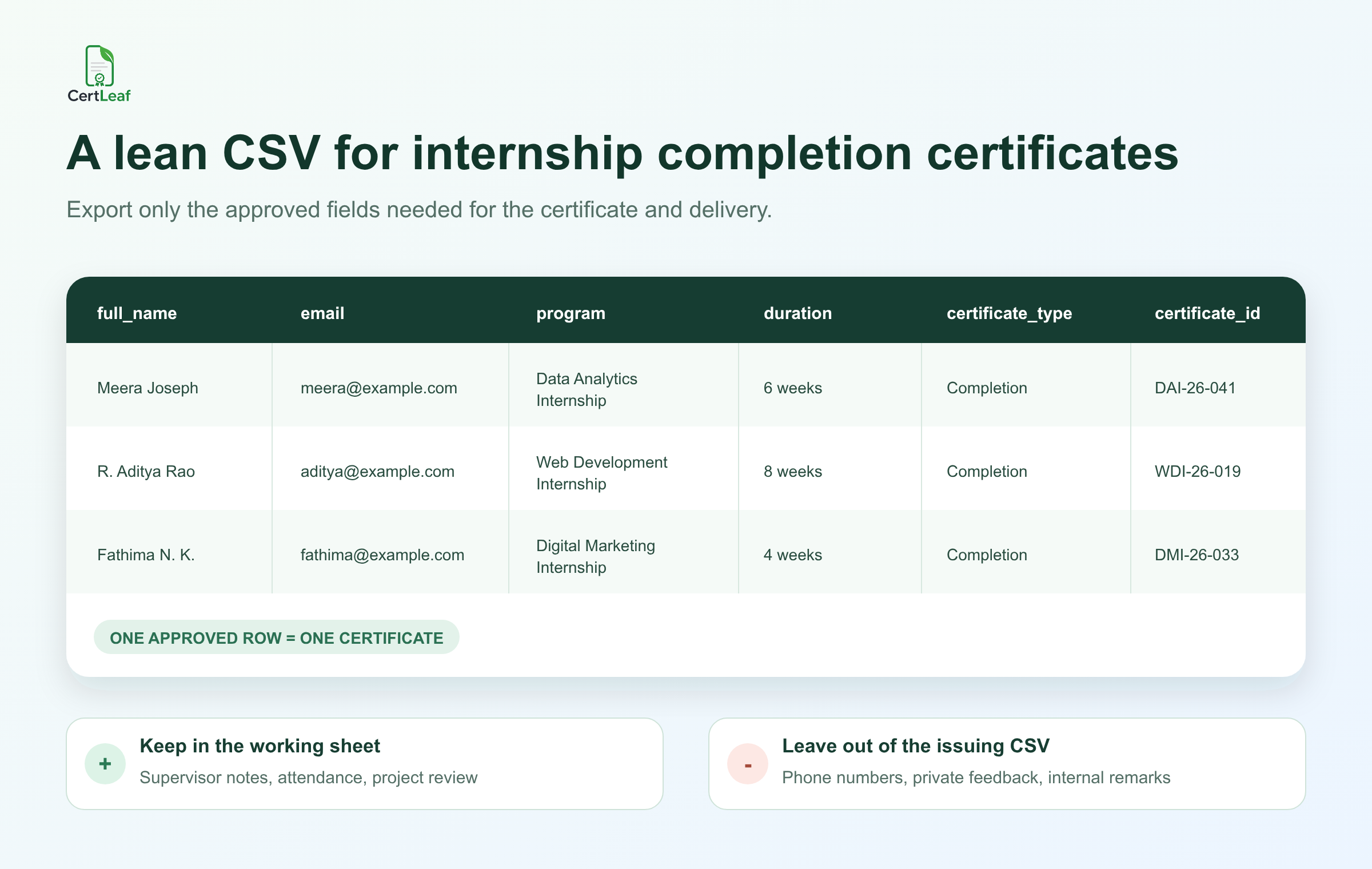
Export a smaller file with only the approved fields required for generation and delivery. A useful starting pattern is:
full_name,email,program,duration,completion_date,certificate_type,certificate_id
The exact columns can change. A college internship may also need department and semester. A training provider may need batch name and project track. Keep the file lean enough that another coordinator can explain every column.
For a detailed cleanup pass, use the local guide to prepare a certificate recipient CSV without name or email errors. The most important checks for this batch are duplicate identities, changed email addresses, final duration, and a certificate type that matches the approved evidence.
One detail is easy to miss: the planned internship duration is not always the completed duration. If a student moved from eight weeks to six with formal approval, the certificate should use the accepted final record. Do not copy the original offer period without checking the completion note.
Use a stable certificate ID when the record may be checked later
Internship certificates often leave the original email thread quickly. Students add them to portfolios, placement files, LinkedIn profiles, and job applications. A stable certificate ID gives the issuer a reference when a recruiter or department asks about a record later.
The ID can be simple, such as DAI-2026-0041. It should identify one issued record without exposing the student's phone number or email address. If the institute already has an internship tracking code, decide whether it is suitable for public use before placing it on the certificate.
The important part is consistency. Assign or confirm the ID before bulk generation. Do not type IDs into exported PDFs one at a time. For a more detailed policy, see how to plan QR-verifiable training certificates with unique certificate IDs.
A corrected name will usually remain part of the same internship completion record. Record the correction instead of creating a second unrelated identity. If the underlying completion decision changes, the issuer needs a documented process for the old record and any replacement.
Test the awkward records before the full batch
A random preview usually picks the easiest row. I would test the longest student name, the longest program title, a name with initials, a revised duration, and one record with every optional field filled.
Read the exported certificate at normal size. Check the issuer name, internship title, final duration, completion date, student name, certificate ID, signatory area, and QR placement. Then send the sample to an inbox the team can open.
At a Pune web development internship, the certificate design passed its first preview because the sample title was "Web Internship." The approved program name was "Full Stack Web Development Industry Internship Program." It wrapped into the signature area on 63 certificates. Testing the longest real title would have caught that before the batch existed.
This is also the right moment to check the email mapping. The correct PDF must go to the email in the same approved row.
Move from evidence to delivery in a fixed order
The workflow is easier to manage when each stage has a clear owner. The supervisor or program lead approves completion. The coordinator builds the final row. The certificate system generates and distributes the batch. The verification record remains available for later checks.
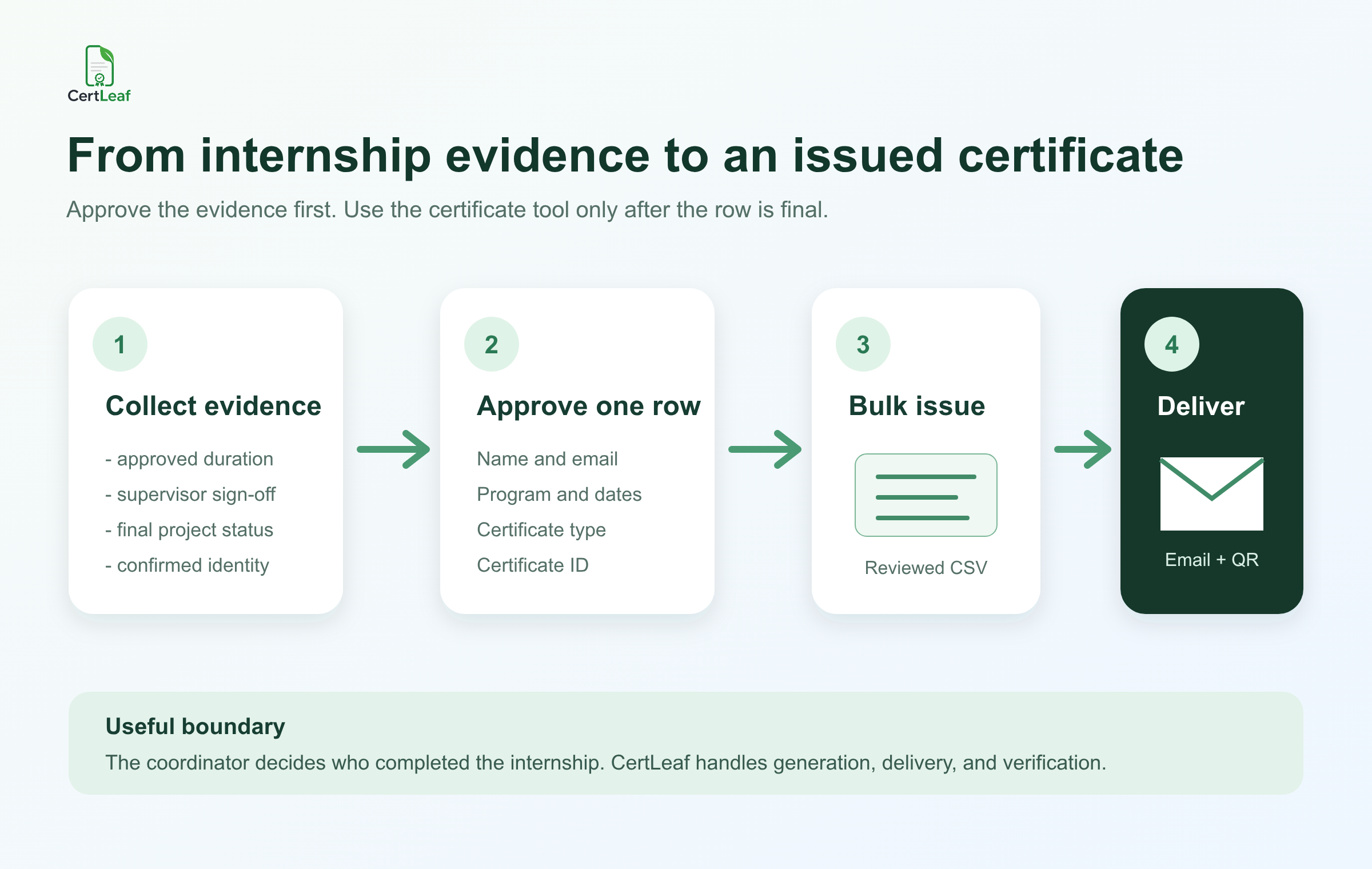
My preferred order is:
Freeze the completion rule and authorized issuer.
Resolve exceptions in the working tracker.
Export one approved issuing CSV.
Test the difficult records in the actual template.
Generate the approved batch and email each student.
Record late approvals and corrections separately.
The four pending supervisor confirmations from the Bengaluru batch should not delay the 84 approved certificates. They can become a small supplementary batch once the evidence arrives. That is cleaner than adding uncertain rows or rerunning everyone.
Add QR verification when students will share the certificate
A QR code is useful when it opens a verification page for the specific certificate record. It is less useful when it opens a generic homepage or another copy of the same PDF.
For an internship completion certificate with QR verification, the student, recruiter, or placement team should be able to scan the code and compare the relevant certificate details. The public result should not expose private supervisor notes, assessment comments, phone numbers, or internal eligibility evidence.
QR verification does not prove that every task in the internship was performed exactly as described. It provides a way to check that the issuer created the matching certificate record. The issuer remains responsible for its completion criteria and approval.
Before sending, scan QR codes from exported certificates, not only from the template editor. Use more than one sample and confirm that each code opens the matching record.
Send the certificates without building a manual mail queue
Once the batch is approved, delivery should be routine. Downloading 84 PDFs, renaming them, and attaching them one by one adds another place for identities to become mixed.
Tell students which email address will receive the certificate and when to expect it. Then use the approved CSV to deliver the matching certificate to each recipient. If a message is not received, investigate the specific row rather than sending the whole batch again.
Teams planning that step can follow the broader workflow for how to send certificates by email automatically after an event or program. The internship context adds evidence and issuer checks, but the delivery discipline is the same: one approved identity, one matching certificate, one intended inbox.
Where CertLeaf fits
CertLeaf handles the issuing work after the internship decision is settled. A college or training provider can upload its approved base design, create a reusable template, map fields from the final CSV, generate certificates in bulk, deliver them by email, and use QR verification when a certificate needs a public checking path.
The coordinator still decides who qualifies, which organization is authorized to issue, what duration is correct, and how exceptions are approved. CertLeaf does not replace the internship tracker or the supervisor's judgment.
The pay-as-you-go model suits internship cycles because the volume is uneven. A college may issue one large summer batch and a smaller winter batch. A training provider may run separate cohorts throughout the year. Credits can be purchased when certificates need to be issued, without keeping a subscription active between batches. New accounts receive 20 free credits for testing the workflow.
FAQ about internship completion certificate generators
What is an internship completion certificate generator?
An internship completion certificate generator is a tool used to create certificates from approved student data. For larger batches, it should support reusable templates, CSV-based generation, email delivery, and optional QR verification rather than requiring individual PDF edits.
Can colleges generate internship certificates in bulk from a CSV?
Yes. After the college or authorized issuer approves the completion records, it can export student names, emails, program details, duration, completion dates, and other certificate fields into a CSV. A bulk certificate platform can use one row for each certificate.
Who should issue an internship completion certificate?
The issuer should be the organization authorized to confirm the internship completion. That may be the host company, a college running an internal program, or a training provider that delivered and assessed the internship. Do not imply an endorsement from an organization that did not approve the certificate.
What fields should an internship certificate include?
Common fields include the student's confirmed name, internship or program title, issuer name, completed duration or dates, completion wording, issue date, signatory details, and an optional certificate ID and QR code. Include only details supported by the approved record.
Should an internship completion certificate have a QR code?
QR verification is useful when students will share certificates with recruiters, placement teams, colleges, or clients. The code should open a verification record for that certificate, not a generic website or only the same PDF.
Can internship certificates be emailed automatically?
Yes. Once names and email addresses are approved in the final CSV, CertLeaf can generate the batch and support email delivery so the coordinator does not have to attach each certificate manually.
What should happen when supervisor approval arrives late?
Keep the unapproved student out of the main issuing CSV. When the authorized confirmation arrives, add the student to a documented supplementary batch. Avoid rerunning or resending the certificates that were already approved.
Can CertLeaf be used without a subscription?
Yes. CertLeaf uses pay-as-you-go credits. Colleges and training providers can issue certificates when internship batches finish without committing to a monthly subscription.
The approval row is the real starting point
The cleanest internship certificate batches begin before the certificate editor opens. Someone confirms the issuer, checks the evidence, resolves the duration, and approves one final row for each student.
After that, the technical work is ordinary: map the fields, test the difficult records, generate the batch, send it, and keep a verification path when needed.
That is the standard I would use for the Bengaluru group. Eighty-four supported completion records become 84 certificates. The unresolved cases wait for evidence. The certificate tool makes the approved work faster; it does not make the approval decision for the team.