CertLeaf
Seminar Participation Certificate Generator for Colleges With QR Verification
A practical article for college departments and student coordinators who need to generate seminar participation certificates in bulk, email them to students, and keep each certificate QR-verifiable.
The seminar ended, but the certificate list was still moving
At 4:20 pm, the auditorium lights were back on and the speaker had already left for the station. The department seminar on AI tools for research had gone better than expected. Around 260 students registered, 214 marked attendance, and 31 faculty members joined for at least part of the session.
The certificate work was less neat.
One student had registered as "A. Meera" but wrote "Ananya Meera S" in the attendance sheet. A final-year student asked if the seminar title could include the full department name. Two people attended from a friend's QR code. The coordinator had three tabs open: registration export, attendance export, and a WhatsApp chat full of spelling corrections.
That is the real job a seminar participation certificate generator for colleges has to support. Not just designing a nice PDF. The useful part is taking one cleaned list, generating certificates in bulk, emailing the right certificate to each participant, and giving every certificate a QR verification link for later checks.
| Before issuing | Why it matters | What I would check |
|---|---|---|
| Registration list | Shows intent, not presence | Do not use it as the final certificate list |
| Attendance list | Usually the closest source of truth | Remove duplicate rows and wrong emails |
| Feedback form | Useful for corrections | Treat it as support, not the master sheet |
| WhatsApp edits | Catches initials and spelling | Apply only before the final CSV is locked |
First decide who actually gets the seminar certificate
College seminar certificates become messy when the rule is decided after students start asking for certificates.
For a one-hour guest lecture, the department may give a participation certificate to everyone who marked attendance. For a half-day technical seminar, the rule may include attendance plus feedback submission. For a paid seminar or sponsored session, payment confirmation may also matter.
I would write the rule before preparing the certificate template. Something plain is enough:
"Students and faculty who attended the seminar and submitted the official attendance form by 5:00 pm will receive a participation certificate."
This sentence saves time later. It tells the coordinator which sheet to trust. It also gives volunteers a simple answer when someone messages at 10:30 pm saying they forgot to fill the form but were definitely present.
Do not make the rule more complex than the event needs. A seminar is not a full course. If the certificate says "participated", the list should prove participation. That usually means a checked attendance sheet, not the raw registration list.
Build one final CSV instead of fixing PDFs later
Most certificate errors start before the certificate generator is even opened.
The registration export has full names, but some students typed nicknames. The attendance export has the correct presence data, but a few emails are wrong. The feedback form has corrected names, but not everyone filled it. If the coordinator generates certificates from any one raw export, corrections will keep coming after the first batch is already sent.
For a college seminar participation certificate, I would create one final CSV with only the fields needed for issuing and delivery:
participant_name
email
seminar_title
department_name
college_name
seminar_date
certificate_type
If roll numbers matter for internal records, add a roll_number column. If faculty and students need different wording, add a participant_type column or issue two separate batches.
Before generating all certificates, test the awkward rows first. Use the longest student name. Use the full seminar title. Use a department name that wraps onto two lines. In one Pune seminar example, the title "Research Methods and AI Tools for Undergraduate Project Work" looked fine on the poster but crowded the certificate when the department name was also included.
That is the kind of problem you want to catch with three test certificates, not after emailing 214 PDFs.
Keep the certificate wording honest
A seminar participation certificate should not pretend to prove more than it does.
If the participant attended a guest session, say they participated in the seminar. If they completed a hands-on workshop, say that separately. If a student only registered but did not attend, keep them out of the certificate batch unless the department has a different policy.
This matters because certificates travel. Students upload them to LinkedIn. Placement cells may ask for proof. Another department may scan a certificate months later to confirm whether it is genuine.
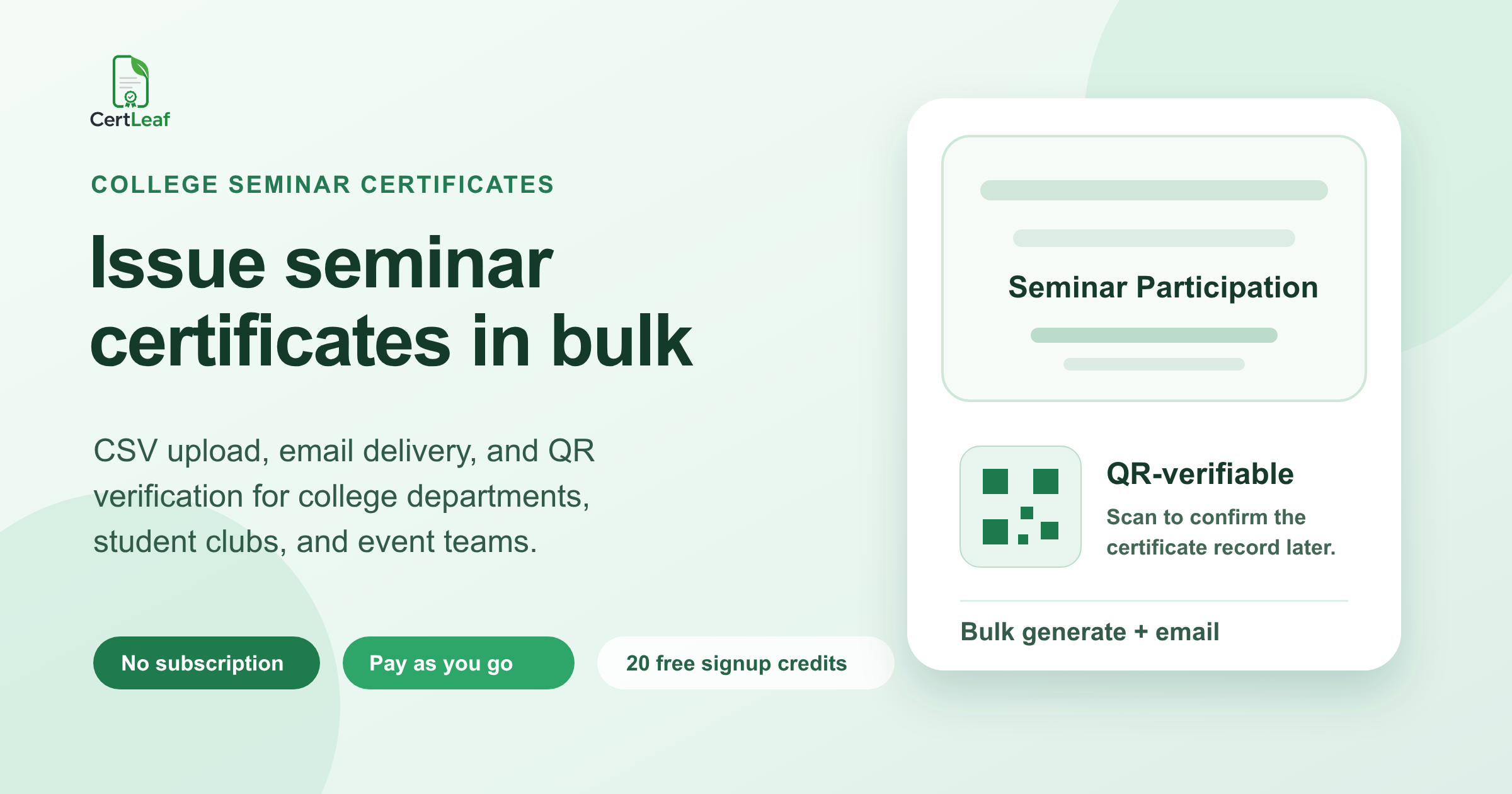
QR verification helps here. A QR-verifiable certificate gives the viewer a public verification page instead of only a PDF file. The PDF can still be shared, but the QR code gives the college, student, or recruiter a cleaner way to check the record.
Email delivery is part of the certificate workflow
Many college teams still generate certificates and then send them manually from Gmail. That is manageable for 25 participants. It becomes tiring with 200 students, and it creates avoidable mistakes.
The wrong file gets attached. A student receives someone else's PDF. A volunteer forgets to send the corrected certificate. The inbox fills with "certificate not received" messages because some emails bounced or were typed incorrectly.
For seminar certificates, I would treat email delivery as part of the issuing workflow, not a separate chore after generation. The same final CSV should contain the participant name and email address. The certificate system should use that data to generate and send each certificate to the correct person.
Even then, keep a small correction window. Tell participants something like: "If your name is wrong, reply by tomorrow 12 pm with the corrected spelling." That is better than silently reissuing certificates for a week.
Where CertLeaf fits
CertLeaf is built for this kind of certificate follow-up work after seminars, workshops, events, and training programs.
You create a reusable certificate template, upload the final CSV, generate certificates in bulk, and send them by email. If you choose QR-verifiable certificates, each certificate includes a QR code that opens a verification page. That makes the certificate easier to check later when a student shares it or a department needs confirmation.
The pricing also fits event-sized work. CertLeaf uses pay-as-you-go credits, so a college department or student club does not need to start a subscription just to issue one seminar batch. New signups get 20 free credits, and the current early-user offer is 50% off until 31 July 2026.
I would not use CertLeaf to plan the whole seminar. That belongs in your forms, calendar, and coordinator group. I would use it once the final certificate list is ready and the team wants to issue, email, and verify certificates without manual PDF work.
A simple seminar certificate workflow I would follow next time
Start with the attendance rule. Decide who qualifies before the event begins, even if the rule is basic.
During the seminar, collect attendance in one place. Avoid running two parallel forms unless someone is responsible for merging them. After the session, create one final CSV for certificates. Apply name corrections before generation, not after.
Then test three certificates: the longest name, the longest seminar title, and one row with faculty or department details if those fields appear on the certificate. If those look clean, generate the full batch and send the certificates by email.
Finally, keep one record of the issued batch. This does not have to be complicated. The department should know which CSV was used, when the certificates were sent, and whether QR verification was enabled.
That record matters when someone comes back after two months asking for a certificate again.
Related certificate workflows
For spreadsheet preparation, prepare the seminar certificate list in Excel.
For future seminars and events, reuse a college event certificate design.
FAQ
What is a seminar participation certificate generator?
A seminar participation certificate generator helps a college department or event team create certificates for seminar attendees from a participant list. A useful generator should support bulk issuing, certificate templates, email delivery, and preferably QR verification.
Can colleges generate seminar certificates in bulk?
Yes. Colleges can generate seminar certificates in bulk by preparing a final CSV with participant names, email addresses, seminar title, date, and other required fields. The important step is cleaning the final attendee list before generating certificates.
Should seminar certificates have QR verification?
QR verification is useful when certificates may be shared outside the college, used for student records, or checked later by another department, organizer, or recruiter. The QR code gives viewers a way to verify the certificate instead of trusting the PDF alone.
What should be included in a college seminar participation certificate?
Most seminar participation certificates include the participant name, seminar title, organizing department, college name, date, and certificate type. Some colleges also include roll number, speaker name, duration, or a certificate ID.
Is CertLeaf suitable for one college seminar?
Yes. CertLeaf works well for one-time seminar batches because it uses pay-as-you-go credits rather than a subscription. A department can upload a CSV, generate certificates in bulk, email them, and enable QR verification when needed.
The quiet part is the part worth fixing
The seminar itself gets the photos, LinkedIn posts, and thank-you messages. Certificate work happens later, usually with a tired coordinator checking spellings and email IDs.
That quiet follow-up work deserves a cleaner system. Decide the rule, clean one CSV, test the awkward rows, send certificates by email, and make them verifiable. It is not glamorous, but it is the difference between a good seminar memory and a week of certificate corrections.