CertLeaf
Language Course Certificate Generator for Institutes
Issue language course certificates in bulk for institute cohorts with reusable templates, email delivery, QR verification, and pay-as-you-go credits.
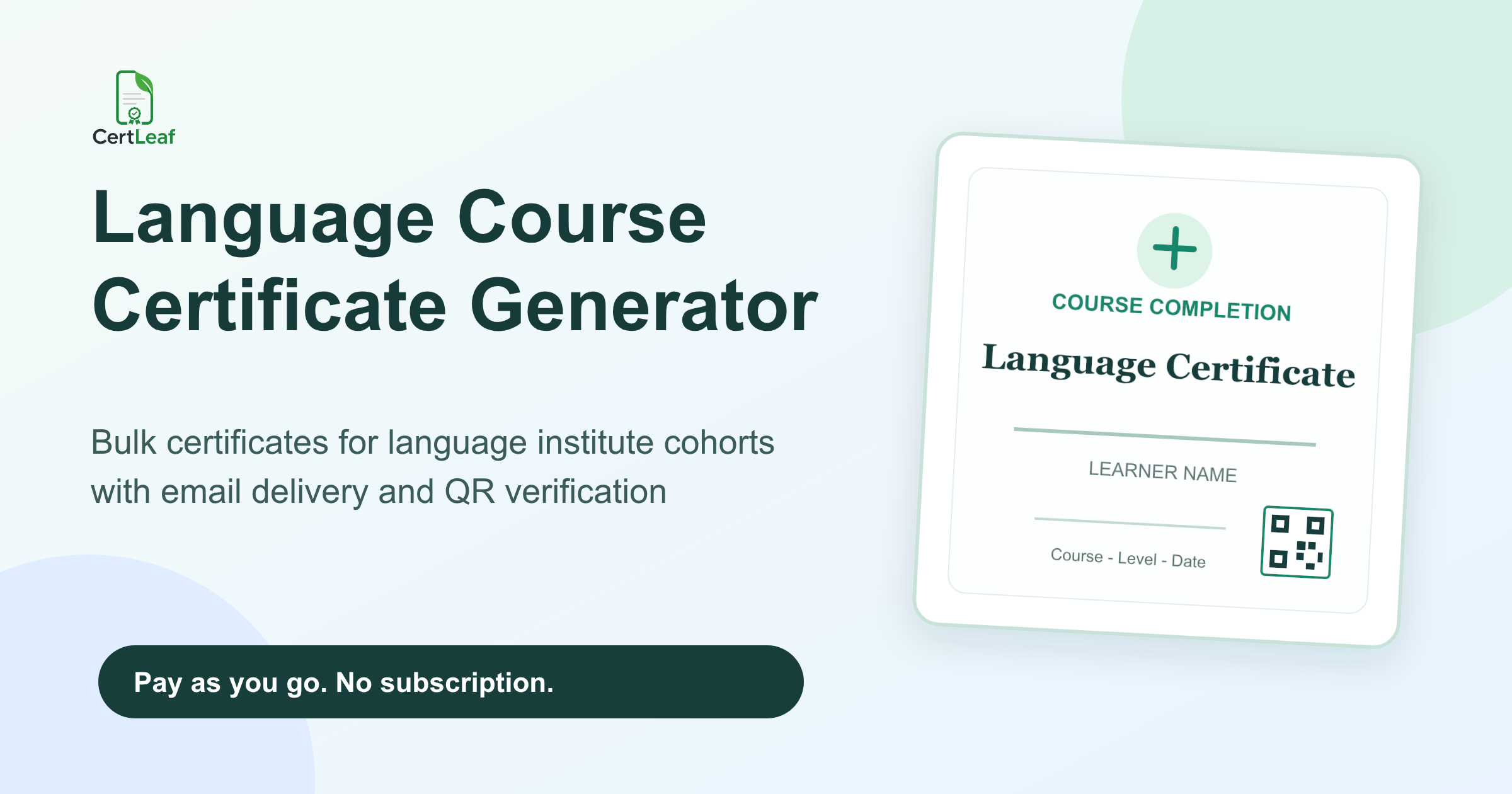
Language institutes need certificate software that can keep up with recurring cohorts without turning every course ending into a design and email project. A spoken English center may finish three batches in the same week. A foreign-language academy may issue different certificates for beginner, intermediate, and advanced groups. Conversation clubs, short masterclasses, guest trainers, and corporate batches can need different wording again.
CertLeaf gives language schools and training centers one focused place to save reusable certificate templates, issue a cohort from an approved CSV, email each certificate to the right learner, and add QR verification when the record will be shared outside the institute. It uses pay-as-you-go credits rather than a subscription, which fits institutes whose batch sizes and completion dates change through the year.
CertLeaf does not teach languages, test proficiency, award CEFR levels, or replace official exam bodies. The institute remains responsible for assessment, course claims, level names, and approval of the final recipient list. CertLeaf handles the certificate issuing, delivery, verification, and record layer after those decisions are made.
A language course certificate generator should match the program claim
A language institute may use the same brand across several certificate types, but the central claim should change with the program.
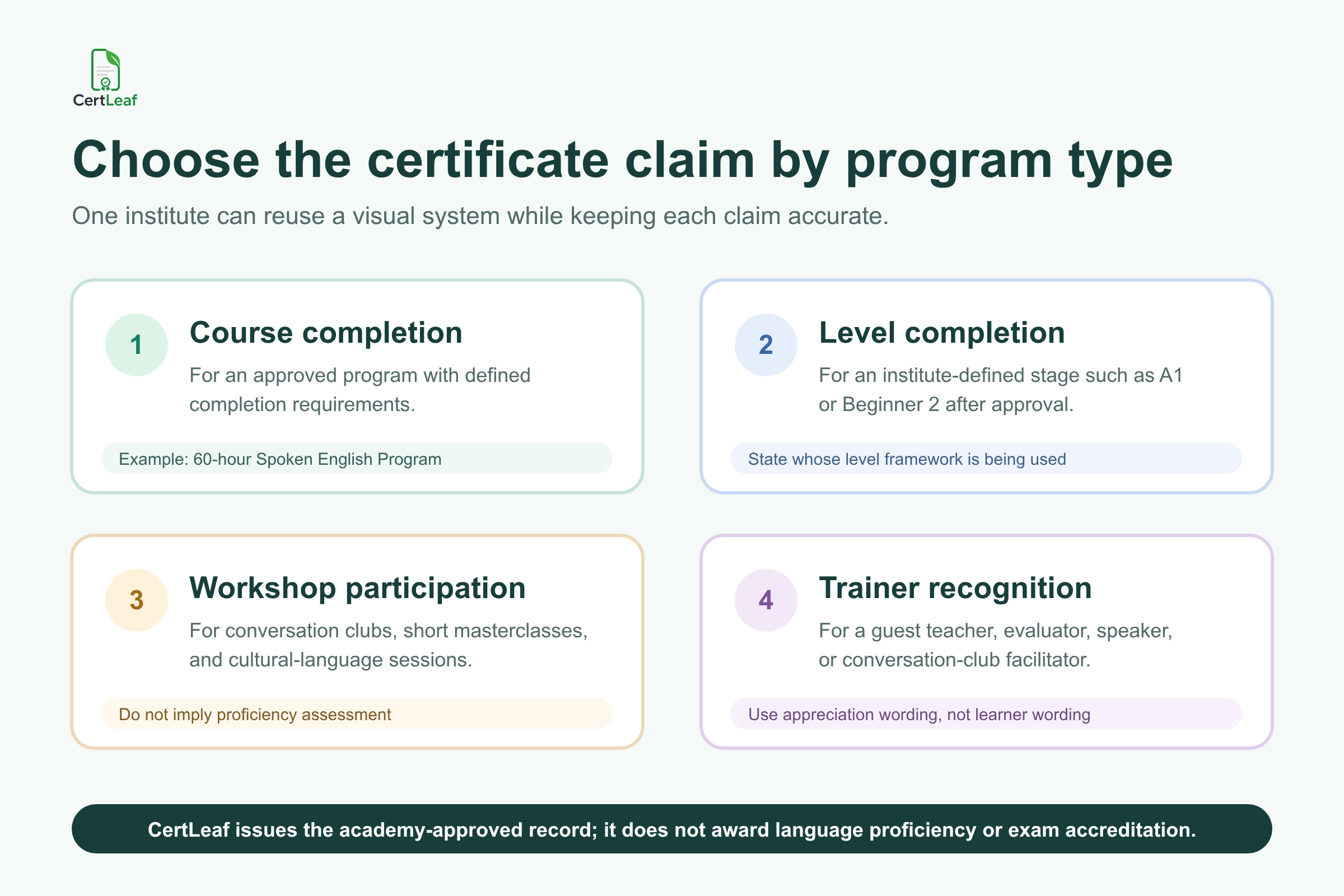
A course completion certificate can state that a learner completed an approved spoken English, business communication, German, French, Japanese, or other language program. A level completion certificate can name an institute-defined stage when that level has been assessed and approved. A short conversation session or cultural-language event usually needs participation wording. A guest teacher or evaluator needs an appreciation certificate, not a learner certificate.
The distinction matters because language certificates are often shared with employers, colleges, clients, or another training provider. "Completed a 60-hour Business English Communication Program" tells the reader what happened. "Certified language expert" makes a much broader claim and should not be used unless the issuer has the authority and evidence to support it.
If an institute uses labels such as A1 or B2, the certificate should clearly state the framework or internal basis for that level. Do not suggest that an academy-issued completion certificate is an official Goethe, DELF, IELTS, JLPT, Cambridge, or other examination result unless the responsible organization has actually issued or authorized that credential.
Running a language cohort now? Sign up for CertLeaf and use the 20 free signup credits to test the certificate wording, longest learner names, and delivery flow before issuing the full batch.
Reusable templates help one institute serve several courses
Language institutes rarely run one course forever. A center can offer spoken English in the morning, interview communication in the evening, and weekend foreign-language classes. Rebuilding certificates for every batch invites small inconsistencies: a changed logo size, an outdated signatory, a missing course duration, or a level label that no longer matches the current program.
With CertLeaf, the institute can upload an approved base design, place the fields that change, and save the layout as a reusable template. The next cohort uses the same visual system with a new approved learner file.
Useful dynamic fields can include:
learner name
course or program name
institute-approved level
batch name or code
course duration
completion date or date range
certificate type
certificate ID
Separate templates are useful when the central claim changes. A course completion certificate, workshop participation certificate, and trainer appreciation certificate can share colors and branding while using different titles and statements.
Test each template with difficult values before issuing the complete cohort. Long names, initials, multi-part course titles, and bilingual program names can stretch a layout that looked fine with sample text. The broader guide to reusing certificate templates across training batches is a useful next step when an institute wants to standardize several recurring courses.
Build a certificate-ready CSV, not a copy of the learner database
The language school may already hold registration details, payments, phone numbers, passport information, attendance, scores, teacher notes, and learning goals. Most of that does not belong in a certificate issuing file.
Use one smaller CSV with only the fields required to create, email, or verify each certificate.
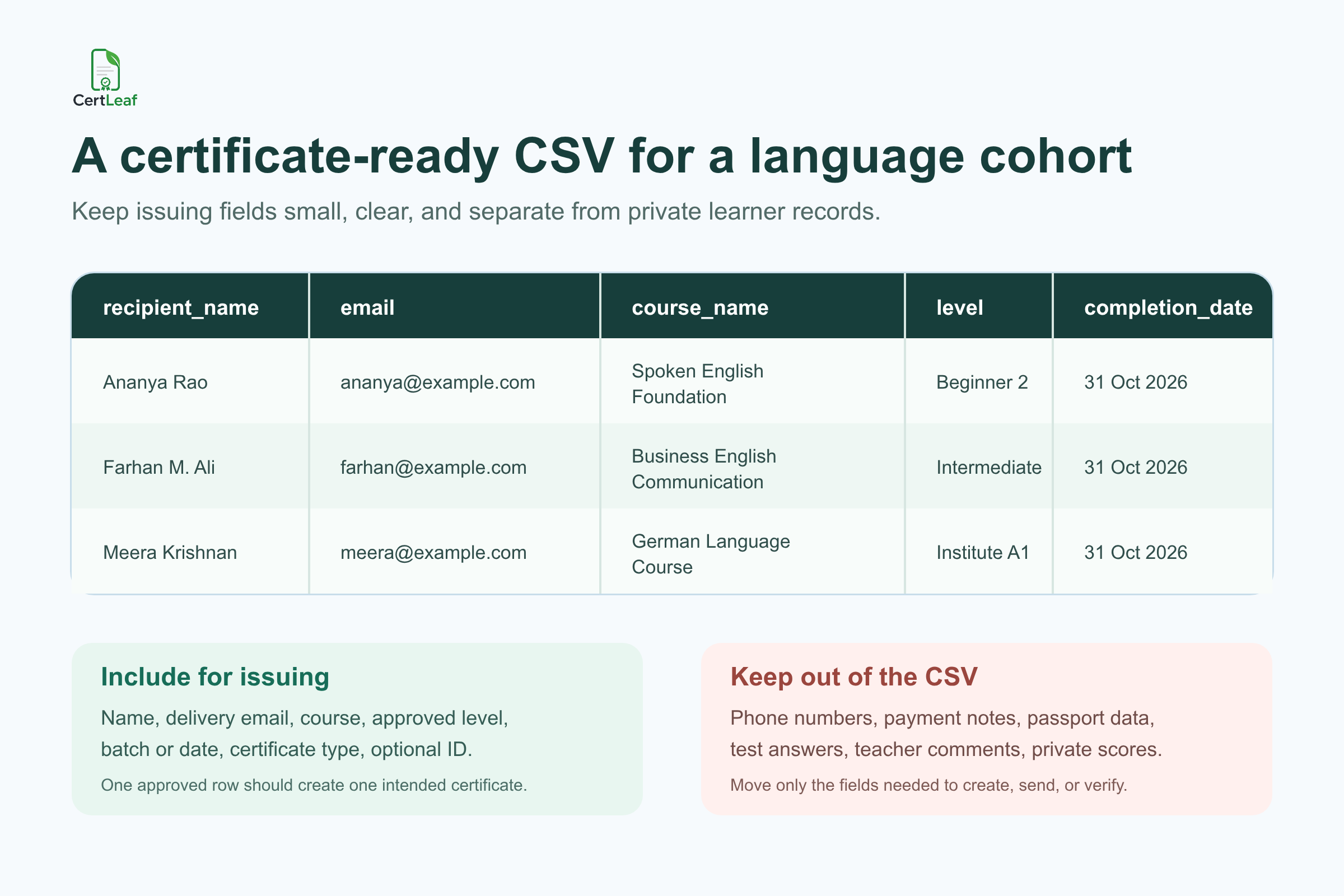
A practical file might use:
recipient_name,email,course_name,level,batch_name,completion_date,certificate_type,certificate_id
Use one approved row per intended certificate. If one person receives both a course completion certificate and a speaking-contest award, treat them as two deliberate records or separate batches. Do not leave an unexplained duplicate and hope the issuing operator understands it later.
The academic or course lead should approve the course outcome before the CSV reaches CertLeaf. For programs that use tests or projects, the existing article on turning approved assessment results into course certificates explains the boundary between academic decisions and certificate issuing.
Keep test answers, private scores, teacher comments, payment status, phone numbers, identity documents, and unrelated registration fields out of the upload. A smaller file is easier to review and reduces the chance of moving private learner data into a system that does not need it.
Email delivery matters when cohorts finish together
A five-person private tutoring group may be manageable with manual attachments. A language institute with 80 learners across four batches has a different problem. Similar filenames are easy to confuse. A coordinator can miss the evening cohort, send a certificate to the wrong address, or lose track of which learner received a corrected version.
CertLeaf can email each issued certificate to the address in the approved CSV row. That removes the repeated download, rename, attach, and send process. It also gives the institute a clearer place to start when a learner says the message did not arrive: check the approved email field, inspect spam or filtering, and correct only the affected record when needed.
Before the full issue, send a small internal set. Include the longest learner name, the longest course title, a name with initials, an institute-defined level, and an email address the team can open immediately. Check the PDF and email on both a phone and laptop.
Have an approved learner list? Try CertLeaf with 20 free signup credits. Issue a small internal language-course batch, review the emails, and scan the sample QR codes before using paid credits for the cohort.
For teams that want more delivery detail, the guide to sending certificates by email automatically covers recipient data, test sends, and common resend cases.
QR verification gives a shared certificate a checkable record
Language learners may add course certificates to job applications, college activity records, portfolios, LinkedIn profiles, or applications for further study. A PDF shows the institute's design, but it does not by itself give another person a direct route back to the issuing record.
A QR-verifiable CertLeaf certificate can open a public verification page tied to that certificate. The visible details should match the PDF: learner name, course, institute-approved level when appropriate, completion date, and certificate ID.
QR verification confirms that the institute issued that record. It does not independently prove language ability, validate the curriculum, or turn a private course certificate into an official examination credential. That boundary should stay clear in the certificate wording and verification details.
Keep the public record limited to useful certificate information. Email addresses, phone numbers, attendance, test scores, identity documents, and teacher notes should remain private. Institutes that need a stable public reference can follow the guide to QR-verifiable training certificates with unique certificate IDs.
Pay-as-you-go credits fit changing language cohorts
Language course volumes are rarely identical every month. Summer communication programs may be large. Exam-preparation periods may create several short batches. Corporate training can arrive as a one-off project. A center may then have a quiet month with no certificates to issue.
CertLeaf uses pay-as-you-go credits, so the institute can buy credits for actual certificate batches instead of keeping a monthly certificate subscription active. India-first customers can pay in INR through Razorpay. New accounts receive 20 free signup credits for testing.
A simple certificate uses 1 credit, while a QR-verifiable certificate uses 2 credits. Calculate the requirement from the approved recipient count and leave a small allowance for testing or corrections. Use the free credits to prove the template, CSV mapping, email delivery, and verification path rather than treating them as the operating budget for a large cohort.
Where CertLeaf fits in a language institute
CertLeaf is a practical fit for:
spoken English and communication centers
foreign-language academies
corporate language-training providers
colleges running language cells or add-on courses
tutors and small institutes with recurring cohorts
cultural organizations running structured language programs
The institute creates or approves the course, teaches the learners, assesses any required outcomes, and decides who should receive each certificate. CertLeaf then provides reusable templates, bulk CSV issuing, email delivery, QR verification, pay-as-you-go credits, and no subscription.
It is not a learning management system, examination board, student assessment platform, or language accreditation body. Keeping that boundary clear makes the resulting certificate more credible, not less.
Language course certificate generator FAQ
What is a language course certificate generator?
A language course certificate generator helps institutes personalize and issue certificates for spoken English, communication, and foreign-language course cohorts. CertLeaf supports reusable templates, bulk CSV issuing, email delivery, and optional QR verification.
Can a language institute issue course certificates in bulk?
Yes. The institute can approve one row per learner in a certificate-ready CSV, map the fields to a reusable template, review sample certificates, and issue the complete batch through CertLeaf.
What should a language course completion certificate include?
Common fields include learner name, course name, institute name, approved level when relevant, course duration, batch or completion date, signatory details, and an optional certificate ID or QR code.
Can a private institute put A1 or B2 on a certificate?
Only when the institute has a clear and approved basis for using that level label. The wording should identify the framework or state that it is an institute-defined level. It should not imply an official external exam result or accreditation that the institute does not hold.
Can language course certificates have QR verification?
Yes. CertLeaf can issue QR-verifiable certificates linked to public certificate records. The QR check confirms the institute's issued record; it does not independently assess the learner's language proficiency.
Does CertLeaf require a subscription?
No. CertLeaf uses pay-as-you-go credits. New users receive 20 free signup credits, and India-first customers can buy credits in INR through Razorpay.
Is CertLeaf an official language examination body?
No. CertLeaf is certificate issuing software. It does not conduct language exams, award official proficiency levels, accredit courses, or replace examination bodies. The issuing institute owns the course and certificate claim.
Give every language cohort a certificate process the institute can repeat
A useful certificate should say what the learner completed, reach the correct email address, and remain checkable when it is shared later. The institute should not need to rebuild that process for every spoken English, business communication, or foreign-language cohort.
CertLeaf keeps the repetitive work in one place: reusable templates, approved CSV batches, email delivery, QR verification, and pay-as-you-go credits without a subscription. Start with a few difficult sample rows, confirm the certificate claim, and then issue the approved cohort.