CertLeaf
Skill Development Certificate Generator for Training Institutes
A practical article for training institutes that need to issue skill development certificates in bulk, email them to learners, and keep each certificate QR-verifiable.
The certificate work starts after the last batch leaves
The final session of a weekend skill development course rarely ends cleanly. At 6:15 pm, the trainer wants to leave. The students want group photos. The front desk has payment notes open. Someone from the morning batch says their name is spelled wrong in the registration form. Two learners attended the Excel course under one email address because they enrolled through the same office.
That is when the certificate job actually begins.
In one ordinary training institute setup, the course may have 73 learners across two batches: 41 in spoken English, 22 in basic Excel, and 10 in Tally with GST. The institute needs course completion certificates by Monday because students want to attach them to job applications. The design is already ready. The hard part is cleaning the list, generating certificates without mistakes, sending them, and answering verification questions later.
A useful skill development certificate generator for training institutes should handle that operational mess. It should not only make a good-looking certificate. It should help the coordinator issue certificates in bulk, email them to learners, and give each certificate a QR verification page so the PDF is not the only proof.
| Institute record | What usually goes wrong | How to use it before issuing |
|---|---|---|
| Admission sheet | Names are typed in a hurry | Use it for official spelling, then verify corrections |
| Attendance sheet | Batch-wise presence is clearer | Use it to decide who completed the course |
| Payment notes | Some learners paid late | Keep it separate unless payment is part of eligibility |
| WhatsApp corrections | Initials and email fixes arrive late | Apply only before locking the final CSV |
Decide the certificate rule before exporting the list
The first mistake is issuing certificates from the wrong sheet.
A registration list only proves that someone joined or enquired. It does not prove that they completed the skill development program. For a short course, the institute may decide that learners need 70 percent attendance. For a practical course, they may need to submit a final assignment. For a placement-linked course, the coordinator may also check assessment marks.
The rule does not need to be complicated. It just needs to be written before the certificates are generated.
For example:
"Learners who attended at least 5 of 6 sessions and completed the final practice task will receive a skill development course completion certificate."
That one sentence gives the admin team something to stand on. When a learner messages after dinner saying they missed two classes but still wants the certificate, the coordinator is not inventing a rule under pressure.
I would keep the wording on the certificate equally honest. If the learner completed a 12-hour Excel basics course, say that. If they attended a two-day communication skills workshop, do not make it sound like a full diploma. Certificates become more useful when they describe the training clearly instead of trying to look bigger than the course.
Build one clean CSV for the certificate batch
Most certificate errors are spreadsheet errors wearing a nicer shirt.
The institute may have one sheet from admissions, one from attendance, one from Google Forms feedback, and one list maintained by the counsellor. If certificates are generated from a half-clean export, the coordinator will spend the next two days reissuing PDFs for small corrections.
Before using any bulk skill development certificate generator, create one final CSV with the fields that belong on the certificate and in the email workflow.
For a training institute, the CSV often needs these columns:
learner_name
email
course_name
batch_name
training_hours
completion_date
certificateid or internalreference
If the institute runs multiple branches, add branch_name. If courses are run under a partner college or NGO, add partner_name. Keep the file simple enough that someone else at the front desk can understand it without calling the trainer.
Then test the awkward rows first. Use the longest learner name. Use the course name that wraps badly, such as "Advanced Spoken English and Interview Readiness Program". Use a learner with initials. Use a Gmail address that was corrected after registration.
A training coordinator in Kochi once told me the most annoying certificate mistakes were not big mistakes. They were things like "Mohammed" versus "Muhammed", or a course title that pushed the completion date too close to the signature line. These are small enough to look careless and common enough to waste a full afternoon.
The template should survive real learner names
Certificate templates are usually approved with a neat sample name like "Rahul Sharma". Real batches are less polite.
You will get names with initials, long surnames, hyphenated names, parent initials, and course titles that were written for a brochure rather than a certificate. If the training institute offers several programs, one template may need to handle "Python Basics", "Practical GST Filing", and "Communication Skills for Front Office Staff" without breaking the layout.
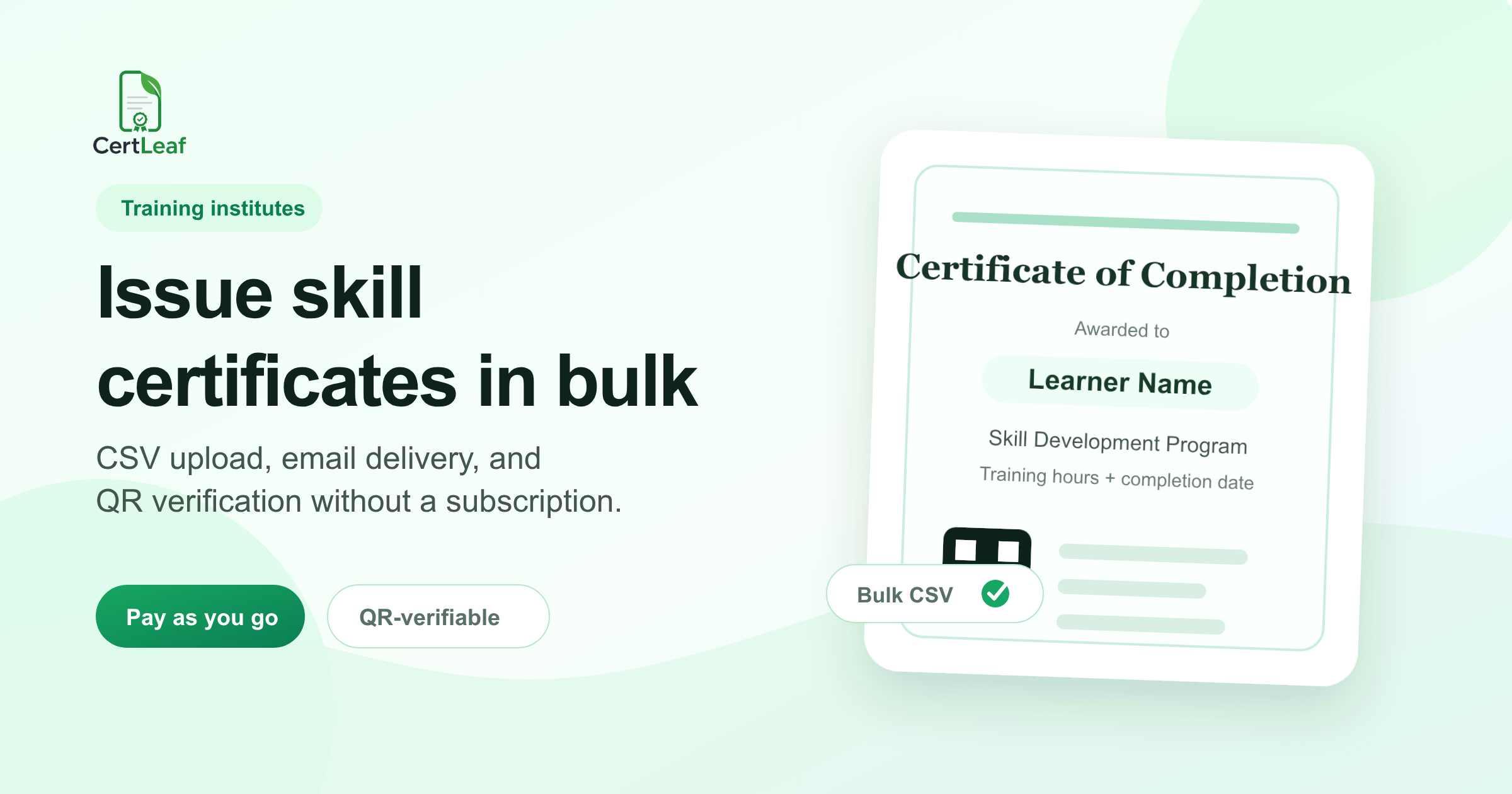
Before issuing certificates in bulk, I would create a reusable template and check it with realistic data. The certificate should have enough space for:
learner name
course or skill program name
institute name
completion date
certificate ID or QR code
Do not crowd the certificate with every internal detail. Attendance percentage, assessment score, batch timing, trainer name, and branch notes may be useful internally, but they do not always belong on the certificate itself. If a detail helps someone verify or understand the certificate, include it. If it only exists because it was available in the spreadsheet, leave it out.
This is where a reusable certificate template helps. The institute can set the fixed design once, place the dynamic fields, and use it again for the next batch. The admin team should not need to open a design tool for every learner.
Email delivery should not be an afterthought
Generating the PDFs is only half the job. Delivery creates its own mistakes.
Manual emailing works for a batch of 12. It starts to hurt at 80 learners. Someone attaches the wrong PDF. Someone forgets the evening batch. A learner who registered through a parent's email asks for the certificate to be sent again. The institute's Gmail sent folder becomes the only record of what happened.
For skill development programs, email delivery should be part of the certificate workflow. After the final CSV is checked, the system should generate each certificate and send it to the matching email address. The coordinator should not be downloading 73 PDFs and attaching them one by one.
This also gives the institute a calmer support process. If a learner says they did not receive the certificate, the team can first check whether the email address in the CSV was correct. If the name itself is wrong, they can update the record and reissue that certificate instead of trying to edit a finished PDF.
The goal is not to make certificates fancy. The goal is to make certificate follow-up boring.
Why QR verification matters for skill certificates
Skill development certificates are often used outside the classroom. Learners upload them to LinkedIn, add them to resumes, submit them to placement coordinators, or show them during interviews. Once a PDF leaves the institute's email, it can be forwarded, edited, or separated from the original context.
A QR-verifiable certificate gives the certificate a public check point. When someone scans the QR code, they can see whether the certificate record is valid. That is useful for training institutes because it reduces the number of manual verification calls and makes the certificate feel more credible without turning the institute into a large credentialing department.
QR verification should still be used carefully. Do not put private learner data on a public page. Keep the verification page focused on the certificate record: learner name, course name, issuing institute, issue date, and certificate status. That is enough for most practical checks.
For a small institute, this is usually the right level of seriousness. More than a plain PDF. Less than an enterprise credentialing project.
Where CertLeaf fits
CertLeaf is built for this exact issuing workflow: create a reusable certificate template, upload a CSV, generate certificates in bulk, send them by email, and let recipients verify certificates through QR codes.
For a training institute, that means the admin team can prepare one final learner list instead of editing individual PDFs. The same template can be reused for the next skill development batch. Certificates can be issued without taking a monthly subscription, which matters when batches are seasonal or course volume changes month to month.
The pay-as-you-go credit model is a practical fit for institutes that run weekend courses, short-term batches, workshops, and placement programs. You buy credits, issue certificates when you need them, and avoid paying for a tool during quiet months.
CertLeaf also gives new users 20 free signup credits, so an institute can test the workflow with a small batch before moving a full course list into it.
A simple workflow I would use next time
I would not start with the certificate design. I would start with the final list.
First, write the certificate eligibility rule. Then merge the admission, attendance, and correction records into one CSV. After that, prepare or reuse the certificate template and test it with the awkward rows. Only when the test certificates look right should the full batch be generated and emailed.
For training institutes, this order matters because certificate mistakes usually become support work. Every wrong name becomes a WhatsApp message. Every missing email becomes a resend. Every unverifiable PDF becomes a phone call from someone asking whether the certificate is genuine.
A better workflow removes those small problems before they multiply.
Related certificate workflows
For portable proof, add unique IDs to QR-verifiable training certificates.
For the broader issuing process, review the bulk course completion certificate workflow.
FAQ
What is a skill development certificate generator?
A skill development certificate generator is a tool that helps institutes create certificates for learners who complete short-term courses, workshops, practical training programs, or skill batches. A useful one should support bulk issuing from a CSV, reusable templates, email delivery, and QR verification.
Can training institutes issue certificates in bulk?
Yes. Training institutes can issue certificates in bulk by preparing a final learner CSV, mapping the CSV fields to a certificate template, generating the certificates in one batch, and sending them by email. This is much faster than editing and emailing each PDF manually.
Should skill development certificates include a QR code?
A QR code is useful when learners may share certificates with employers, colleges, placement teams, or clients. QR verification lets someone check the certificate record instead of trusting only a PDF file.
What fields should be in a skill development certificate CSV?
Most institutes need learner name, email, course name, batch name, completion date, and sometimes training hours, branch name, or certificate ID. The CSV should include only the fields needed for issuing, delivery, and verification.
Is CertLeaf suitable for small training institutes?
Yes. CertLeaf is designed for bulk certificate issuing without a subscription. A small institute can use pay-as-you-go credits, test with the free signup credits, and issue certificates when batches are completed.
The useful certificate system is the one your admin team can repeat
A training institute does not need a complicated certificate department. It needs a repeatable way to turn a cleaned learner list into certificates that are sent, stored, and verifiable.
That means fewer late-night corrections. Fewer wrong attachments. Fewer manual verification calls. And a better experience for learners who completed the course and just want a certificate they can actually use.