CertLeaf
Teacher Training Certificate Generator With QR Verification: Bulk Certificates After a Workshop
A practical article for training coordinators who need to issue teacher training certificates in bulk, send them by email, and keep each certificate QR-verifiable.
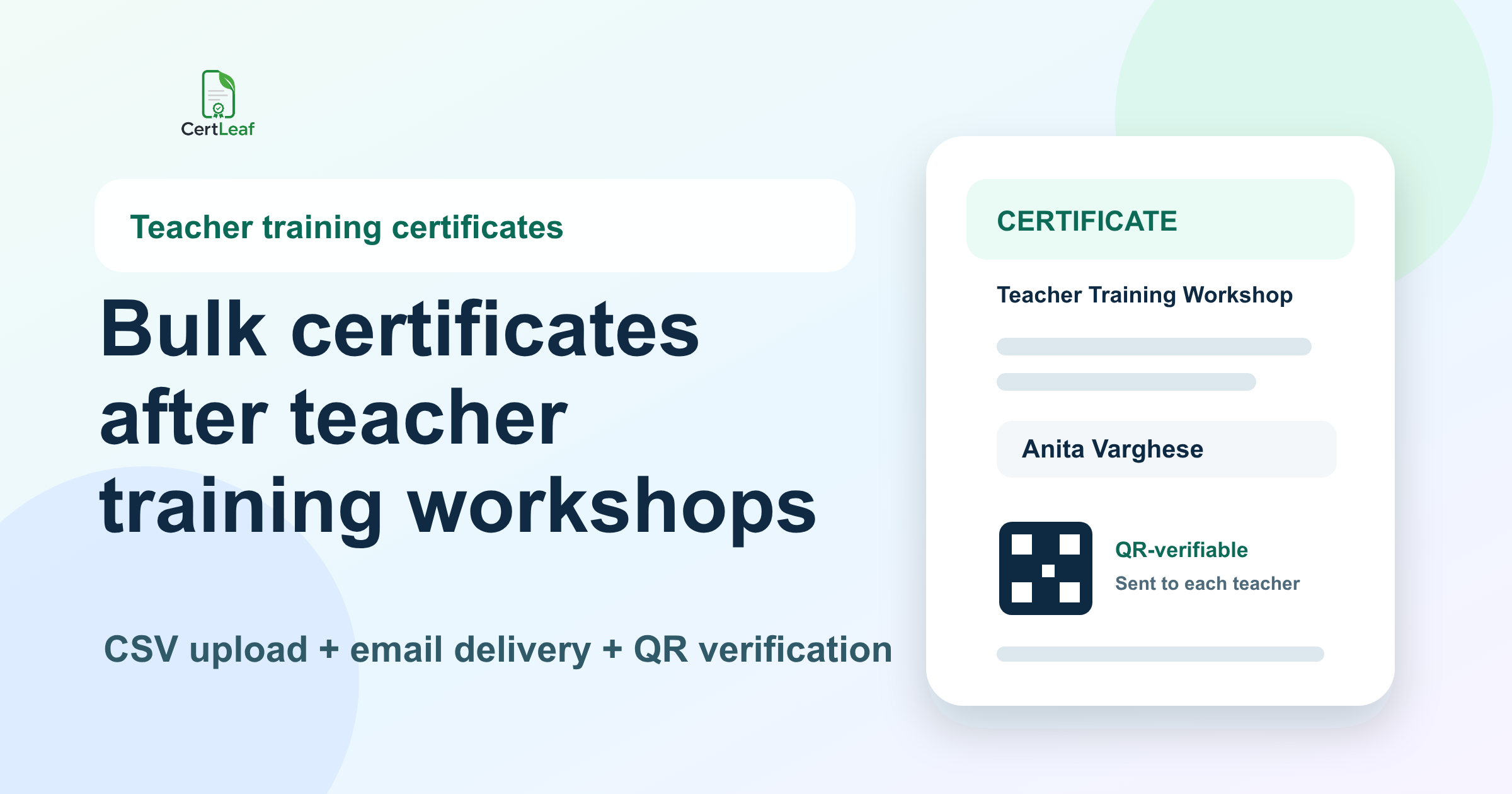
The workshop ended, but the certificate list was still open
At 5:40 pm, the resource person had left the seminar hall and the projector was finally off. The teacher training workshop on classroom assessment tools had gone well. Around 126 school teachers attended the two-day session in Kochi, the feedback form had 119 responses, and the coordinator had a WhatsApp thread full of corrections like "Please use my full name with initial" and "I joined with my school email on day one."
That is the part people forget when they search for a teacher training certificate generator. The certificate is not just a nice PDF. It is the last administrative job after attendance, feedback, names, school details, and email addresses have all moved through different files.
For a teacher training program, the sources usually look like this:
| Source | What it tells you | What can go wrong |
|---|---|---|
| Registration form | Who planned to attend | Short names, wrong school names, duplicate entries |
| Day-wise attendance | Who actually attended | Teachers signing with different email IDs |
| Feedback form | Who completed the closing step | Missing responses from genuine attendees |
| WhatsApp corrections | Last-minute name fixes | Corrections not copied into the final sheet |
| Training report | Official title and dates | Long titles breaking the certificate layout |
I would rather spend 20 minutes cleaning this table before generation than spend two evenings correcting certificates one by one.
Decide what the certificate is actually saying
Teacher training certificates can mean different things. A one-day orientation may need a participation certificate. A five-day faculty development style program may need a completion certificate. A hands-on digital pedagogy workshop may need wording that says the teacher "participated in" the training, not that they mastered every tool shown.
That distinction matters because teachers often submit these certificates to schools, departments, principals, and promotion files. If the certificate says "completed 12 hours of training", the attendance record should support 12 hours. If the workshop was an awareness session, plain participation wording is safer.
Before opening the certificate template, I would write the rule in one sentence:
"Teachers who attended both days and submitted the feedback form will receive the teacher training participation certificate."
That sentence helps everyone. It tells the volunteer which rows to include. It gives the coordinator a clear answer when someone asks why their certificate is missing. It also keeps the certificate wording honest.
Make one final issuing sheet
Most certificate mistakes start because there are too many almost-final spreadsheets. One file has the registration names. Another has attendance. The feedback export has better email addresses. The WhatsApp corrections are sitting in a phone, not the sheet.
For bulk teacher training certificates, I would create one final issuing sheet with only the fields that need to appear on the certificate or support delivery:
nameemailschool_nametraining_titletraining_datesorganizer_namecertificate_type, if there are participation and completion versions
Keep the rest outside the issuing file. The full attendance history may be useful for records, but it does not need to be mapped into the certificate template.
The awkward rows deserve a test before the full batch. Pick the teacher with the longest name. Pick a school name that runs across a line. Pick the longest workshop title, something like "Integrating Formative Assessment and AI Tools in Middle School Classrooms". If those rows fit cleanly, the normal certificates usually behave.
Email delivery is part of the certificate work
Generating certificates is only half the job. Sending them is where the follow-up starts.
In one training program, a coordinator may have 90 teachers from government schools, 25 from private schools, and a few external participants who used personal email IDs. If certificates are downloaded into a folder and attached manually, the coordinator still has to match each PDF to the right person. That is slow, and it is easy to send a certificate to the wrong teacher when names are similar.
A teacher training certificate generator with email delivery should let the coordinator use the final sheet as the source of truth. The same row that generates the certificate should decide where it gets sent. If the email column is wrong, fix the sheet first. Do not fix the batch manually after sending.
Why QR verification helps for teacher training certificates
QR verification is not only about stopping fake certificates, though that matters. It also reduces small verification requests later.
A principal may want to check whether a certificate is real before adding it to a teacher's file. A training institute may need to confirm a participant months after the workshop. A teacher may forward the certificate during an application process. A QR-verifiable certificate gives each certificate a public verification page instead of forcing every check back to the coordinator.
The QR code should not be treated as decoration. It should connect to a certificate record that matches the issued PDF. If the name, training title, date, or certificate ID can be checked from the verification page, the certificate becomes easier to trust.
Where CertLeaf fits
CertLeaf is useful when the certificate work has moved beyond a small manual batch. You create a reusable certificate template, upload the final CSV, map fields like name and school, generate certificates in bulk, and send them by email. If you choose QR-verifiable certificates, each certificate can include a QR code linked to a public verification page.
The practical benefit is not that the coordinator gets a fancier design tool. Canva and similar tools are fine for design. The real benefit is that CertLeaf handles the boring issuing workflow: bulk generation, email delivery, and verification.
It also fits training budgets because it is pay-as-you-go. There is no subscription required just to issue certificates after one workshop or one training cycle. New users can test the workflow with 20 free credits, and Indian teams can buy credit packs in INR through Razorpay.
A simple workflow I would use next time
I would not start with the design. I would start with the final issuing sheet.
First, merge registration, attendance, and feedback into one clean list. Then decide the certificate rule and remove anyone who does not meet it. After that, fix names, school names, and email IDs. Only then would I upload the certificate design and test a few awkward rows.
Once the test certificates look right, the full batch can be generated and sent. The coordinator should still keep the final CSV because it becomes the record of what was issued.
This sounds slower at the beginning, but it prevents the worst kind of follow-up: finding out after sending that 30 certificates used the wrong workshop title or that five teachers received someone else's PDF.
Related certificate workflows
For completion certificates, set attendance and feedback rules before issuing.
After approval, send workshop certificates by email automatically.
FAQ
What is a teacher training certificate generator?
A teacher training certificate generator is a tool that creates certificates for teachers who attend a workshop, orientation, FDP-style session, or training program. A useful one should support bulk generation from a spreadsheet, not just one certificate at a time.
Can teacher training certificates be issued in bulk?
Yes. If the participant data is clean, teacher training certificates can be issued in bulk from a CSV or spreadsheet. The important step is preparing one final issuing sheet with names, email addresses, school names, training title, and dates.
Should teacher training certificates include QR verification?
QR verification is useful when certificates may be checked later by schools, departments, principals, or other institutions. The QR code lets someone verify the certificate record online instead of asking the organizer to confirm it manually.
Can certificates be sent by email automatically?
Yes. CertLeaf can generate certificates in bulk and send them by email using the recipient details in the uploaded CSV. That avoids downloading hundreds of PDFs and attaching them one by one.
What should be checked before issuing teacher training certificates?
Check the eligibility rule, final name spelling, school name, training title, dates, email address, and certificate wording. Test the longest names and titles before generating the full batch.
The certificate should not become a second workshop
A teacher training workshop already has enough moving parts: attendance, trainers, venue, lunch, feedback, reports, and participant questions. Certificates should not become another full project after everyone goes home.
The clean way is simple. Decide the rule. Clean one sheet. Test the awkward rows. Generate the certificates in bulk. Send them by email. Keep them QR-verifiable if the certificate may need to be checked later.
That is the workflow I would want before the next training calendar starts filling up.