CertLeaf
Entrepreneurship Development Program Certificate Generator: From Attendance to Bulk Issue
A practical workflow for colleges and training institutes that need to turn EDP attendance, assignments, and mentor approvals into bulk certificates with email delivery and QR verification.
At 7:35 pm on the last day of a five-day entrepreneurship development program in Bengaluru, the demo tables had been cleared but the certificate sheet was still open.
The college innovation cell had 112 registrations, 89 learners marked present on at least four days, 73 pitch decks, and 76 names in a file called EDP_certificate_final.xlsx. Two teams had submitted one deck between them. A participant who attended every session had used a different email for the mentoring portal. Three learners had helped at the closing showcase but had not completed the program exercises.
The coordinator did not have a PDF problem yet. She had a decision problem.
An entrepreneurship development program certificate generator can remove the repeated work of creating, emailing, and verifying the final certificates. It should not decide who completed the program. That decision needs to be settled in the attendance, assignment, and mentor records first.
| Program record | What it can confirm | What still needs a decision |
|---|---|---|
| Registration export | Who enrolled and the original email | Who actually participated |
| Daily attendance | Session presence | How many sessions count as completion |
| Pitch or exercise tracker | Required work submitted | Whether team submissions cover every member |
| Mentor sign-off | Review or presentation completed | How approved exceptions are recorded |
| Final certificate CSV | Who will receive which certificate | Nothing unresolved should remain here |
For that Bengaluru batch, I would stop comparing totals and write the certificate rule in one sentence.
Define what the EDP certificate records
Entrepreneurship development programs vary. One college may run a two-day idea workshop. A training institute may run six weeks of classes, mentor reviews, customer interviews, and a final pitch. Both can issue certificates, but the wording should not imply the same outcome.
A participation certificate can record attendance in the program. A completion certificate should mean that the learner met the published completion requirements. A recognition certificate can record a specific outcome such as best validated idea or final showcase selection, provided the program has an approved result.
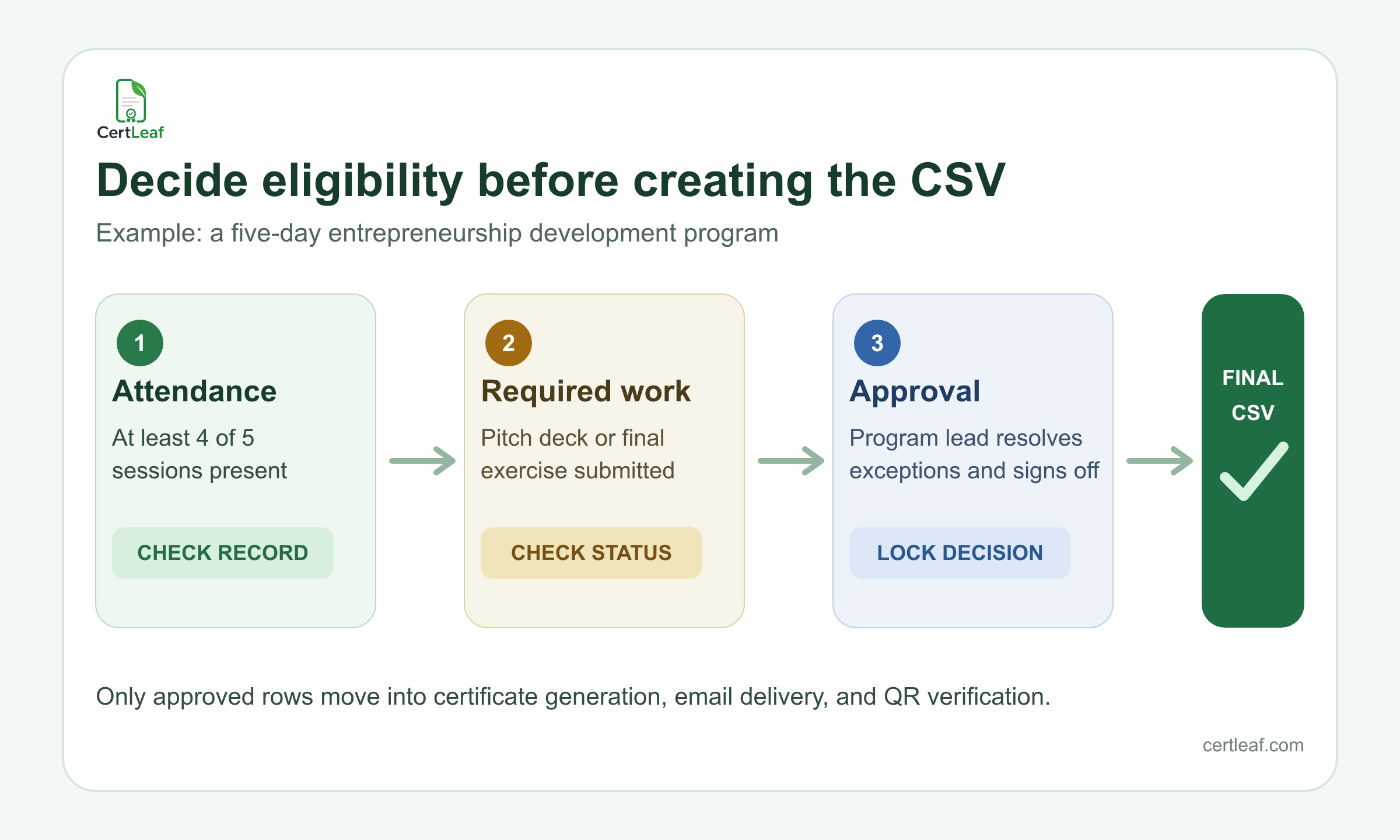
I would write the rule before filtering names. For example:
> A completion certificate is issued to learners who attended at least four of five sessions, submitted the final pitch exercise by 12 September 2026, and received program-lead approval.
That sentence identifies the threshold, required work, deadline, and owner. If your EDP runs across several days, the existing guide to setting certificate eligibility from multi-day training attendance is the useful next step for merging daily records and handling identity mismatches.
Do not change a completion rule quietly because the eligible count looks low. If the program lead approves a genuine exception, record the learner, reason, approver, and date. The person preparing certificates should not be forced to interpret a mentor's WhatsApp message at the last minute.
Keep participation, completion, and recognition separate
At a Kochi startup bootcamp, a team nearly gave every attendee a certificate that said "successfully completed the venture validation program." Some people had joined only the opening day. Others attended the classes but skipped the final customer-interview exercise. Four teams presented at the showcase.
The single certificate design was ready. The single claim was not.
I would create separate approved batches when the meaning changes. Participation rows use participation wording. Completion rows come from the completion rule. Recognition rows come from the final result sheet. The visual design can remain consistent across all three, but the title and fixed sentence need to match the evidence.
This is particularly important when a learner legitimately receives two certificates. Someone may complete the EDP and also receive recognition for a pitch. Those are two intentional records, not a duplicate to delete.
Build one working sheet before the issuing CSV
The working sheet is where the messy evidence belongs. Keep one row per learner identity, then add the fields needed to review the rule: daily attendance, exercise status, mentor approval, exception note, and final outcome.
Match exact email addresses first, but expect a short exception pass. College learners often register with an institutional address and submit work through a personal account. Team projects can also hide individual records. A pitch deck labelled with a startup name does not automatically prove which four people completed the required work.
For the Bengaluru program, one learner appeared as A. Meera Nair in registration, Meera Nair in attendance, and [email protected] in the pitch tracker. The college email and personal email were already connected in the mentor's review file. That was enough to merge the evidence after a human check. A name resemblance alone would not have been enough.
Use a small set of review states such as eligible, review, and not_eligible. The middle state matters because it gives unresolved rows somewhere honest to sit. Without it, people tend to include doubtful names "for now," and temporary decisions leak into the final certificate file.
Export only the fields needed for issuing
The program workbook may contain phone numbers, startup ideas, mentor comments, assessment notes, funding interests, and private exception details. The certificate workflow does not need all of that.
A practical EDP issuing file might contain:
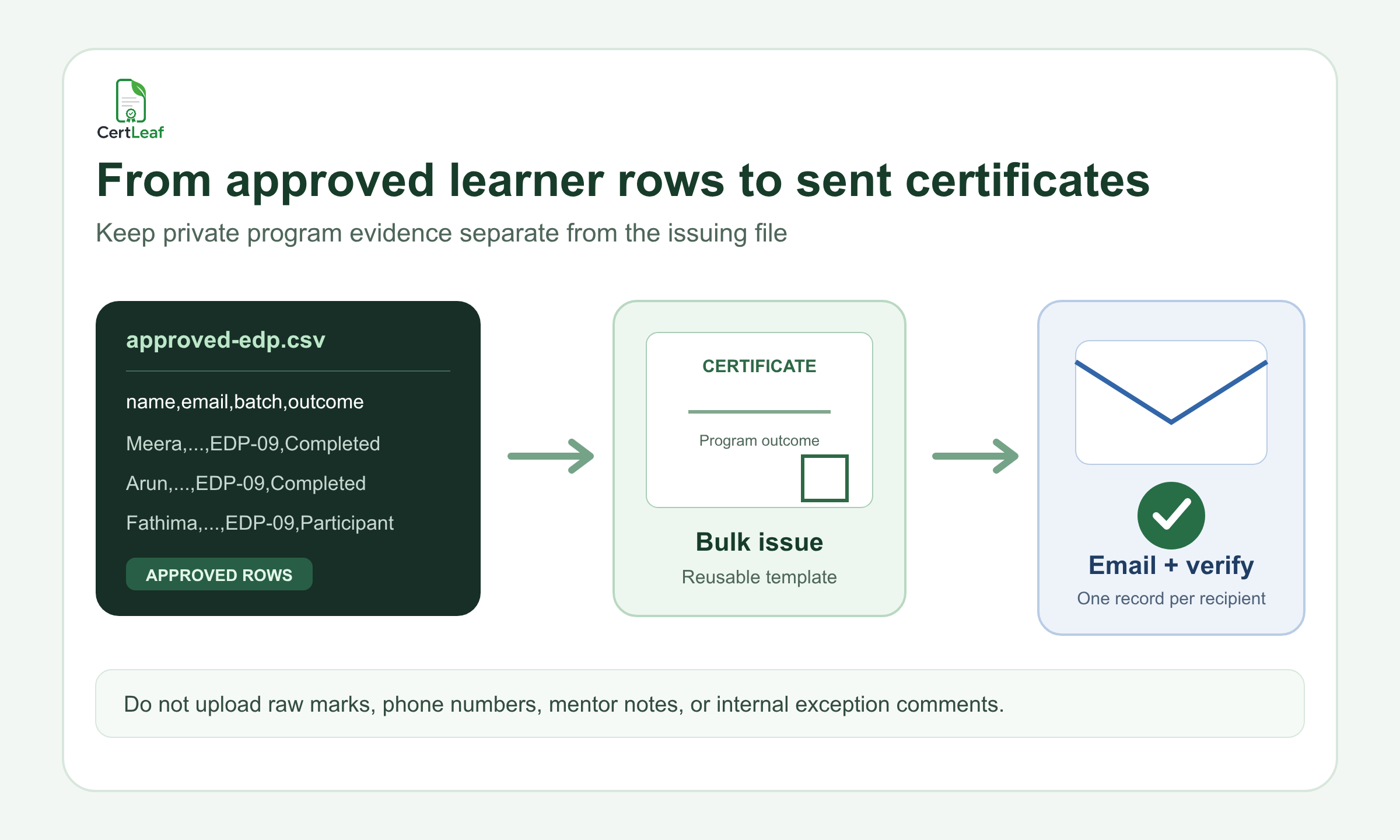
recipient_name,recipient_email,program_name,batch_name,program_outcome,completion_date
Add a certificate ID if it is part of the planned record. Add a team or project name only when the program has approved it for public display. Keep raw marks and mentor notes in the private program workbook.
Before export, use the certificate recipient CSV preparation workflow to check certificate-ready names, duplicate identities, email addresses, and awkward values. The final CSV should contain approved outputs, not unresolved program evidence.
At a Pune EDP, the longest startup-track title was "Circular Economy and Sustainable Product Innovation." It fitted the spreadsheet cell and ran straight into the signature area on the first certificate proof. This is why I test the longest program name, the longest recipient name, every certificate outcome, and one row with optional fields left blank.
What an entrepreneurship program certificate should include
The certificate should answer the ordinary questions a learner or reviewer will have later: who received it, which program it records, who issued it, when the program happened, and what the outcome means.
For most EDP certificates, that means the recipient name, program title, date or date range, issuing institution, certificate type, and approved signatory details. A batch name can help when the same program runs several times a year. A certificate ID and QR verification path are useful when learners may share the document with placement teams, incubators, partners, or future course providers.
Avoid claims the program cannot support. "Completed a five-day entrepreneurship development program" is clear. "Certified entrepreneur" suggests a broader status that a short college program may not establish. The certificate should preserve the program's real achievement rather than inflate it.
Use QR verification without exposing the program file
A QR-verifiable certificate can give an outside reviewer a direct way to compare the issued record with the PDF. The public view should show only what is needed to identify the certificate, such as the recipient, program, date, outcome, and certificate ID.
It should not reveal attendance percentages, private mentor comments, phone numbers, raw scores, or the participant's business idea. Verification is a public record check, not a window into the EDP workbook.
If the institute wants a stable reference policy, the guide to QR-verifiable training certificates with unique certificate IDs explains ID patterns, correction handling, and QR testing in more detail.
Scan the QR code from an exported sample PDF, not only from the template screen. Confirm that the page opens without an organizer login and that the visible details match the sample. Then repeat the test with another row to make sure different certificates do not lead to the same record.
Where CertLeaf fits after approval
CertLeaf handles the issuing work after the college or training institute has approved the participant rows.
Upload a base certificate design, place the changing fields, and save it as a reusable template. Import the final CSV, generate the approved certificate batches, distribute them by email, and use QR-verifiable certificates when the records need a public verification route.
CertLeaf does not run attendance, evaluate pitch decks, score startup ideas, or approve program completion. The EDP team owns those decisions. Keeping that boundary clear makes the workflow easier to trust: program evidence stays with the institution, while repeated certificate generation, delivery, and verification happen from the final approved data.
The pay-as-you-go credit model also suits colleges and institutes that run entrepreneurship programs in occasional cohorts. There is no subscription to keep active between batches, and new accounts receive 20 free credits for a small test.
I would use the test on the rows most likely to reveal a problem: the longest name, the longest program title, one participation certificate, one completion certificate, and one recognition certificate if the program uses it. Email the samples to internal addresses, inspect the PDFs, and test each QR path before the full batch.
Keep late approvals out of the original batch
Some EDP decisions arrive after the first issue. A mentor confirms that a team submitted before the deadline. A coordinator finds an attendance scan under another email. A pitch result is corrected.
Do not replace the original CSV and rerun everyone. Record the new approval, then issue only the affected learner in a small supplementary batch. If a name correction is needed, keep a note of the original value, corrected value, approval, and reissue date.
That keeps the first batch understandable. It also avoids sending duplicate certificates to 80 learners because two rows changed.
Entrepreneurship development program certificate generator FAQ
Can I generate EDP certificates from an Excel or CSV file?
Yes. First apply the program's attendance, submission, and approval rules in a working sheet. Export only the approved recipient rows and certificate fields to CSV, then use that file for bulk generation and email delivery.
What is the difference between an EDP participation and completion certificate?
A participation certificate records involvement or attendance under the program's stated rule. A completion certificate should mean the learner met every published completion requirement, such as attendance plus a pitch exercise or mentor approval.
Should entrepreneurship program certificates include project names?
Only when the institution has approved the project name for public display and the wording will remain accurate. Keep draft ideas, private mentor notes, and sensitive business information out of the certificate and verification page.
Can one learner receive both a completion and recognition certificate?
Yes, when the program has approved two distinct outcomes. Keep them as two intentional records and use wording that makes the difference clear.
Are QR-verifiable EDP certificates useful?
They are useful when learners may share certificates with placement teams, incubators, employers, colleges, or partners. The QR path lets a reviewer compare the PDF with the issuer's certificate record.
Does CertLeaf decide who completed the entrepreneurship program?
No. The college or training institute decides attendance rules, exercise requirements, mentor approvals, and exceptions. CertLeaf supports reusable templates, bulk CSV issuing, email delivery, and QR verification after those decisions are complete.
Approve the decision, then issue the batch
The Bengaluru coordinator's problem became manageable when the team stopped asking why the files had different totals and agreed on one completion rule. The pitch tracker resolved two alternate-email records. The program lead reviewed five exceptions. The approved first batch contained 74 completion certificates, plus a separate participation batch for learners who met the attendance rule but not the final exercise.
That is the order I would repeat. Define what the certificate means. Resolve uncertain identities. Approve the outcome. Export a small issuing CSV. Test the difficult rows, then generate, email, and verify the batch.
An entrepreneurship development program certificate generator removes repeated certificate work. The institution still makes the decision that gives every certificate its meaning.