CertLeaf
World Radiography Day Certificate Generator for Workshops and CME Events
Issue World Radiography Day certificates in bulk for workshop attendees, speakers, presenters, volunteers, and radiography teams with email delivery and QR verification.
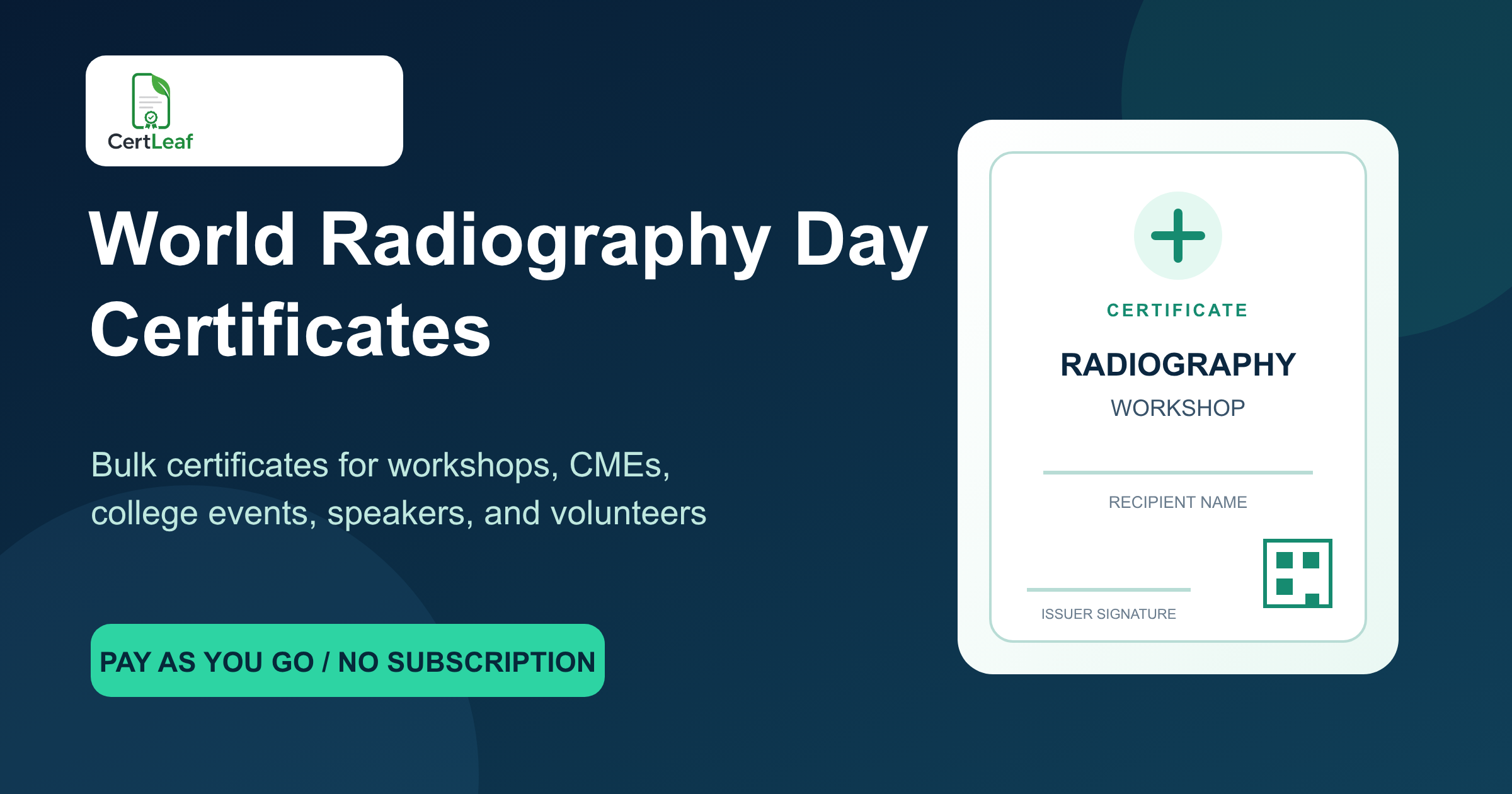
Radiography departments, allied health colleges, diagnostic centers, and professional associations often use World Radiography Day for serious educational programs: technical workshops, CME sessions, research presentations, guest lectures, webinars, and student events. Those programs deserve a certificate platform that can preserve the difference between attending, completing, presenting, teaching, and organizing.
CertLeaf is built for that issuing job. The team can prepare reusable certificate templates, import an approved recipient CSV, generate a complete batch, send each certificate by email, and add QR verification when a recipient may need to share the record later. Credits are pay-as-you-go, with no subscription to keep active after the event.
World Radiography Day is observed on November 8 each year. In 2026, it falls on a Sunday. A department preparing a November 8 program can set up its certificate types before registrations close, test the awkward names and long session titles, and leave the final recipient approval with the people who actually own the event record.
That last point matters in this segment: CertLeaf issues the record the organizer approves. It does not award CME or CPD credit, validate clinical skill, determine attendance, or accredit a radiography program.
A radiography event rarely has only one kind of recipient
A one-day program may include students at an awareness lecture, staff in a hands-on session, invited faculty, research presenters, moderators, volunteers, and an organizing committee. Flattening those roles into one generic certificate makes the documents less useful and can overstate what some recipients did.
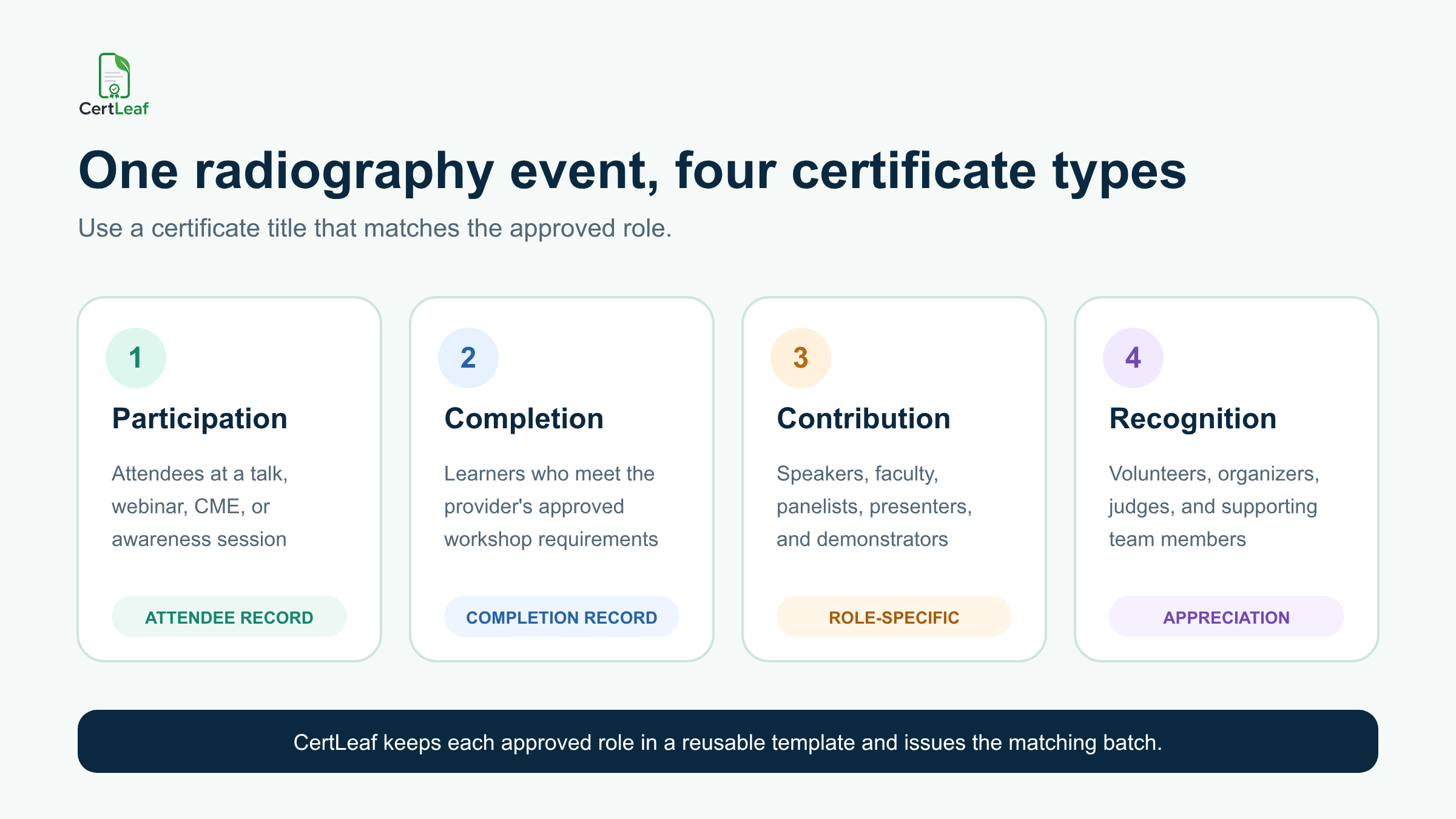
A practical certificate set usually needs only a few clear categories:
Participation: For approved attendees at a lecture, webinar, awareness program, scientific meeting, or CME event.
Completion: For learners who met completion terms defined by the provider for a workshop or structured program.
Contribution: For speakers, faculty, panelists, presenters, moderators, judges, or demonstrators.
Recognition: For volunteers, organizing staff, coordinators, and supporting teams.
The title should match the evidence behind it. A person who joined a lecture should not receive a completion certificate by default. A poster presenter should not get the same wording as a general attendee. A volunteer certificate should acknowledge service without suggesting clinical training.
CertLeaf lets the issuer save separate templates for these meanings while keeping a consistent event identity. The logo, date, signatories, color system, and fixed event details can remain aligned. The title, role wording, and mapped fields can change where the record requires it.
Professional bodies with a year-round member education calendar can extend this approach beyond November 8. The article on using a CPD certificate generator for professional associations covers recurring webinars, regional programs, conferences, and short courses in more detail.
Put the approval boundary before the bulk issue button
A radiography certificate can look formal even when the underlying wording is vague. The organizer should settle four questions before building the batch:
Who owns the approved recipient list?
What does each certificate confirm?
Which body, if any, approved CME or CPD hours?
Which details are suitable for a public certificate and verification record?
CertLeaf should receive the answers, not invent them. A hospital department may approve staff participation. A college may approve student presentations and winners. A professional association may approve member attendance and learning hours. A training provider may confirm workshop completion under its own published terms.
The platform then turns those approved facts into issued certificates. It does not replace a hospital learning system, association membership database, attendance tool, assessment platform, regulator, or accreditation process.
This separation is commercially useful, not a limitation hidden in the fine print. Radiography teams can keep their existing systems and use CertLeaf only for the repetitive certificate work: personalization, batch generation, delivery, and verification.
If your November 8 recipient categories are already approved, sign up for CertLeaf and use the 20 free signup credits to test one attendee, speaker, presenter, and volunteer certificate before committing the full batch.
Treat CME and CPD wording as controlled event data
The letters "CME" or "CPD" should not be added because they make a certificate sound more valuable. Use them only when the authorized event owner has approved the program description and any stated hours or points.
A certificate might include the recipient name, program title, provider, date, certificate type, and an approved number of hours. It should not say that CertLeaf accredited the program or independently confirmed the credit. CertLeaf did neither.
The same discipline applies to completion language. If the provider required attendance at two sessions, a practical demonstration, or an assessment, that decision belongs in the provider's source record. CertLeaf can print the approved result. It does not evaluate clinical competence or decide whether the requirement was met.
For a World Radiography Day lecture without formal credit, a straightforward participation certificate may be more accurate than a document labeled CME completion. Specific, modest wording is more useful than a stronger claim the issuer cannot support.
Build templates that remain useful after November 8
World Radiography Day creates a timely reason to prepare the certificate setup, but the templates should not become disposable November artwork.
A radiography department can keep a participation template for technical seminars, a completion template for structured workshops, a contribution template for faculty, and a recognition template for event teams. For the next program, update the title, date, issuer details, and approved fields instead of rebuilding every layout.
Useful dynamic fields may include:
recipientName, programName, recipientRole, certificateType, eventDate, sessionTitle, presentationTitle, approvedHours, and certificateId
Not every template needs every field. A speaker certificate may need the session title but no approved hours. A student presentation certificate may need a poster title. A volunteer certificate may need only the role and event name.
Test real edge cases before the final issue. Use the longest recipient name, the longest department or institution name, the full event title, a poster title, and a row with every optional field present. Check that nothing collides with the signatory area or becomes unreadably small.
When QR verification is enabled, leave proper space for the CertLeaf QR code. Do not draw a fake QR code into the certificate background. The useful part is the recipient-specific verification record behind the code.
Use a certificate CSV, not a copy of a clinical system
Healthcare and educational teams already handle information that has no place in a certificate tool. A World Radiography Day issuing file should stay deliberately narrow.
A practical starting structure is:
recipientName,email,programName,role,certificateType,eventDate,certificateId
Add institutionName, sessionTitle, presentationTitle, or approvedHours only when the certificate or verification record genuinely needs the value.
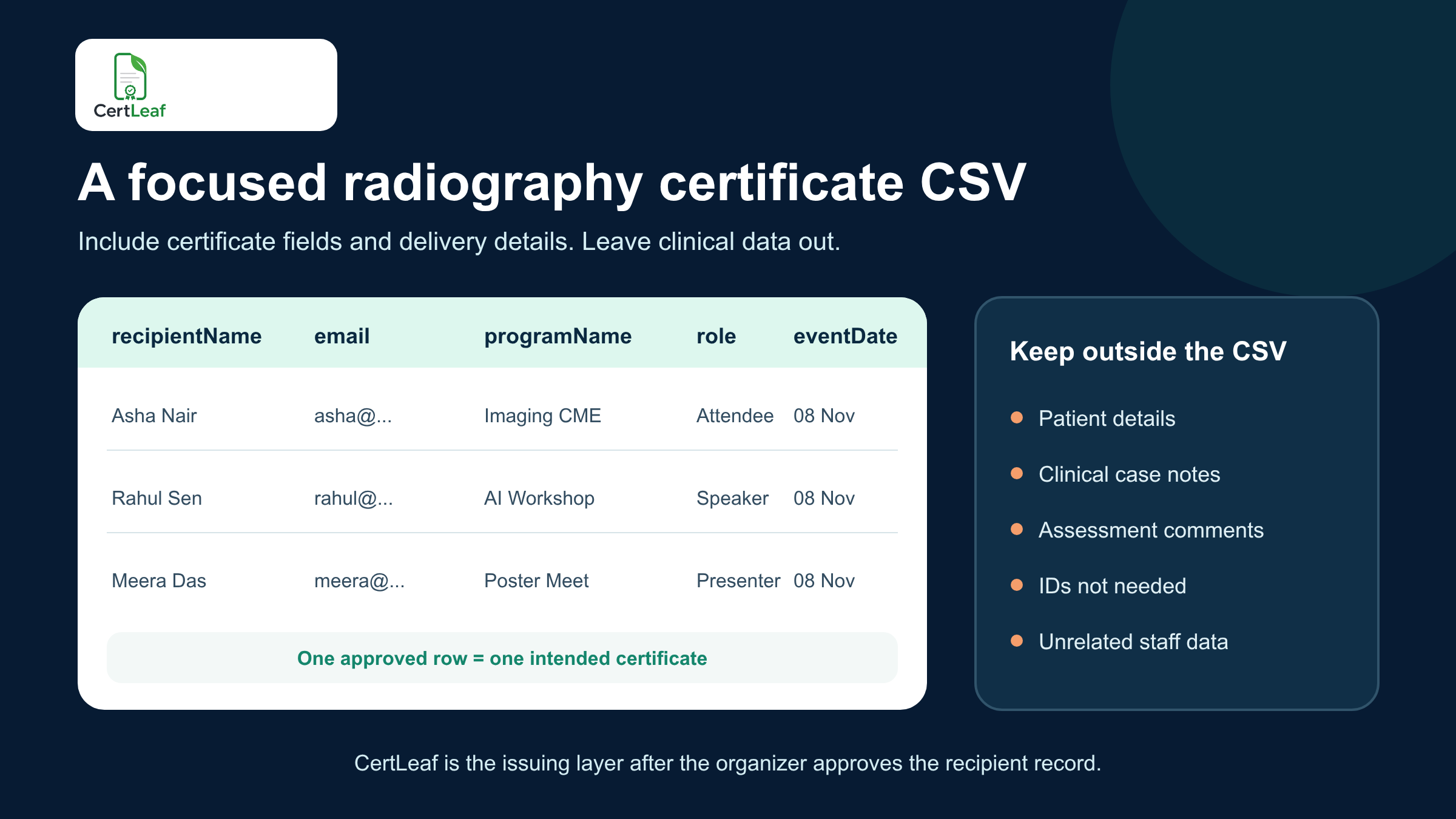
Patient information, clinical case notes, medical images, assessment comments, unnecessary employee identifiers, and unrelated staff data should stay outside the CSV. The certificate process needs approved recipient and event details, not the source system around them.
One approved row should also equal one intended certificate. If a faculty member spoke at the event and completed a separate workshop, decide whether that creates one contribution record, one completion record, or two certificates. Do not let a duplicate spreadsheet row make the choice accidentally.
A final check should cover duplicate emails, similar names, blank certificate types, unexpected role labels, and long field values. The guide to preparing a certificate recipient CSV without name or email errors gives a focused method for cleaning the issuing file without turning it into a second database.
Have the approved list ready? Try the radiography event use case in CertLeaf with 20 free signup credits. Generate a small internal batch, send it to addresses your team can open, and inspect the exported certificates before buying credits for the full list.
Email delivery should stay connected to the approved row
Generating the PDF is only half the job. The correct recipient still needs the correct certificate.
Manual distribution gets awkward when the folder contains several similar layouts. An attendee file and a speaker file may share the same event name and branding. Renaming downloads and attaching them one by one creates another opportunity to omit a recipient or send the wrong record.
CertLeaf uses the email address in the approved row for delivery. The same row that supplies the recipient name, role, program, date, and certificate type also identifies where the finished certificate should go.
The message can stay short: name the program, identify the certificate, explain how to request a genuine correction, and mention QR verification if the certificate includes it. For student programs, the institution should decide whether delivery goes directly to students or through a department coordinator. For staff events, follow the organization's approved delivery route.
Send internal samples for every certificate category. Check the name, title, role, issuer, date, signatory, inbox, and access experience on both phone and desktop. A test that covers only the shortest attendee name tells the team very little.
QR verification confirms the issued record, not clinical ability
Radiography certificates may later appear in professional portfolios, institutional files, association submissions, student activity records, or staff learning records. A QR-verifiable CertLeaf certificate gives the next viewer a direct route to compare the document with the public record created by the issuer.
The page can show suitable certificate facts such as recipient, issuer, program, certificate type, date, and certificate ID. It should not expose patient details, private assessment notes, internal staff comments, or information that never belonged on the public certificate.
The boundary should be explicit: the QR route confirms that the issuer created a matching certificate record through CertLeaf. It does not independently prove attendance, award CME or CPD credit, verify licensure, validate a research presentation, or certify clinical competence.
For programs where the record may be checked months later, the guide to QR-verifiable training certificates with unique certificate IDs explains how a stable reference and public verification page can work together.
CertLeaf fits uneven radiography event schedules
Certificate volume in this segment is rarely flat. A college may issue 220 records after a World Radiography Day program and 45 after a later technical workshop. An association may have one large annual meeting and several smaller webinars. A diagnostic center may issue only around occasional staff sessions.
CertLeaf uses pay-as-you-go credits, so those organizations do not need a monthly subscription between batches. A simple certificate uses 1 credit. A QR-verifiable certificate uses 2 credits. New accounts receive 20 free signup credits, and India-first customers can purchase credits in INR through Razorpay.
Use the free credits as a proof set. Include each template type, the longest fields, at least one internal email delivery, and a QR-verifiable sample. Then calculate the full credit requirement from the approved recipient count and certificate option.
Practical setups for three common organizers
Allied health college or radiography department
Prepare participation, presenter, speaker, winner, and volunteer records for lectures, poster sessions, quizzes, demonstrations, and department events. Keep the certificate CSV separate from student files and any clinical teaching material.
Diagnostic center or hospital imaging team
Issue approved certificates for internal learning sessions, equipment application workshops, technical updates, and invited faculty. CertLeaf can document the approved program record, but it does not certify professional competence or regulatory compliance.
Radiography association or training provider
Maintain separate member, attendee, speaker, moderator, and completion templates across scientific meetings, webinars, and short courses. Add hours or points only when the authorized provider has approved them, and keep membership or assessment systems outside CertLeaf.
FAQ about World Radiography Day certificates
When is World Radiography Day 2026?
World Radiography Day is observed annually on November 8. In 2026, November 8 falls on a Sunday. An organization may schedule its related workshop or education program on the date or on a nearby day that fits its audience.
Can CertLeaf generate World Radiography Day certificates in bulk?
Yes. The organizer can prepare an approved CSV with one row per intended certificate, map the fields into a reusable CertLeaf template, generate the batch, and send the certificates by email.
Can speakers, attendees, and poster presenters get different certificates?
Yes. Use separate template types or batches for participation, completion, contribution, presentation, awards, and recognition. The responsible organizer decides which record each recipient receives.
Does a CertLeaf certificate award CME or CPD credit?
No. CertLeaf issues the certificate that the event provider approves. It does not accredit the program, award credit, validate attendance independently, or certify professional or clinical competence.
What data should be excluded from a radiography certificate CSV?
Exclude patient details, medical images, clinical case notes, private assessment material, unnecessary employee identifiers, internal comments, and unrelated HR or membership data. Include only what is needed for certificate personalization, delivery, and the approved verification record.
Should every radiography event certificate include a QR code?
No. QR verification is most useful when the recipient may share the certificate outside the event and a later viewer needs a route to check the issued record. A simple internal appreciation certificate may not require it.
Is CertLeaf subscription-based?
No. CertLeaf uses pay-as-you-go credits with no subscription. New accounts receive 20 free signup credits, and India-first customers can purchase credits in INR through Razorpay.
Prepare the certificate layer before the event roles get mixed together
A World Radiography Day program can create valid records for attendees, completers, presenters, speakers, moderators, judges, volunteers, and organizers. The certificate system should preserve those roles without pulling clinical data into the process or turning an attendance record into an unsupported professional claim.
CertLeaf handles the focused work: reusable templates, bulk CSV issuing, email delivery, optional QR verification, and pay-as-you-go credits. Set the certificate meanings first, approve the rows, test the difficult examples, and let the platform issue the batch without a recurring subscription.