CertLeaf
Credly Alternative for Certificates: Simple QR-Verifiable Certificates for Events and Courses
A careful guide for event and course teams deciding between a badge-centered digital credential platform and a focused tool for bulk certificate PDFs, email delivery, and QR verification.
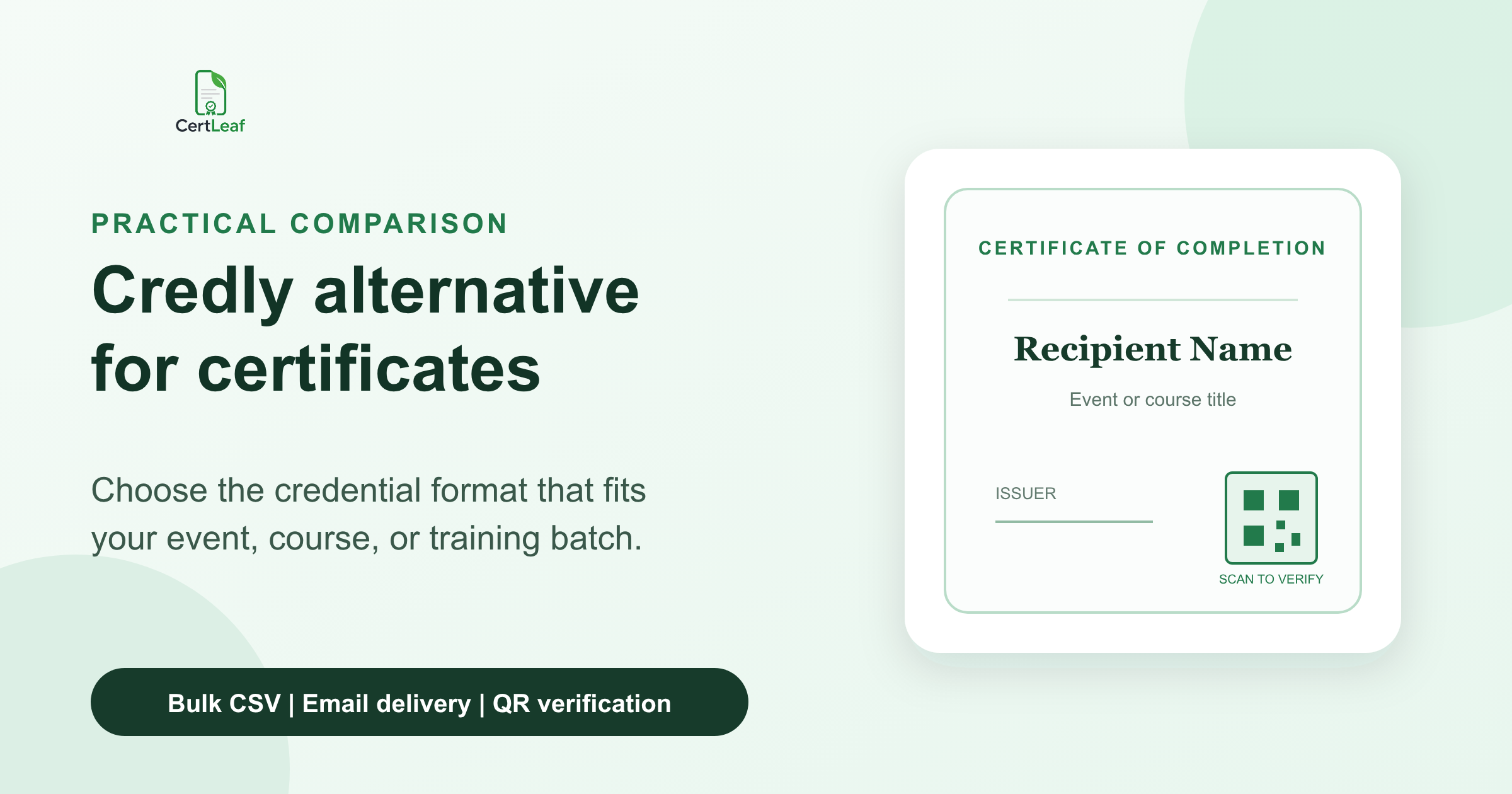
At a Bengaluru training institute, a Friday close-out meeting has drifted from certificate wording into a bigger question: should this two-day product workshop issue digital badges or certificate PDFs?
The course lead has a Credly page open on the projector and likes the idea of a credential learners can share. Beside her, the operations coordinator has the approved participant sheet and the certificate design. His job for Monday is more literal: import the names, generate the PDFs, email each participant, and give anyone checking a certificate a verification route.
The disagreement is useful. They are choosing between two different artifacts.
That is the useful starting point when searching for a Credly alternative for certificates. Credly describes its badges as digital representations of learning outcomes, experiences, or competencies, based on the Open Badges standard and linked to contextual metadata. Some programs need that badge-centered model. A workshop, competition, short course, or training batch may mainly need accurate certificate PDFs sent in bulk with QR verification.
This article does not rank one format above the other. It helps an event organizer, training institute, course creator, or college team decide what the recipient should actually receive.
The artifact decision at a glance
| Decision point | Consider a badge-centered platform | Consider a focused certificate tool |
|---|---|---|
| Main artifact | A data-rich digital badge | A certificate PDF with an optional QR verification route |
| What the recipient does | Accepts, manages, and shares a badge | Downloads, prints, submits, or forwards a certificate |
| Meaning carried | Structured context attached to the credential | Certificate wording plus the issuer's online record |
| Program shape | Continuing skills or achievement program | Event, course, workshop, or training batch |
| Team responsibility | Maintain the wider credential experience | Approve, issue, deliver, and verify certificates |
The table is deliberately about format and operating fit, not feature superiority. Credly also documents downloadable and printable badge certificates. CertLeaf does not claim to reproduce an Open Badge ecosystem. Confirm the exact artifact and recipient experience your program requires before choosing either route.
Digital badges, digital credentials, and QR-verifiable certificate PDFs
These terms get mixed together in software comparisons, which makes the buying decision harder than it needs to be.
A digital credential is the broad idea: digital evidence that an issuer has recognized an achievement, skill, completion, certification, or other outcome. Different providers and standards use the term in different ways.
A digital badge is a visual and data-bearing way to represent that credential. Credly says a badge issued through its platform is based on the Open Badges standard and links to metadata that provides context and verification. The badge is more than a decorative image. Its value includes the information and verification connected to it.
A certificate PDF with QR verification is a different artifact. The recipient receives a familiar certificate document. The QR code points to a public verification page where a reviewer can compare the certificate with the issuer's record. Adding a QR code does not turn the PDF into an Open Badge, and it should not be described that way.
Both approaches can support online checking. They do it through different formats and recipient experiences.
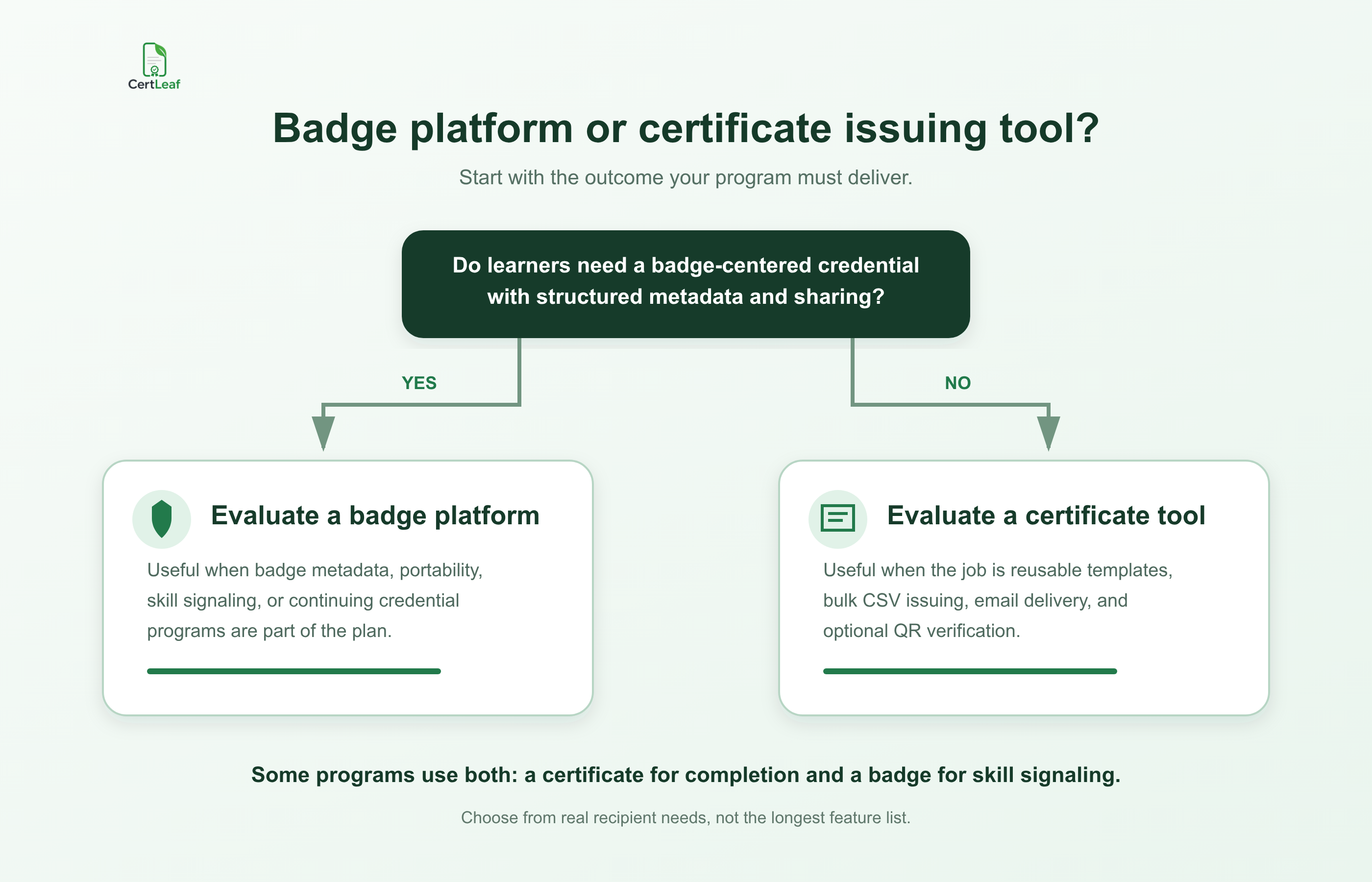
Start with what happens after the learner clicks the email
The difference becomes clearer when you follow one recipient instead of comparing product pages.
A badge-centered flow may ask the learner to accept or manage the badge, inspect the achievement details, and share it through professional or social channels. Credly's support documentation describes badge sharing, website embedding, email-signature use, and online verification. That recipient experience can be valuable when visibility and portable achievement context are part of the program.
A certificate flow usually ends somewhere else. The learner downloads a PDF, prints it for a file, uploads it to a portal, attaches it to an application, or forwards it to a coordinator. If a reviewer wants to check it, the QR code opens the issuer's record.
Neither behavior is more legitimate by default. They solve different recipient tasks. Asking, "What should Priya do with this six months later?" is more useful than asking which platform has more features.
When a Credly-style badge experience deserves a serious look
Now change the Bengaluru example. Instead of a two-day workshop, the provider runs a year-long professional learning program. Learners complete foundation, intermediate, and advanced modules. Each step represents a separate competency. The provider wants achievements to carry structured context and remain part of a continuing credential journey.
That is a real reason to evaluate a badge-centered platform.
I would take that route seriously when the badge itself is part of the learner promise: a shareable achievement with structured information behind it, not merely a different picture attached to the completion email. The team should know what each badge represents, who can earn it, which evidence or criteria support it, and how the program will maintain those definitions over time.
There is also an ownership question. Who will run the credential program after launch? A wider platform gives the team tools, but someone still has to write useful criteria, maintain issuer information, answer recipient questions, and decide how several credentials relate to one another.
If those responsibilities are intentional, broader capability is not clutter. It is the work.
When a certificate PDF is the product the learner expects
Return to the short workshop. Participants completed two days of sessions and a final exercise. They expect a certificate carrying their name, workshop title, dates, and issuer. Some will upload the PDF to a college record or include it with an application. The organizer wants those third parties to have a direct way to check the certificate.
That requirement is specific: issue the approved document to every eligible participant, deliver it, and keep a matching verification route available.
A focused certificate tool may be enough for this situation. CertLeaf supports reusable templates, bulk CSV issuing, email delivery, and QR-verifiable certificates. It does not position itself as an Open Badge platform or a replacement for every wider credential-program capability.
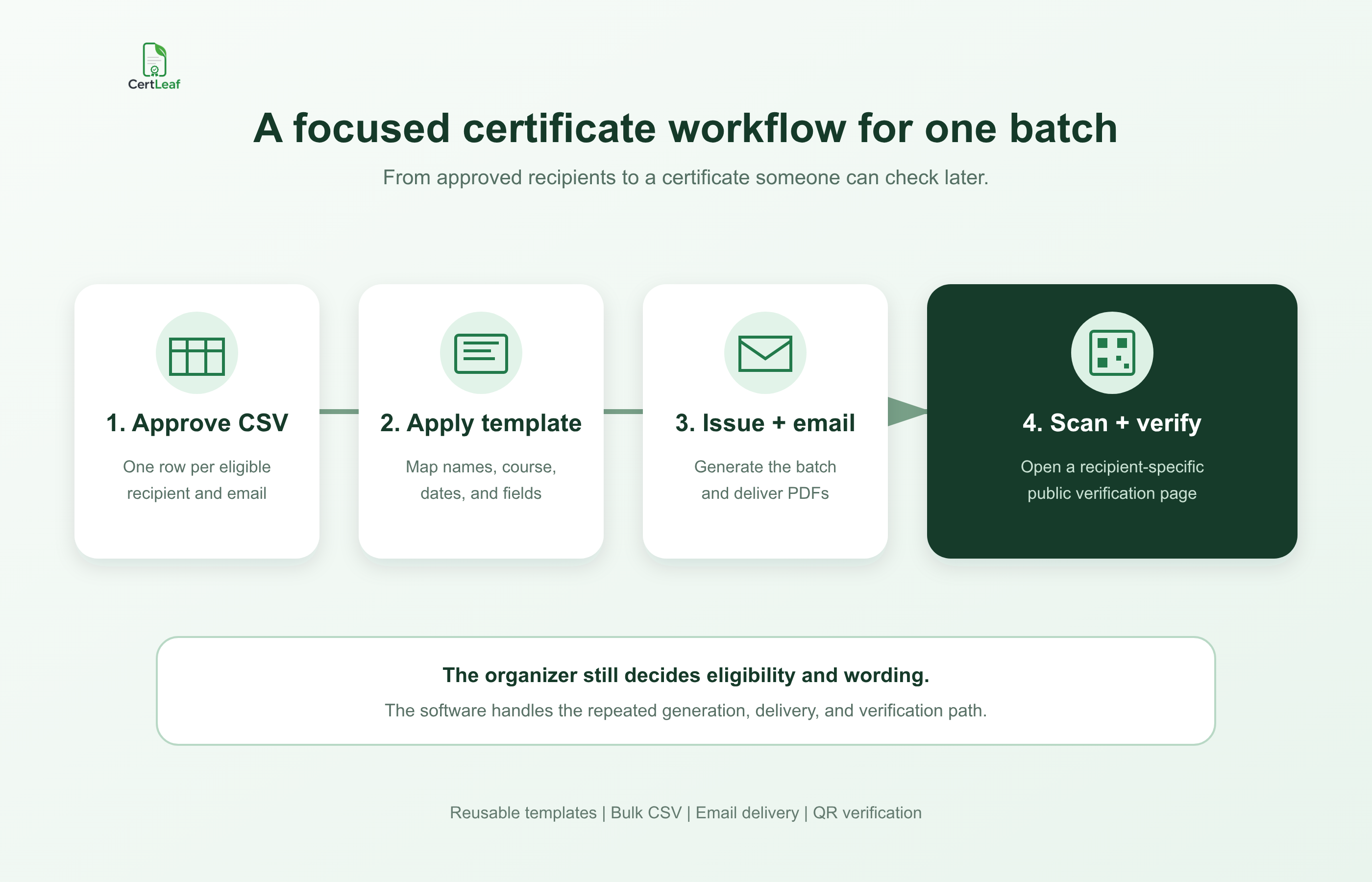
The organizer still owns the important decisions. Which participants qualify? Does the document say participation or completion? Which institute name and dates appear? The software handles the repeated generation, delivery, and verification path after those answers are settled.
For a training team ready to map that work, the bulk course completion certificate workflow covers the steps from an approved learner list to delivery.
A badge and a certificate can coexist
Some programs should not choose one artifact for every purpose.
Consider a six-month data program with three assessed modules. The provider might issue a badge after each demonstrated skill and a formal certificate after the learner completes the full course. The badges show progression. The certificate records completion of the named program.
That only works when the distinction is clear. If the same outcome is represented twice without a reason, recipients get extra files and unclear language. If each artifact has a job, using both can make sense.
Write a one-line purpose before creating either:
Badge: "Recognizes demonstrated spreadsheet modeling skill at the intermediate level."
Certificate: "Confirms completion of the six-month Data Operations Program."
The wording forces a decision about what the issuer is claiming. It also gives the learner a simple explanation when a recruiter or college asks what the artifact means.
Verification should answer a real question
A QR code can look reassuring while doing very little. It might open the event homepage, a shared folder, or a generic form. That does not necessarily confirm that this recipient received this certificate.
In CertLeaf, a QR-verifiable certificate links to a recipient-specific public verification page. A reviewer scans the code and compares the displayed details with the PDF. The purpose is a direct checking route, not a universal claim that the document is fraud-proof or equivalent to identity verification.
A digital badge also should not be judged by its artwork alone. Credly says its badges link to metadata that supplies context and verification. The underlying information is what gives the badge meaning beyond its visible image.
For either format, test the reviewer's side. Can someone outside the issuing team see who issued the recognition, who received it, what it represents, and whether the record matches? The practical guide to QR code certificates for workshops and training programs explains the certificate side of that check in more detail.
The data model should match the claim
A short event certificate may need only a recipient name, email address, event title, date, and certificate type. A structured badge program may need richer information about achievement criteria, skills, evidence, or levels.
Collecting more fields does not make a credential better. It creates more information to define, check, and maintain. Collecting too little can leave the recognition vague.
For the workshop team, one clean CSV is enough to drive the certificate batch. Before upload, the organizer resolves duplicate registrations, confirms certificate-ready names, removes ineligible rows, and checks the email column. The certificate recipient CSV preparation guide is the useful next step when the source data still lives across registration, attendance, and correction sheets.
For a badge program, ask a different set of questions. What metadata will help a learner or reviewer understand the achievement? Who approves it? Will the criteria still make sense next year? Do not copy a long metadata template unless the program can keep those fields accurate.
Where CertLeaf fits as a Credly alternative for certificates
CertLeaf is a lightweight option for teams whose main artifact is the certificate PDF and whose main work arrives in batches.
The issuer uploads a base design and turns it into a reusable template. The final recipient data comes from a CSV. CertLeaf generates the batch, supports email delivery, and can issue QR-verifiable certificates linked to public verification pages.
Its commercial model follows the same narrow scope. CertLeaf uses pay-as-you-go credits with no subscription. A simple certificate uses 1 credit and a QR-verifiable certificate uses 2 credits. New accounts receive 20 free signup credits. India-first customers can buy credits in INR through Razorpay.
That model can fit a college competition in September, a training cohort in November, and quiet months between them. A continuing badge program may justify a different operating and buying model. Do not assume one is cheaper in every situation, and do not use an unverified competitor price. Compare the current requirements, quotes, annual recipient pattern, currency, procurement route, and the work the team will actually maintain.
For teams whose calendar is irregular, the guide to a certificate generator without a subscription shows how to map a real batch to credits without turning the comparison into a headline-price contest.
A practical evaluation brief
Before requesting demos, write a six-line brief:
The exact achievement or completion being recognized
The artifact the recipient should receive
What the recipient will do with it later
What an outside reviewer should be able to check
How often the team will issue during the next year
Who owns the program after the first send
Then test the same brief in each product. For a badge platform, inspect the metadata and sharing experience. For a certificate tool, inspect the PDF, delivery email, and QR verification page. Use real wording from the next event or course rather than a generic sample called "Introduction to Excellence."
The answer may be a badge platform, a certificate tool, or both. The brief makes that answer explainable.
FAQ about choosing a Credly alternative for certificates
Is CertLeaf a Credly alternative for certificates?
CertLeaf can be a practical alternative for teams that mainly need reusable certificate templates, bulk CSV issuing, email delivery, QR verification, and pay-as-you-go credits. It does not claim to replace every digital badge, Open Badge, credential-sharing, integration, analytics, or enterprise capability associated with broader credential platforms.
What is the difference between a Credly badge and a QR-verifiable certificate PDF?
Credly describes its badges as digital representations of outcomes, experiences, or competencies based on the Open Badges standard and connected to metadata. A QR-verifiable certificate PDF is a certificate document whose QR code opens an online verification record. They can both support checking, but they are not automatically the same technical format.
Do I need digital badges for a short course?
Not necessarily. A badge may be useful when structured achievement data, skill signaling, sharing, or a continuing credential journey is part of the course. A certificate PDF may be enough when learners mainly need proof of participation or completion that they can download, print, submit, and verify.
Can a program issue both a badge and a certificate?
Yes. A program might use badges for specific skills or milestones and a certificate for overall course completion. Define the purpose and criteria for each so the two artifacts do not make duplicate or confusing claims.
Can CertLeaf issue certificates to a full event or course batch?
Yes. CertLeaf supports bulk issuing from a CSV, reusable templates, and email delivery. The organizer remains responsible for approving eligibility, names, email addresses, and certificate wording before uploading the final list.
Does CertLeaf support QR verification?
Yes. A QR-verifiable CertLeaf certificate links to a public verification page. A simple certificate is also available when that verification route is not required.
Does CertLeaf require a subscription?
No. CertLeaf uses pay-as-you-go credits. Simple certificates use 1 credit and QR-verifiable certificates use 2 credits. New accounts receive 20 free signup credits, and India-first customers can pay in INR through Razorpay.
Choose the artifact before the vendor
The Bengaluru team does not need to decide whether badges or PDFs are better in the abstract. It needs to decide what participants should receive after this workshop and what they will do with it later.
If the program depends on a badge-centered, metadata-rich credential that learners can carry through a longer professional journey, evaluate Credly seriously. If the immediate job is to turn an approved spreadsheet into emailed certificate PDFs with a direct QR verification route, a focused pay-as-you-go tool may be enough.
Write the artifact's purpose in one sentence. Follow the recipient after delivery. Then choose the system whose ongoing work your team can actually own.
Start a small CertLeaf test with 20 free credits
Sources checked for this comparison
Credly Support: What is a badge?, reviewed September 4, 2026.
Credly: What is a Digital Credential?, reviewed September 4, 2026.
Credly digital credentials FAQ, reviewed September 4, 2026.
Credly Support: Can I download and print my badge certificate?, reviewed September 4, 2026.
Credly Support: How do I share my badge?, reviewed September 4, 2026.